14 Hidden and Notable Hot Springs of Tokushima Prefecture — Japan's Three Great Secret Springs and the Mountain Gorge Baths of Shikoku
14 Hidden and Notable Hot Springs of Tokushima Prefecture — Japan's Three Great Secret Springs and the Mountain Gorge Baths of Shikoku
Tokushima Prefecture is a mountainous province where the Shikoku Mountain Range dominates the landscape, and distinctive hot springs are scattered throughout its deep gorges and remote valleys. The Iya Valley — counted among Japan's three great secluded regions — is one of the country's most remarkable concentrations of hidden hot springs. A cable car descending a cliff face to reach a free-flowing open-air bath at the bottom of a gorge, a bonnet-bus-style cable car ascending to a sky bath on a mountaintop, solitary inns steeped in the legends of Heike clan refugees — the Iya area alone offers bathing experiences found nowhere else on earth. Beyond the Iya Valley, the central part of the prefecture harbors a pH 10.2 ultra-alkaline spring ranking among Japan's strongest, an iron-rich mineral spring seeping from a former copper mine, and a bicarbonate spring steeped in the legend of a celestial maiden. Along the Pacific coast in the south, visitors find the easternmost hot spring in Shikoku at a dramatic cape, and a resort hotel with a 40-meter panoramic bathhouse. At the foot of Mount Tsurugi, a sulfur spring is piped from a sacred mountain source, while in the north, a beautifying cold mineral spring awaits near the starting point of the Shikoku Pilgrimage. From this rich landscape, 14 particularly distinctive springs have been selected.
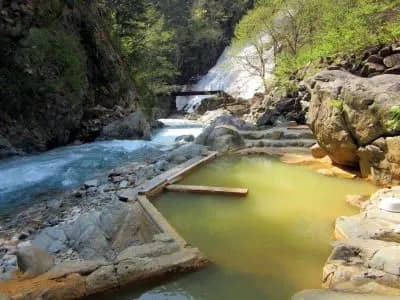
1. Hotel Iya Onsen (Tokushima, Miyoshi City)
Source: Hotel Iya Onsen website
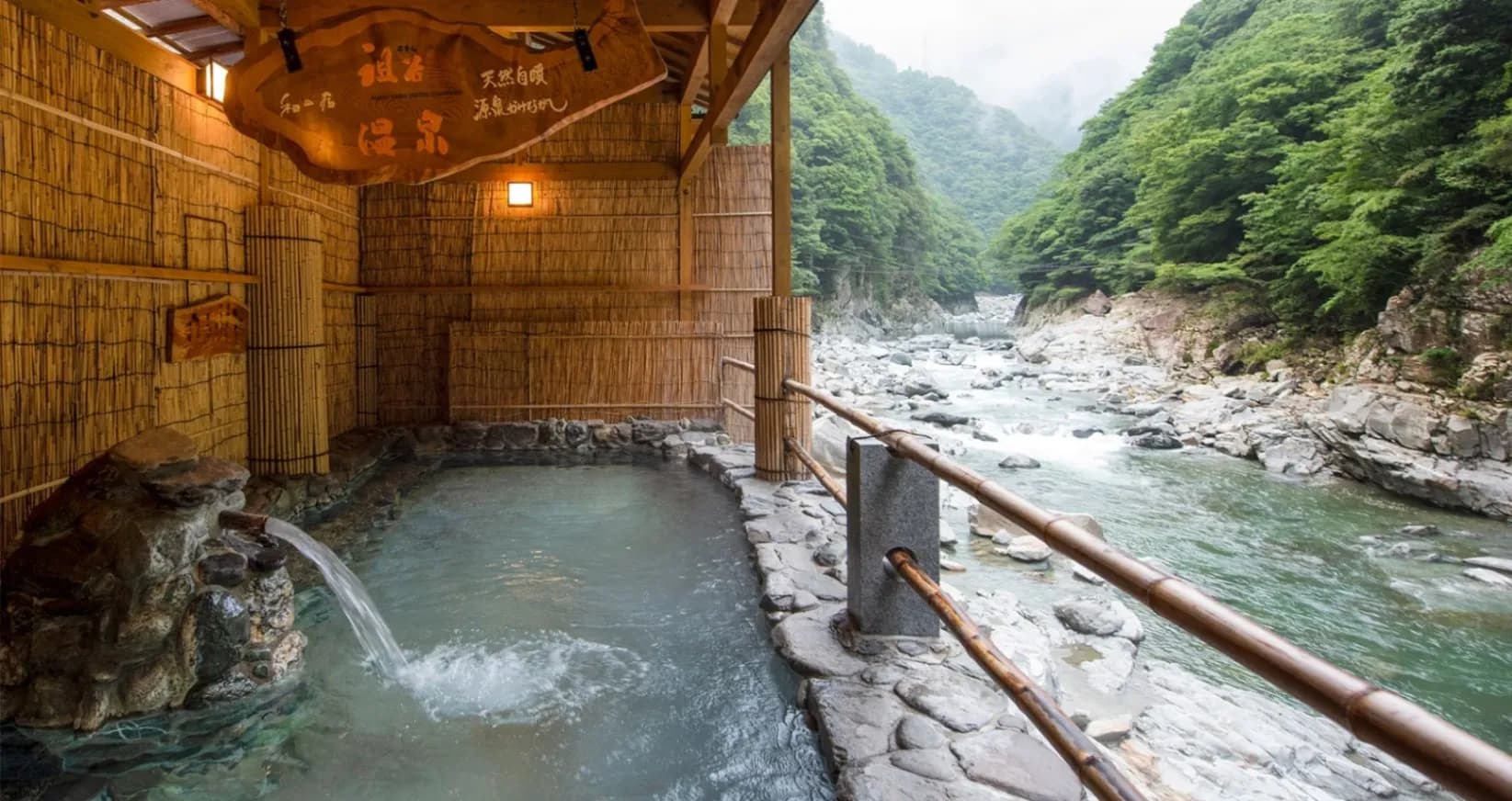
Hotel Iya Onsen is the sole inn of Iya Onsen, counted among Japan's Three Great Secret Hot Springs alongside Niseko Yakushi Onsen in Hokkaido and Yachi Onsen in Aomori Prefecture. The Iya Valley, together with Kitayama Gorge in Wakayama and Odaigahara in Nara, is recognized as one of Japan's Three Great Secluded Regions — a mystical canyon steeped in the legends of the defeated Heike warriors. The spring was drilled in 1965, and the hotel opened in 1972. It is the only member of the Japan Association of Secluded Hot Spring Inns in all of Shikoku.
The water is classified as an alkaline simple sulfur spring with a notably high pH of 9.1. The source temperature hovers around 38 to 39 degrees Celsius — close to body temperature — making it a pleasantly lukewarm soak and one of only two natural free-flowing hot springs in Shikoku, alongside Dogo Onsen. The alkaline compounds including sodium, calcium, and sulfur gently dissolve dead skin cells, earning the water its reputation as a beautifying spring. The silky, slightly viscous texture and the fine bubbles that cling to the skin are hallmarks of this natural source.
The hotel's most extraordinary feature is the open-air bath at the bottom of the gorge, reached by a cable car that descends 170 meters at a 42-degree angle over approximately five minutes along a 250-meter track. A new cable car vehicle was introduced in spring 2023. Inside the hotel, the panoramic bath Unyu Tenku no Yu (SORANOYU), renovated in 2021 as an infinity-style bath overlooking the Iya mountains, adds another dimension to the experience.
Day-trip bathing costs 2,000 yen for the outdoor bath including the cable car, or 700 yen for the panoramic bath only; hours are 7:30 to 17:00 (last admission 16:00), closed Wednesdays. Overnight stays are available in 17 rooms starting from 20,130 yen per person with two meals. Access is approximately 40 minutes by car from Ikawa-Ikeda IC on the Tokushima Expressway, or 30 minutes by hotel shuttle from JR Oboke Station (one trip daily, reservation required).
2. Shin-Iya Onsen Hotel Kazurabashi (Tokushima, Miyoshi City)
Standing near the nationally designated Iya Kazurabashi vine bridge, this hot spring inn opened in 1988 deep within the Iya Valley. After overcoming a devastating rainstorm in 1999, the hotel underwent a full renovation in May 2000, unveiling its now-iconic attraction: a bonnet-bus-style cable car that carries guests up to the Sky Open-Air Bath perched on the mountaintop.
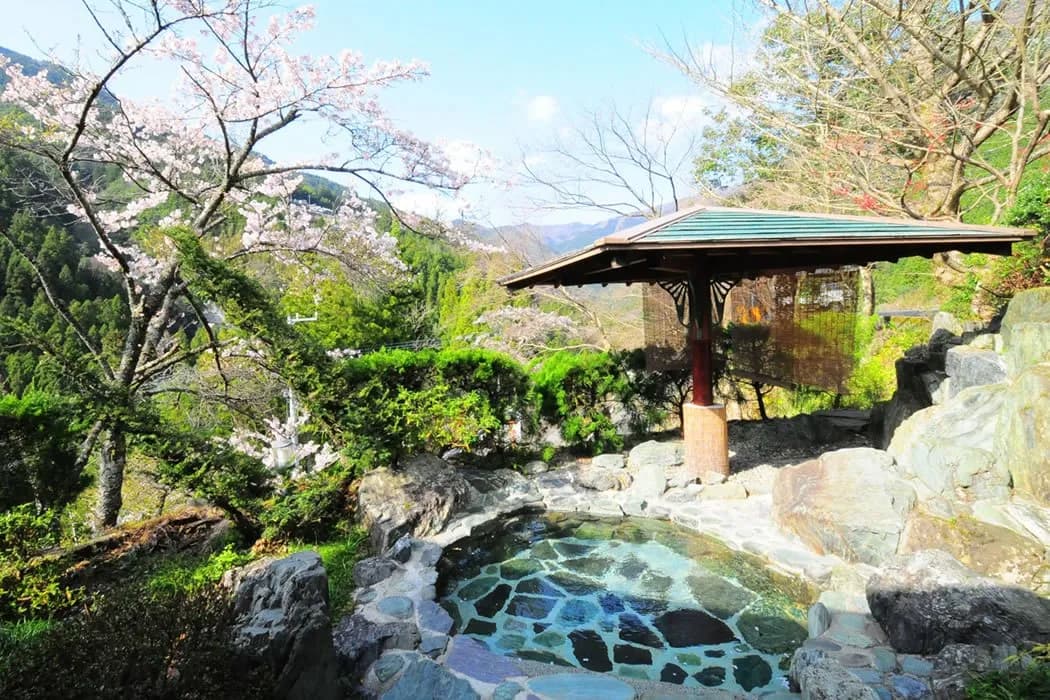
The spring is classified as a simple sulfur cold mineral spring with a source temperature of 17.9 degrees Celsius and a flow rate of 30.8 liters per minute. As a cold mineral spring, the water is heated and circulated for bathing use, yet it retains a refreshingly light bathing sensation. Riding the retro cable car up the steep slope while panoramic views of the Iya mountains unfold is an experience that builds anticipation well before arrival. At the summit, an open-air bath constructed from locally quarried Awa blue stone commands sweeping views of the Iya mountain village below. On fortunate mornings, a sea of clouds spreads beneath the bath, truly earning its name as a bath in the sky.
The facility also offers a large indoor bath, a private open-air bath called Takenoko-no-Yu, three private cypress baths, a foot bath, and a sauna. Dining features Iya regional cuisine served around a traditional irori hearth, including the local specialty dekomawashi, Iya soba noodles, and soba rice porridge. Day-trip bathing is 1,200 yen for adults from 10:30 to 16:00. Approximately 20 minutes by bus from JR Oboke Station.
3. Iyakei Onsen Hotel Hikyou no Yu (Tokushima, Miyoshi City)
This hot spring hotel stands on the cliffs of the Iya Valley near the famous Kazurabashi vine bridge. Its floor-to-ceiling glass-walled bathhouse offers a breathtaking panorama of the deep gorge and primeval forest below — a setting that truly earns the name Hikyou no Yu, meaning the Bath of the Hidden Region.
The water is classified as a sodium bicarbonate cold mineral spring, drawn from underground at a source temperature of just 9.8 degrees Celsius and heated for bathing. With an alkaline pH of 9.0, the water envelops the skin with a distinctively silky, slippery sensation, earning its reputation as a bijin-no-yu, or beautifying spring. This particular spring quality is rare even within the Iya region, drawing visitors from distant parts of Japan.
The outdoor bath is constructed with locally quarried Awa blue stone, and the facility offers eight different bathing options including herbal baths, jet baths, and a salt sauna. The restaurant Otokiya serves regional cuisine around a traditional irori hearth, featuring Awa beef, salt-grilled sweetfish, and handmade Iya soba noodles. Day-trip bathing is 1,000 yen for adults; weekday hours 15:00 to 20:00, weekends and holidays 12:00 to 18:00, closed Tuesdays. Approximately 15 minutes by Shikoku Kotsu Bus from JR Oboke Station.
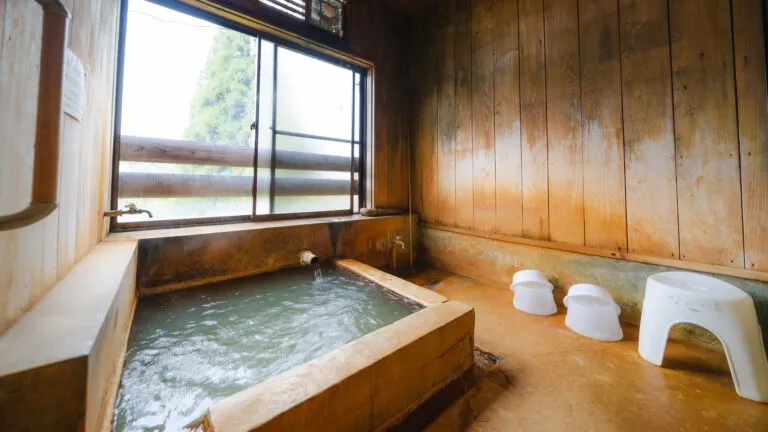
A tranquil 13-room inn nestled in the mountain hamlet of Kanjo in the Iya Valley, Kazuraya is located just a 10-minute walk from the Iya Kazurabashi vine bridge. As an accommodation-only facility, it offers the rare privilege of combining Iya's traditional irori hearth cuisine with bathing in a sulfur spring surrounded by the silence of the mountains.
The spring is classified as a simple sulfur cold mineral spring, drawn from mineral-rich sources that seep through the deep mountain rocks of Iya and heated for bathing. The water is used at full concentration without dilution, producing a characteristically light and refreshing sensation. The cleansing properties inherent in sulfur springs gently remove dead skin cells, leaving the skin smooth and rejuvenated.
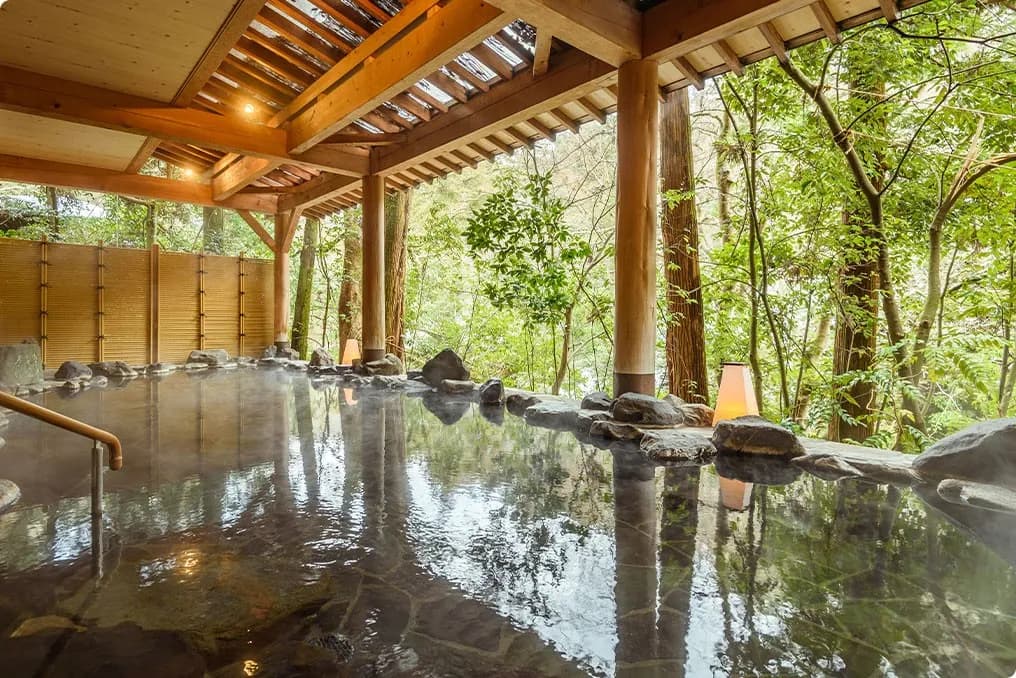
The inn's panoramic outdoor bath is built with locally quarried Iya blue stone, offering views down into the gorge. Meals around the irori hearth feature Iya specialties including dekomawashi skewered tofu and potato, salt-grilled sweetfish and amego trout, pheasant hotpot, and handmade Iya soba noodles. Day-trip bathing is not available. Overnight stays start from 14,900 yen per person with two meals. Access is approximately 20 minutes by bus from JR Oboke Station, with a shuttle from Kazurabashi Yumebutai bus stop (reservation required).
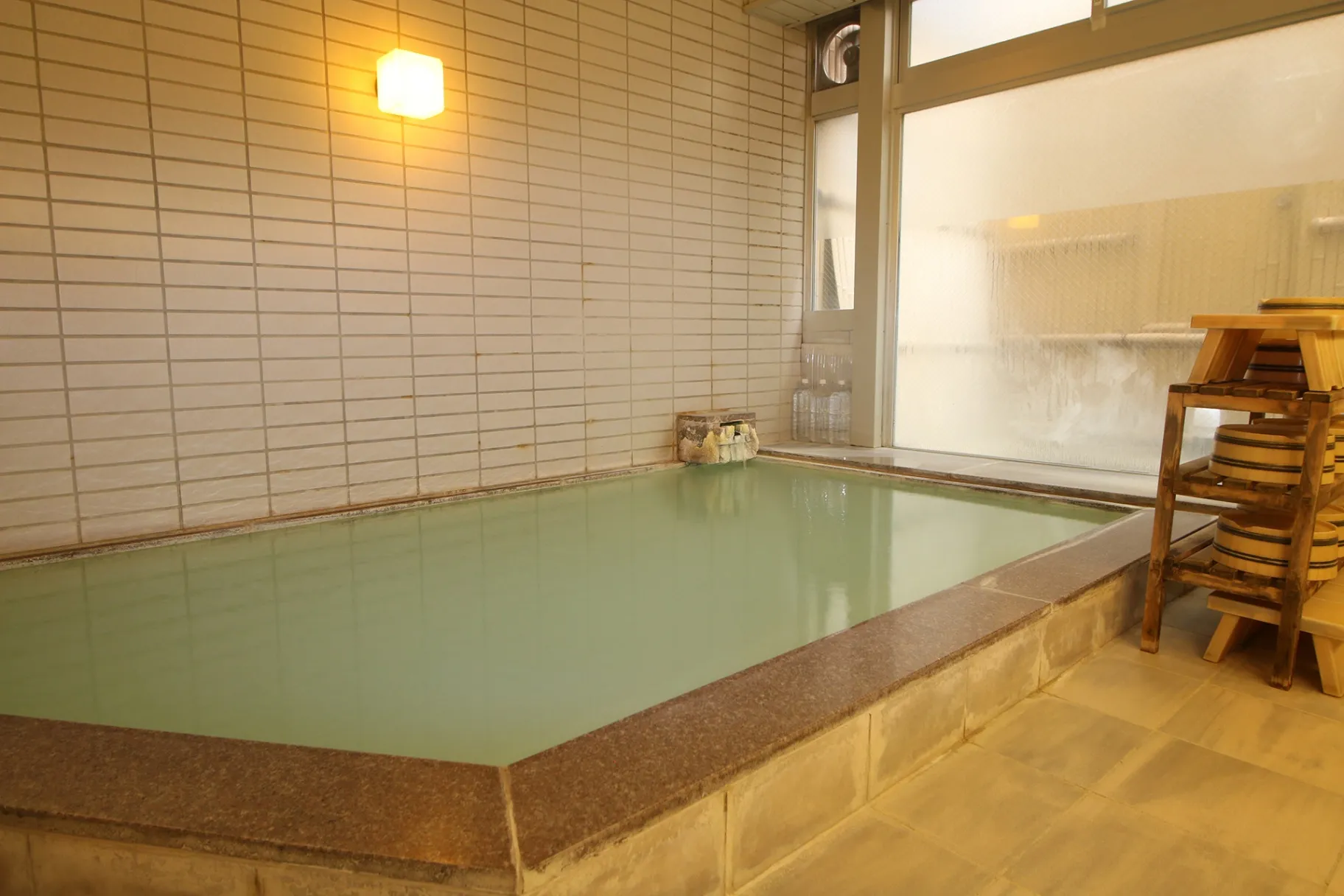
With an extraordinary pH of 10.2, Matsuogawa Onsen ranks among the most alkaline hot springs in all of Japan. Tucked away along the Matsuogawa Valley in the mountains of Miyoshi City, this hidden gem has been quietly cherished by locals as a beautifying bath for generations. The adjacent self-catering lodge Shirasagi-so takes its name from a legend of a white heron that once healed its wounds in these waters.
The water is classified as an alkaline simple sulfur spring with a source temperature of 25.0 degrees Celsius. It is carefully heated using firewood — no dilution, no circulation, and no chemical disinfection — delivering a 100 percent natural free-flowing experience. The moment one enters the water, the sensation is unmistakable: a silky, almost viscous slipperiness envelops the skin. Combined with a faint sulfur aroma, the powerfully alkaline water dissolves dead skin cells, leaving bathers with astonishingly smooth skin. The facility's tagline — "You'll notice it in five minutes: the best in Shikoku" — is no exaggeration.
The bathing facilities consist of indoor stone baths separated by gender, with views of the Matsuogawa Valley. The Shirasagi-so lodge offers affordable self-catering accommodation from 4,500 yen per night. Day-trip bathing is 580 yen for adults, open 10:00 to 19:00, closed Wednesdays. Approximately 30 minutes by car from Ikawa-Ikeda IC. Public bus service is limited, so driving is recommended.
Fuigo Onsen is deeply connected to the mining heritage of Mount Takakoe, once home to the largest copper mine in Tokushima Prefecture. After the mine closed, the mineral spring water that naturally seeped from the abandoned site was harnessed in 1972 to create this bathing facility. The name Fuigo comes from a suspension bridge called Fuigo-bashi built for miners during the Meiji era, where bellows (fuigo) were used for ore smelting. The massive piemontite schist formations flanking the bridge site are designated as a National Natural Monument.
The water is classified as an acidic green vitriol iron spring with a source temperature of 15.4 degrees Celsius, heated for bathing. Iron-containing springs are exceptionally rare in Shikoku, and mineral springs from former copper mines are scarce even nationwide. The flow rate is a generous 214 liters per minute. Therapeutic indications include neuralgia, muscle and joint pain, chronic rheumatism, cold sensitivity, and fatigue recovery.
The bathhouse windows frame views of the vermilion Takakoe Bridge and the copper-tinted green waters of the Kawata River. Two types of bathing rooms are available, complemented by a sauna, jacuzzi, and waterfall shower. Day-trip bathing is 600 yen for adults, with early morning hours from 7:00 (10:00 on Sundays and holidays). Overnight stays from 6,600 yen. Approximately 25 minutes by car from Wakimachi IC, or 5 minutes by taxi from JR Awa-Yamakawa Station.
Quality
Acidic - Copper-containing - Iron(II) - Sulfate Spring
Kamiyama Onsen is steeped in a celestial maiden legend stretching back to mythological times. The locals enshrined the maiden as Shiomizu Daimyojin, and her small shrine still stands near the spring source. The bathing facility's history began in 1868 as a communal bathhouse for copper mine laborers, later revived in 1925 as Benten Kosen-yu after a Buddhist priest confirmed the water's medicinal value. The current Iyashi-no-Yu day-trip facility opened in 2003.
The water is classified as a sodium chloride and bicarbonate spring with a pH of 8.2. Despite a source temperature of just 5.4 degrees Celsius, the dissolved mineral content is remarkably rich at 2,767.2 mg/kg. The distinctive bicarbonate-rich saline water has a silky texture that leaves the skin exceptionally smooth, earning it recognition as a bijin-no-yu. Despite its salt content, the bathing experience feels refreshing, and the body retains warmth for hours afterward.
Iyashi-no-Yu is distinguished by its nationally rare tatami-floored bathing halls. Two themed bathrooms — Aoishi-no-Yu with local blue stone and Tamaishi-no-Yu with round river stones — alternate weekly between men and women. The large-scale facility accommodates 200 bathers, with a main bath, semi-open-air bath, sauna, waterfall shower, reclining bath, and children's bath. Day-trip bathing is 680 yen for adults; April to September 10:00 to 21:00, October to March 10:00 to 20:00. Closed the 4th Tuesday monthly. Approximately 60 minutes by Tokushima Bus from JR Tokushima Station.
According to legend, the revered Buddhist monk Kobo Daishi was practicing asceticism in this area when the Medicine Buddha Yakushi Nyorai appeared and declared the spring water a medicinal spring capable of curing all ailments. Kamikatsu Town, where the inn is located, gained international recognition in 2003 as the first municipality in Japan to declare a Zero Waste policy.
The water is classified as a simple sulfur cold mineral spring with a source temperature of 15 degrees Celsius. The source lies approximately 1.5 kilometers away on the sacred mountain Tsukigatani, where cold water naturally seeps through rock crevices and is piped to the inn for heating. Rich in sulfur-derived minerals, the water holds therapeutic benefits for conditions ranging from neuralgia to diabetes.
The main bathhouse features locally sourced Kamikatsu cedar wood and diatomaceous earth, with large windows overlooking the Katsuura River and surrounding mountains. Facilities include rock baths, sauna, jet bath, and waterfall shower, with morning and evening alternation between men and women. Day-trip bathing is 650 yen for adults, open 10:00 to 20:00, closed the 2nd Wednesday monthly. Approximately 50 minutes by car from central Tokushima City. Public transport is limited, so driving is recommended.
The Oboke Gorge, carved over 200 million years by the Yoshino River through the Shikoku Mountains, is one of western Japan's most dramatic landscapes. Sunriver Oboke was established in 1979 as a public lodge at the heart of this breathtaking scenery. The surrounding area is famous for over 150 yokai (supernatural creature) legends, including the celebrated Konaki-Jijii.
The spring boasts a strongly alkaline pH of 9.57, earning the epithet of a spring that makes cosmetic lotion unnecessary. The source temperature is approximately 20 degrees Celsius, heated for bathing. The water is colorless and transparent yet distinctively slippery, with fluorine ions that promote cellular renewal. Therapeutic indications include neuralgia, skin conditions, and overall skin beautification.
The glass-walled bathhouse offers panoramic views of the Koboke Gorge and the powerful Yoshino River rapids. The outdoor bath provides seasonal vistas from cherry blossoms to snow-dusted gorge scenery. A sauna is also available. Day-trip bathing is 700 yen for adults, open 12:00 to 21:00, year-round. Approximately 7 minutes by taxi from JR Oboke Station, with complimentary shuttle service for overnight guests.
10. Tsurugi no Yado Iwato (Tokushima, Mima District, Tsurugi Town)
This hot spring inn lies at the southern foot of Mount Tsurugi (1,955m), the second highest peak in western Japan. The mountain has been revered since ancient times in the Shugendo ascetic tradition, and legend holds it received its name — meaning Sword Mountain — when Emperor Antoku's sacred sword was enshrined at its summit. The inn serves as a favored base for Mount Tsurugi hikers.
The spring water is piped from the Tsurugisan Yuuma Onsen source and classified as a sulfur-containing sodium chloride and bicarbonate cold mineral spring. Heated for bathing, the sulfur-rich water has a smooth, silky texture with therapeutic indications for neuralgia, rheumatoid arthritis, diabetes, and atopic dermatitis. The spring is registered with the Japan Spa Association.
The facility offers an indoor bath, open-air bath, sauna, and cold plunge pool, with panoramic views of the Sadamitsu River gorge. The restaurant serves local mountain cuisine including game meats. Day-trip bathing is an affordable 400 yen for adults; weekdays 15:00 to 21:00, holidays 11:00 to 21:00, closed Tuesdays. Overnight stays with two meals from approximately 7,000 yen. Fully wheelchair accessible. Approximately 30 to 40 minutes from Mima IC.
Quality
Sulfur-containing - Sodium - Chloride - Bicarbonate Spring
11. Kyokoku no Yuyado Obokekyo Mannaka (Tokushima, Miyoshi City)
This hot spring inn perches directly above the Oboke Gorge — a National Scenic Beauty and Natural Monument — at the confluence of the Yoshino River and the Fujikawa tributary. The view of crystalline schist formations sculpted over 200 million years and the emerald Yoshino River below is simply singular. The Oboke sightseeing boat pier is immediately adjacent.
The main bath features simple sulfur spring water at a source temperature of 18 degrees Celsius, heated through a circulation system. The water is prized for softening the skin, producing the silky tamago-hada (egg skin) effect. The terrace-style open-air bath Seseragi no Yu employs Togol Warmtite artificial mineral water for enhanced skin-beautifying properties.
The gorge views from the outdoor bath are the inn's crowning glory, with each season painting a different masterpiece. A sauna with self-service loyly and an outdoor cold plunge pool are available for the full totonou wellness experience. Day-trip bathing is 700 yen for adults, open 12:00 to 16:00 (last admission 15:00). Approximately 20 minutes on foot from JR Oboke Station, with complimentary shuttle for overnight guests.
12. Kamoda Misaki Onsen Health Center (Tokushima, Anan City)
Cape Kamoda is the easternmost point of Shikoku, and this day-trip facility sits at the foot of the cape within the Muroto-Anan Coast Quasi-National Park. Opened in 2001 and renovated in 2011, the natural spring rises from 1,600 meters underground — the easternmost onsen in all of Shikoku.
The spring is classified as a simple hot spring with a source temperature of 41.4 degrees Celsius and a flow rate of 90 liters per minute. Delivered as a free-flowing source spring without dilution, the water is colorless and transparent with an exceptionally gentle touch. The mildly alkaline quality is reputed for its skin-beautifying properties.
Two main bathhouses — Umigame-no-Yu (Sea Turtle Bath) and Sazanami-no-Yu (Ripple Bath) — alternate between men and women every two weeks. The outdoor bath commands an unobstructed panorama across the Kii Channel, with Awaji Island and the Kii Peninsula visible on clear days. Sunset views are particularly spectacular. Cascade showers, bubble baths, a high-temperature sauna, and a wheelchair-accessible family bath are also available. Day-trip bathing is 600 yen for adults, open 10:00 to 19:00, closed Mondays. The Cape Kamoda lighthouse is minutes away by car, and the surrounding coast is a loggerhead sea turtle nesting ground. Approximately 90 minutes by car from Tokushima IC.
13. Asebi Onsen Yasuragi no Sato (Tokushima, Itano District, Itano Town)
This publicly operated day-trip facility at the foot of the Asan Mountain Range was established in 1999 by the town of Itano to harness natural spring water from 250 meters underground. The name Asebi derives from the Japanese Andromeda that flourishes in these mountains. Located near Temple No. 1 (Ryozenji) and Temple No. 2 (Gokurakuji) of the Shikoku 88 Temple Pilgrimage, the onsen has served as a soothing respite for henro pilgrims for a quarter century.
The spring is classified as a simple sulfur cold mineral spring with a source temperature of 20.7 degrees Celsius and an alkaline pH of 8.9. Of particular note is the dedicated source water bath, where the unheated cold mineral spring is delivered in its natural free-flowing state. Immersing oneself in the 20.7-degree source water offers a singular sensation as the alkaline minerals penetrate deeply into the skin. The main baths are heated for comfortable soaking, and alternating between cold source and warm pools is highly recommended.
The open-air bath is enveloped by towering bamboo groves, with a spacious deck overlooking a meticulously maintained Japanese garden. Both dry and mist saunas, cascade showers, jet baths, and a manga reading corner complement the bathing experience. Admission is 600 yen for adults, open 10:00 to 21:30, closed Wednesdays. Just 10 minutes by car from Itano IC on the Takamatsu Expressway, and roughly 30 minutes from central Tokushima City.
14. HOTEL RIVIERA Shishikui (Tokushima, Kaifu District, Kaiyo Town)
This resort hotel at the southeastern tip of Shikoku is set within the Muroto-Anan Coast Quasi-National Park, adjacent to the Michi-no-Eki Shishikui Onsen roadside station. Every guest room commands an unobstructed Pacific Ocean view, creating an atmosphere of tropical resort luxury.
The spring is classified as a sodium bicarbonate spring, rising from 1,000 meters underground near the Tokushima-Kochi border. With a source temperature of 25.5 degrees Celsius and a pH of 8.6, the water's most distinctive quality is its remarkably silky, toro-toro texture. The mildly alkaline bicarbonate water gently dissolves old keratin, earning it the revered bijin-no-yu designation.
The second-floor panoramic bathhouse stretches an impressive 40 meters in length, with expansive windows framing the Pacific Ocean. Facilities include a jacuzzi, reclining bath, cascade shower, herbal bath, Japanese cypress bath, dry sauna, and steam sauna. Restaurant Vega serves fresh local seafood and the celebrated Awa Odori chicken. Day-trip bathing is 800 yen for adults in two sessions: morning 6:30 to 9:00 and afternoon 12:00 to 21:00. Open year-round. Shishikui Station on the DMV Asa Kaigan Railway is a 10-minute walk away, offering the unique possibility of riding the world's first DMV (Dual Mode Vehicle) before unwinding in the hot spring.
Practical Guide — What to Know Before Exploring Tokushima's Hidden Hot Springs
Tokushima's hot springs can be efficiently explored by dividing them into four areas.
Iya Valley and Oboke Area: Six springs cluster in this region — Hotel Iya Onsen, Shin-Iya Onsen Hotel Kazurabashi, Hotel Hikyou no Yu, Kazuraya, Sunriver Oboke, and Obokekyo Mannaka. Starting from Ikawa-Ikeda IC on the Tokushima Expressway, first visit Sunriver Oboke and Mannaka near JR Oboke Station, then head into the Iya Valley by bus or car. To experience both Hotel Iya Onsen's cable car cliff bath and Kazurabashi's bonnet-bus sky bath, plan for at least two nights. Combined with the Kazurabashi vine bridge, Oboke Gorge boat cruise, and the cliff-perched Manneken Pis statue, a 2-night/3-day itinerary is ideal.
Miyoshi and Tsurugi Area: Matsuogawa Onsen and Tsurugi no Yado Iwato occupy the mountain interiors of Miyoshi City and Tsurugi Town. Matsuogawa Onsen (pH 10.2) is about 30 minutes by car from Ikawa-Ikeda IC. Iwato is 30 to 40 minutes from Mima IC and pairs perfectly with a Mount Tsurugi climb. Public transport is extremely limited in both cases — a rental car is essential. The Mount Tsurugi chair lift at Minokoshi is approximately 50 minutes further up the road, making Iwato an ideal overnight base during hiking season (April through November).
Central and Eastern Tokushima Area: Fuigo Onsen, Kamiyama Onsen, Tsukigatani Onsen, and Asebi Onsen are all within 30 to 60 minutes of central Tokushima City. Fuigo Onsen offers a rare iron spring experience with convenient access from JR Awa-Yamakawa Station. Kamiyama Onsen features a celestial maiden legend and unique tatami-floored baths, while Tsukigatani Onsen carries the legacy of Kobo Daishi. Asebi Onsen, near the starting point of the Shikoku Pilgrimage, makes for a fitting beginning or end to a temple circuit. Two springs per day is a comfortable pace for this area.
Southern Pacific Coast Area: Kamoda Misaki Onsen and HOTEL RIVIERA Shishikui line the Pacific coastline. Kamoda Misaki pairs naturally with a Cape Kamoda lighthouse walk as a half-day excursion, while RIVIERA Shishikui combines memorably with a ride on the DMV Asa Kaigan Railway. The two facilities are approximately 90 minutes apart by car, making a 1-night/2-day coastal driving itinerary feasible. Note that this area is 1.5 to 2 hours from Tokushima City, so generous scheduling is advised.
Regarding seasonal considerations, the Iya Valley, Oboke, and Tsurugi areas are mountainous and prone to snowfall and icy roads from December through February — winter tires or chains are mandatory. Conversely, the autumn foliage season from late October to mid-November is when the Iya Valley is at its most magnificent. The view of autumn leaves from Hotel Iya Onsen's cable car bath is nothing short of breathtaking, though reservations fill early and advance planning is essential. The southern Pacific coast remains mild year-round, and summer visitors to the Kamoda cape area may have the opportunity to observe loggerhead sea turtles coming ashore to nest — a compelling addition to a hot spring journey.
The information in this article (admission fees, operating hours, water quality data, etc.) is based on research conducted at the time of writing. Details may have changed or contain errors. Please verify the latest information on each facility's official website or through the local tourism association.