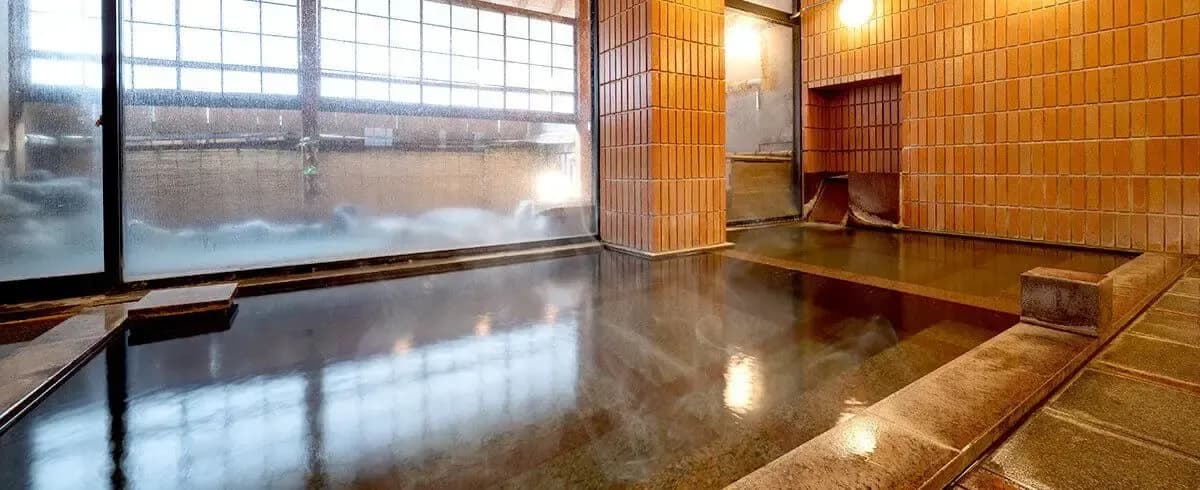
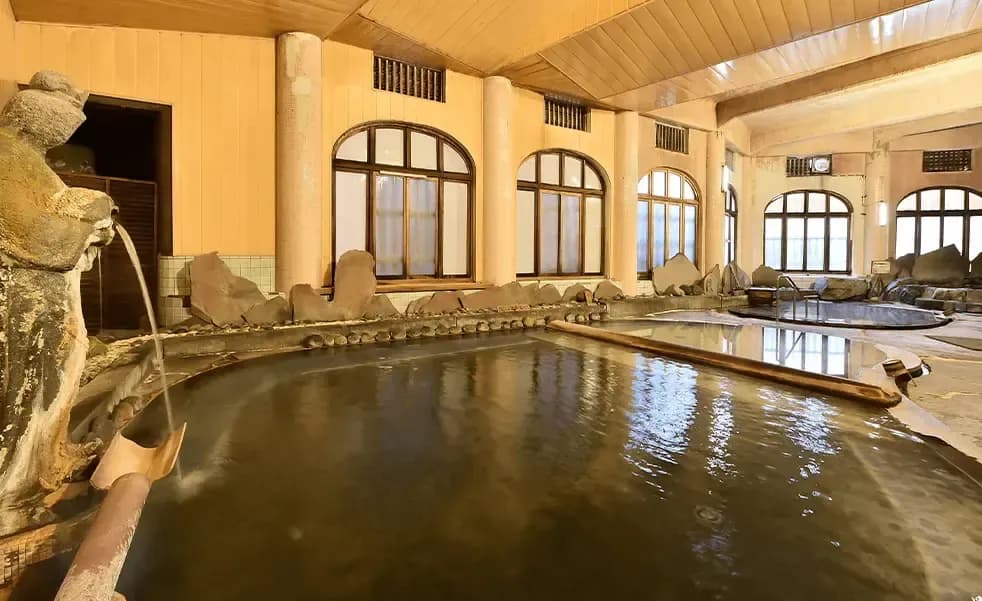
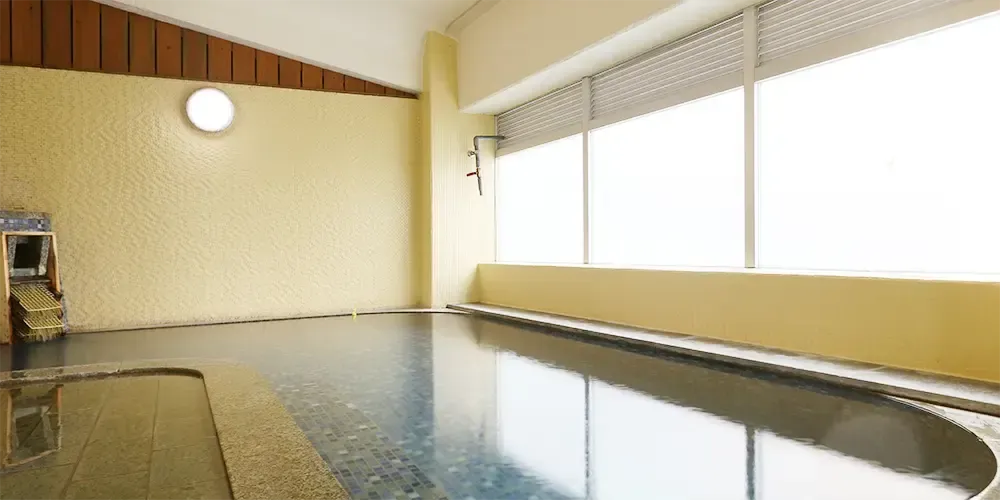
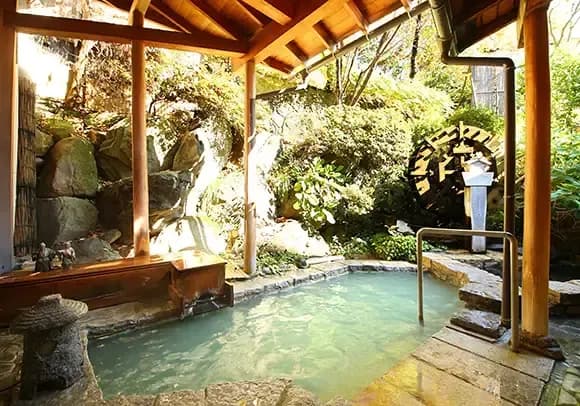
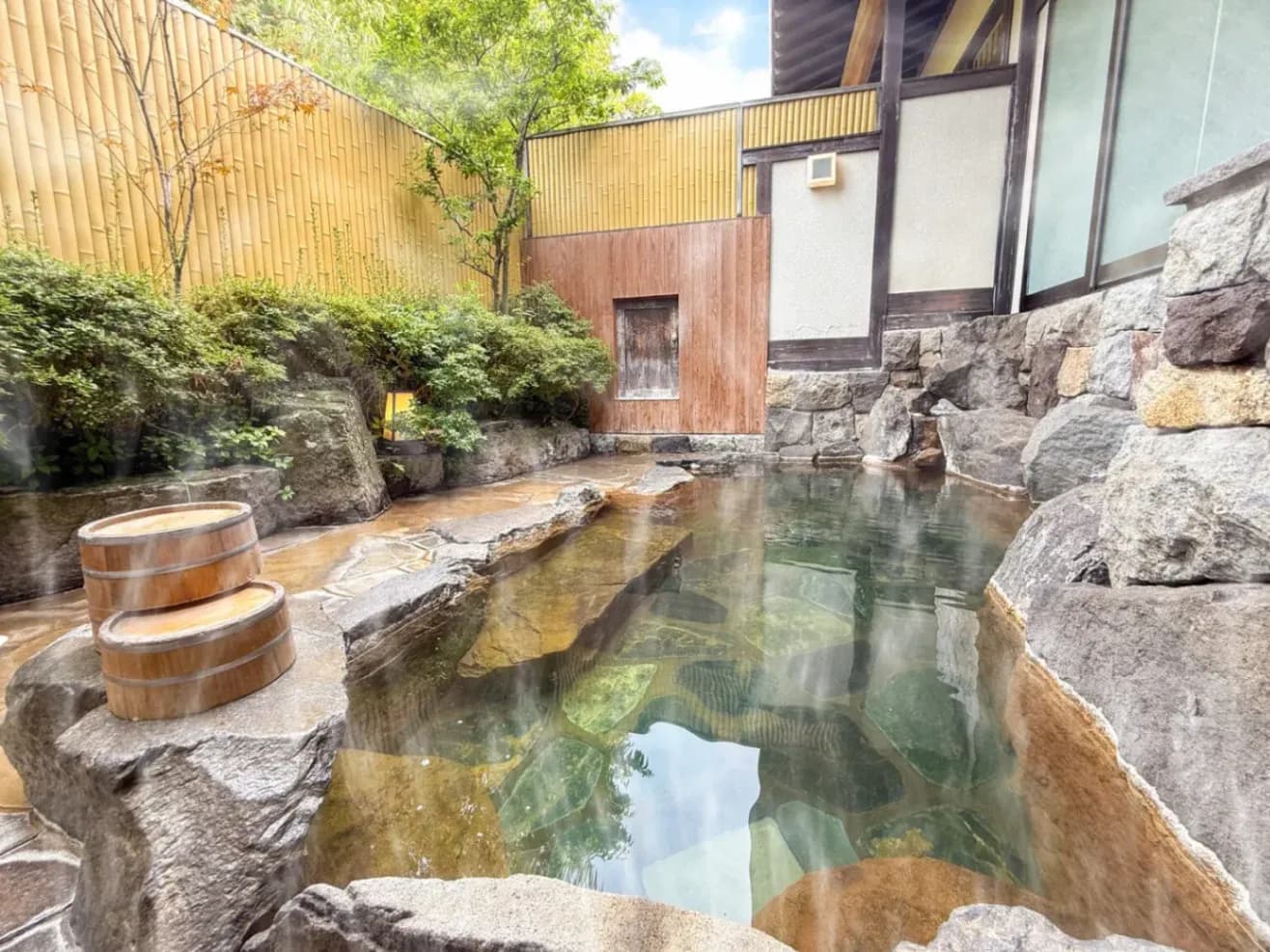
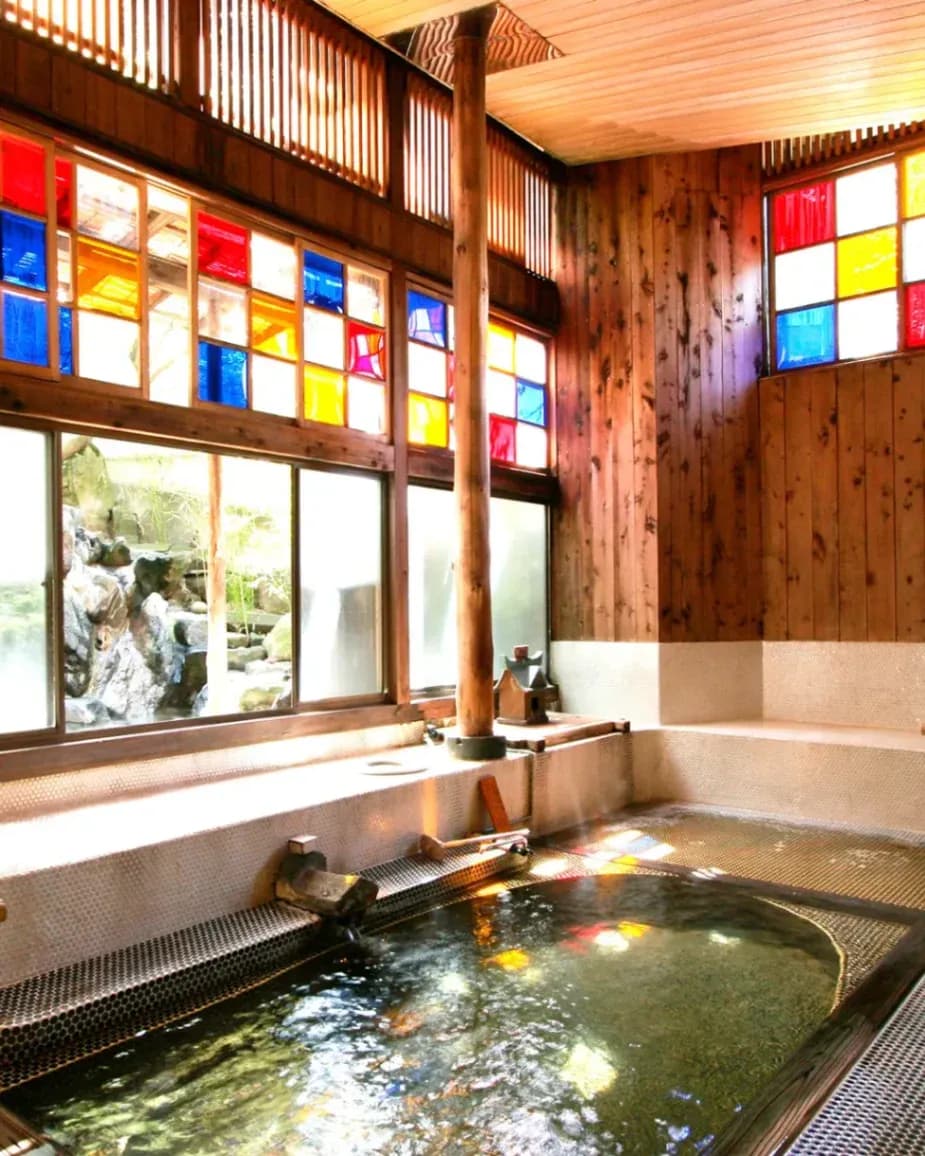
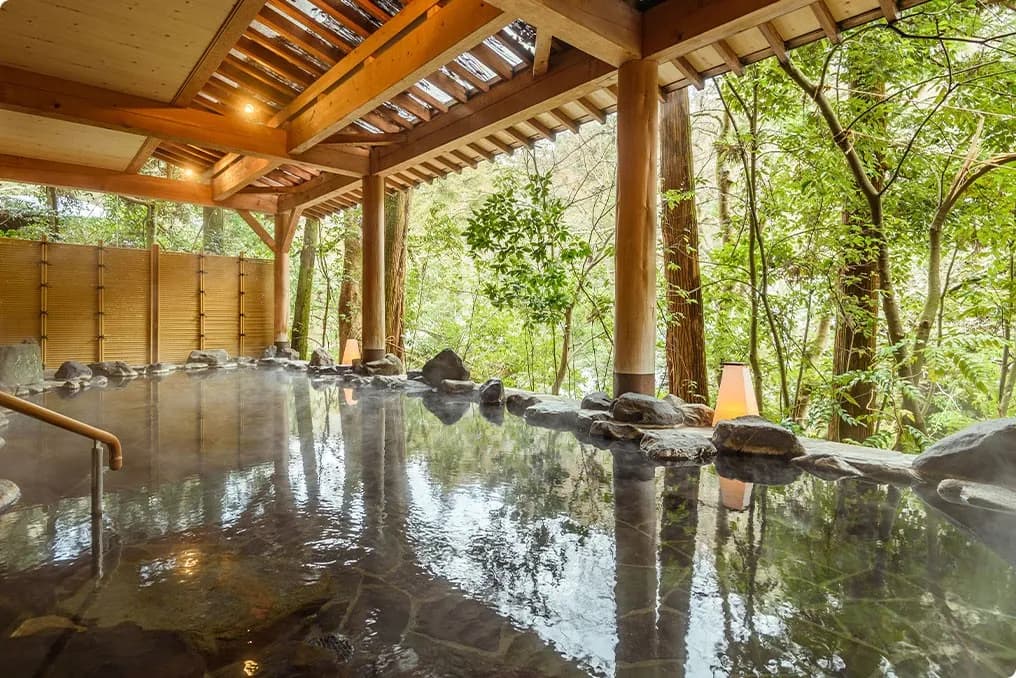
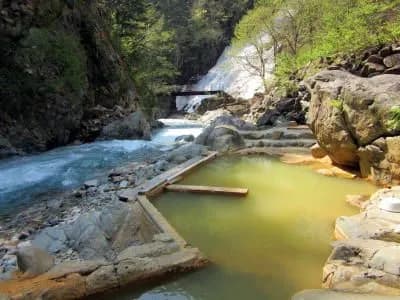
A private onsen bath — kashikiri buro (貸切風呂) — is a bathhouse you use one group at a time, with the door locked behind you. For travellers, it solves three problems at once: tattoos, mixed-gender groups, and simple shyness about communal nudity.
The catch is that "private bath available" means very different things at different inns. At some you hang a sign on the door and walk in as often as you like, free. At others you reserve a 40-minute slot. A few inns have no large communal bath at all — every bath in the building is private.
This guide lists 16 ryokan where you can stay overnight and use a private bath fed by free-flowing hot spring water. Every inn here is gensen kakenagashi (源泉かけ流し): the spring water runs through the tub and out, with no recirculation. Source temperatures range from 38.4°C to 93.2°C and pH from 6.3 to 8.9.
Day-use bathhouses are excluded. A private bath is worth the money when you have an evening and a morning with it, not 40 minutes between trains. Five of the 16 inns do not admit day visitors at all.
What this guide covers
- How kashikiri buro, kazoku buro and rooms with private open-air baths differ
- The four ways inns actually run their private baths, and which inns use which
- 16 inns with spring data, bathing arrangements and access on each detail page
Tattoos, gender and the reason to book a private bath
Tattoos. Many Japanese public baths still refuse guests with visible tattoos. A private bath sidesteps the issue entirely, because nobody else is in the room. Policies are set inn by inn and are not published consistently, so state your situation when you book rather than on arrival.
Gender. Japanese communal baths are almost always separated by gender, and a few older inns still keep konyoku (混浴) mixed baths. A private bath is the only reliable way for a couple, a family or a mixed group of friends to bathe together.
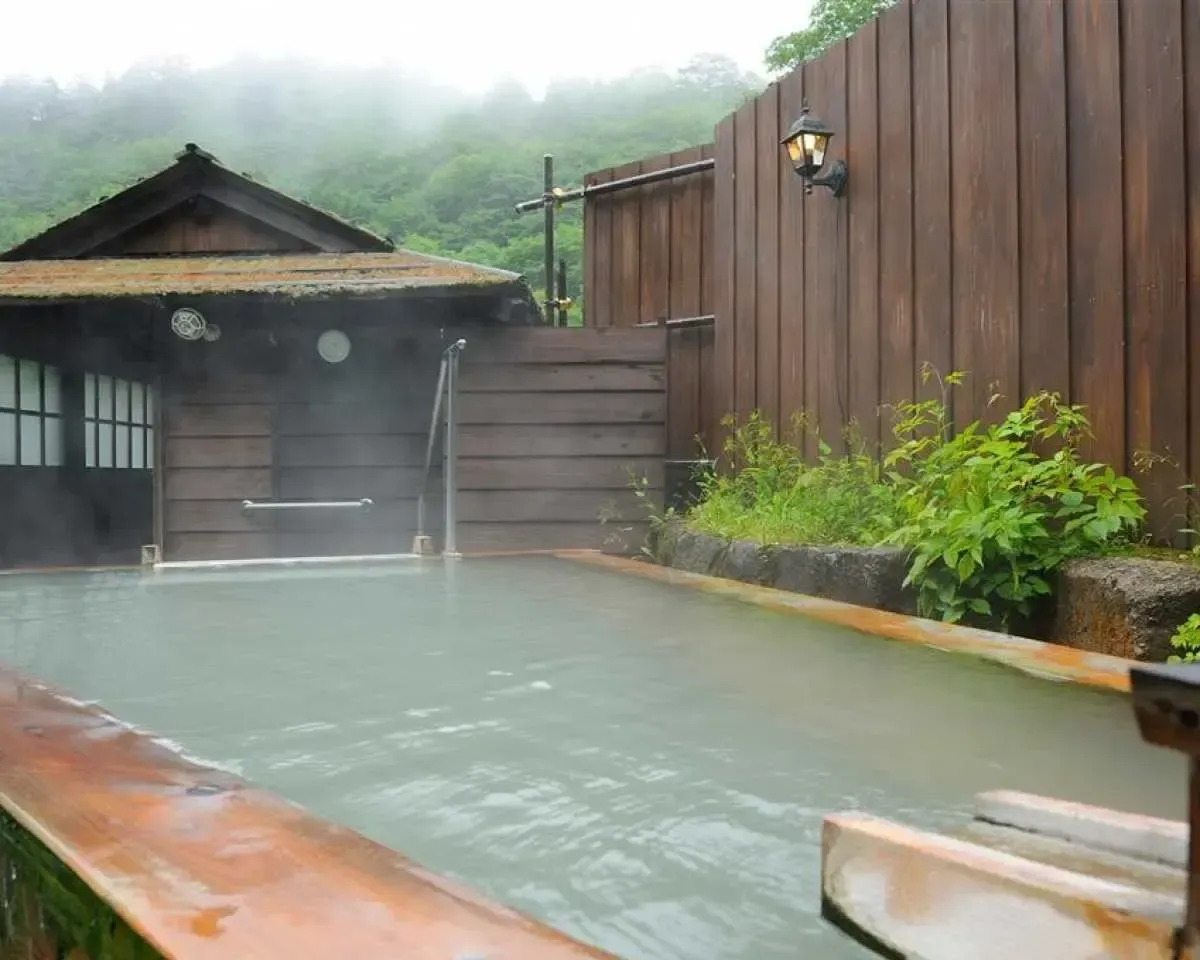
Three inns in this list have mixed communal baths alongside their private ones, and their rules are opposites. At Onikobe Onsen Todoroki Ryokan (鬼首温泉 とどろき旅館), swimwear and wrapped towels are not permitted in the large mixed open-air bath, and photography is forbidden. At Kouchi Onsen Kanaya Ryokan (河内温泉 金谷旅館), women may wear a bathing garment or a towel in the mixed Sennin-buro and there is a separate entrance for them. At Namegawa Onsen Fukushimaya (滑川温泉 福島屋), the mixed rock open-air bath has women-only hours.
Swimwear. Outside those exceptions you bathe naked in a Japanese onsen, private baths included. Wash at the shower station before entering the tub, and keep the small towel out of the water.
Children. Private baths are the usual choice for families with small children, since you are not sharing the space. Two inns here set age limits: Yutagawa Onsen Kyubei Ryokan (湯田川温泉 九兵衛旅館) accepts children from age 10, and Kowakubi Onsen Shohoen (強首温泉 樅峰苑) accepts junior-high-school age and above.
Kashikiri, kazoku buro and rooms with private baths
Three terms overlap in Japanese travel listings.
Kashikiri buro (貸切風呂) is a shared bathhouse used by one group at a time. Access is by key, by a wooden tag you flip at the door, or by a reserved time slot.
Kazoku buro (家族風呂), literally "family bath", is close to the same thing. This guide only counts baths that overnight guests can reserve privately.
Rooms with private open-air baths (露天風呂付き客室) are attached to a guest room and priced into the room rate. That is a different product and is not part of this selection.
The four ways inns run a private bath
1. Free and no reservation. Yutagawa Onsen Kyubei Ryokan and Yoshina Onsen Oyado Sakaya (吉奈温泉 御宿 さか屋) both state their private baths are free and need no booking. Sakaya's guests can use all six of its baths around the clock.
2. Free, but you wait for a vacancy. Onikobe Onsen Todoroki Ryokan, Nigorigo Onsen Asahiso (濁河温泉 朝日荘), Yunomine Onsen Ryokan Adumaya (湯の峰温泉 旅館あづまや), Shirakami Yatate Hikage Onsen (日景温泉) and Funabara Onsen Funabarakan (船原温泉 船原館) let overnight guests bathe privately at no extra charge. Todoroki Ryokan uses a wooden tag at the door; Asahiso is first-come except when busy, when it switches to reservations; Adumaya's two family baths are first-come. Funabarakan's standing bath is a 45-minute private turn per group, free.
3. Overnight guests only. Kowakubi Onsen Shohoen and Fukiage Onsen Nakashima Onsen Ryokan (吹上温泉 中島温泉旅館) keep their private baths closed to day visitors.
4. The whole bathhouse is private. Shirakawago Hirase Onsen Oyado Yunosato (白川郷平瀬温泉 お宿 湯の里) has two private baths and no communal bath at all. Shichikama Onsen Yuyado Okuzawa Ryokan (七釜温泉 湯宿 奥澤旅館) runs both of its indoor baths on a private basis, roughly 40 minutes per turn. Yunotsuru Onsen Yuyado Tsurumisou (湯の鶴温泉 湯宿 鶴水荘) has six private baths open to guests around the clock at no extra charge.
How these 16 were chosen
- Overnight stays only. Day-use facilities were excluded.
- A private bath the inn actually describes, not just a checkbox in a database.
- Free-flowing spring water. All 16 came out as gensen kakenagashi; no recirculated or partially recirculated bath made the list. Two inns do adjust the water: Kyubei Ryokan heats its springs, and Adumaya dilutes its indoor bath.
- Minimal overlap with this site's prefecture-by-prefecture guides. Only two of the 16 — Ryokan Adumaya and Nagayu Onsen Daimaru Ryokan (長湯温泉 大丸旅館) — also appear in the Wakayama and Oita guides.
By region: five in Tohoku, one in Kanto, five in Chubu, two in Kansai and three in Kyushu, roughly north to south.
1. Shirakami Yatate Hikage Onsen (日景温泉) — Odate, Akita

| Mon | Tue | Wed | Thu | Fri | Sat | Sun | Hol | |
|---|---|---|---|---|---|---|---|---|
| 11:00 - 15:00 | ◯ | ◯ | ◯ | ◯ | ◯ | ◯ | ◯ | ◯ |
2. Kowakubi Onsen Shohoen (強首温泉 樅峰苑) — Daisen, Akita
| Mon | Tue | Wed | Thu | Fri | Sat | Sun | Hol | |
|---|---|---|---|---|---|---|---|---|
| 11:00 - 18:00 | ◯ | ◯ | ◯ | ◯ | ◯ | ◯ | ◯ | ◯ |
3. Onikobe Onsen Todoroki Ryokan (鬼首温泉 とどろき旅館) — Osaki, Miyagi
| Mon | Tue | Wed | Thu | Fri | Sat | Sun | Hol | |
|---|---|---|---|---|---|---|---|---|
| 10:00 - 14:00 | ◯ | ◯ | ◯ | ◯ | ◯ | ◯ | ◯ | ◯ |
4. Namegawa Onsen Fukushimaya (滑川温泉 福島屋) — Yonezawa, Yamagata
| Mon | Tue | Wed | Thu | Fri | Sat | Sun | Hol | |
|---|---|---|---|---|---|---|---|---|
| 09:00 - 16:00 | ◯ | ◯ | ◯ | ◯ | ◯ | ◯ | ◯ | ◯ |
5. Yutagawa Onsen Kyubei Ryokan (湯田川温泉 九兵衛旅館) — Tsuruoka, Yamagata
6. Uguisudani Onsen Takenoha (うぐいす谷温泉 竹の葉) — Kitaibaraki, Ibaraki
7. Nigorigo Onsen Asahiso (濁河温泉 朝日荘) — Gero, Gifu
8. Shirakawago Hirase Onsen Oyado Yunosato (白川郷平瀬温泉 お宿 湯の里) — Shirakawa Village, Gifu
9. Kouchi Onsen Kanaya Ryokan (河内温泉 金谷旅館) — Shimoda, Shizuoka
| Mon | Tue | Wed | Thu | Fri | Sat | Sun | Hol | |
|---|---|---|---|---|---|---|---|---|
| 09:00 - 22:00 | ◯ | ◯ | ◯ | ◯ | ◯ | ◯ | ◯ | ◯ |
10. Funabara Onsen Funabarakan (船原温泉 船原館) — Izu, Shizuoka
| Mon | Tue | Wed | Thu | Fri | Sat | Sun | Hol | |
|---|---|---|---|---|---|---|---|---|
| 12:00 - 15:00 | ◯ | ◯ | ◯ | ◯ | ◯ | ◯ | ◯ | ◯ |
11. Yoshina Onsen Oyado Sakaya (吉奈温泉 御宿 さか屋) — Izu, Shizuoka
12. Shichikama Onsen Yuyado Okuzawa Ryokan (七釜温泉 湯宿 奥澤旅館) — Shin-Onsen, Hyogo
13. Yunomine Onsen Ryokan Adumaya (湯の峰温泉 旅館あづまや) — Tanabe, Wakayama
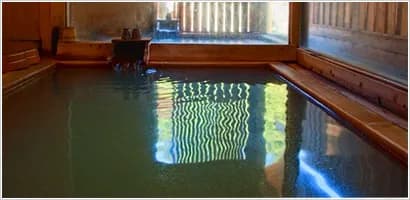
14. Nagayu Onsen Daimaru Ryokan (長湯温泉 大丸旅館) — Taketa, Oita
| Mon | Tue | Wed | Thu | Fri | Sat | Sun | Hol | |
|---|---|---|---|---|---|---|---|---|
| 11:00 - 17:00 | ◯ | ◯ | ◯ | ◯ | ◯ | ◯ | ◯ | ◯ |
15. Yunotsuru Onsen Yuyado Tsurumisou (湯の鶴温泉 湯宿 鶴水荘) — Minamata, Kumamoto
| Mon | Tue | Wed | Thu | Fri | Sat | Sun | Hol | |
|---|---|---|---|---|---|---|---|---|
| 10:00 - 20:00 | ◯ | ◯ | ◯ | ◯ | ◯ | ◯ | ◯ | ◯ |
16. Fukiage Onsen Nakashima Onsen Ryokan (吹上温泉 中島温泉旅館) — Hioki, Kagoshima
| Mon | Tue | Wed | Thu | Fri | Sat | Sun | Hol | |
|---|---|---|---|---|---|---|---|---|
| 06:00 - 21:00 | ◯ | ◯ | ◯ | ◯ | ◯ | ◯ | ◯ | ◯ |
Booking, payment and what to confirm
Reservations. Kyubei Ryokan and Sakaya state that no booking is needed for the private bath. Asahiso switches to reservations only when the inn is busy. Elsewhere, ask when you book the room.
Time limits. Okuzawa Ryokan works on roughly 40 minutes per turn, and Funabarakan's standing bath on 45 minutes per group.
Cost. Eight of the 16 include private bathing at no extra charge for overnight guests. Nagayu Onsen Daimaru Ryokan charges JPY 1,500 per hour for its family bath. Prices change, so confirm at the time of booking.
Payment — bring cash. Six of the 16 do not accept credit cards: Kowakubi Onsen Shohoen, Onikobe Onsen Todoroki Ryokan, Uguisudani Onsen Takenoha, Nigorigo Onsen Asahiso, Shirakawago Hirase Onsen Oyado Yunosato and Nagayu Onsen Daimaru Ryokan. These are mountain and valley inns, so draw yen before you leave the city.
Day visitors. Five of the 16 — Kyubei Ryokan, Sakaya, Asahiso, Adumaya and Okuzawa Ryokan — do not take day bathers. Their water is only available to overnight guests.
Getting there without a car
More of these inns are reachable by public transport than their mountain settings suggest, but the bus services are thin. Check timetables before committing.
Easy. Kouchi Onsen Kanaya Ryokan is about a 4-minute walk from Rendaiji Station on the Izukyu Line. Funabara Onsen Funabarakan is about 20 minutes by Tokai bus from Shuzenji Station, and the Funabara Onsen stop is directly in front of the entrance. Uguisudani Onsen Takenoha is about 5 minutes by taxi from Isohara Station on the JR Joban Line, and the inn offers a pickup if you arrange it in advance.
A bus ride, but straightforward. Yunotsuru Onsen Yuyado Tsurumisou is about 25 minutes by Sankō bus from Minamata Station to the last stop, then a 2-minute walk. Nagayu Onsen Daimaru Ryokan is roughly 50 minutes by bus from JR Bungo-Taketa Station, then a 3-minute walk. Shichikama Onsen Yuyado Okuzawa Ryokan is about 8 minutes by taxi from Hamasaka Station, or 15 minutes by Zentan bus plus a 3-minute walk. Shirakawago Hirase Onsen Oyado Yunosato is reached by Nohi bus from the Shirakawa-go bus terminal (JPY 720 one way) and a 2 to 3 minute walk.
Long or infrequent. Yunomine Onsen Ryokan Adumaya is about 100 minutes by Ryujin bus from JR Kii-Tanabe Station, or 60 minutes by Kumano Kotsu bus from JR Shingu Station; services are few. Onikobe Onsen Todoroki Ryokan is served by the Osaki municipal bus from JR Naruko-Onsen Station, about 20 minutes, but only a few departures a day and no inn shuttle; a taxi takes about 15 minutes. Shirakami Yatate Hikage Onsen is about 5 minutes by taxi from Jimba Station, and Fukiage Onsen Nakashima Onsen Ryokan about 40 minutes by Kagoshima Kotsu bus from JR Ijuin Station plus a short taxi ride.
Car strongly advised. Nigorigo Onsen Asahiso sits at about 1,800 m on the Hida side of Mount Ontake, roughly 1 hour 20 minutes from Takayama IC. Namegawa Onsen Fukushimaya has a narrow cliffside stretch along a river gorge on the final approach, with a warning about passing oncoming cars and falling rocks; the inn does run a free pickup from JR Toge Station for overnight guests by arrangement.
Prefecture guides
Fourteen of these 16 inns do not appear in this site's prefecture guides. For other hot springs in the same areas:
- Hidden onsen of Akita https://www.tan-ken.com/ja/blog/lfr1_7ywj5
- Hidden onsen of Yamagata https://www.tan-ken.com/ja/blog/ds2y_mqv3
- Hidden onsen of Miyagi https://www.tan-ken.com/ja/blog/bsjx4i18djjd
- Hidden onsen of Ibaraki https://www.tan-ken.com/ja/blog/cyt32lg9u
- Hidden onsen of Gifu https://www.tan-ken.com/ja/blog/txqxuturj
- Hidden onsen of Hyogo https://www.tan-ken.com/ja/blog/c03g_oq1i48
- Hidden onsen of Wakayama https://www.tan-ken.com/ja/blog/ubqshji1q45d
- Hidden onsen of Kumamoto https://www.tan-ken.com/ja/blog/n14h42d4src
- Hidden onsen of Oita https://www.tan-ken.com/ja/blog/e1msgqf6q99
- Hidden onsen of Kagoshima https://www.tan-ken.com/ja/blog/2v__hzci7
Choosing between them
If you want to bathe repeatedly across a stay, pick an inn with free, unreserved access. Kyubei Ryokan's guests can use the three private baths at its sister inn as well, and the inn maps out nine baths in total. Sakaya's two private open-air baths are free, and its six baths are open 24 hours to guests.
If the point is never to share a room with a stranger, choose an inn where the bathhouse itself is private. Oyado Yunosato has no communal bath. Okuzawa Ryokan runs both indoor baths privately and has neither an open-air bath nor a sauna. Tsurumisou keeps six private baths open 24 hours, all of them 100% natural spring water.
If you are choosing on the water, look at the source figures. Hikage Onsen draws separate springs for its communal and private baths; the private-bath source runs at about 52.8°C while the communal one is 38.4°C, warm enough for a long soak. Oyado Yunosato's spring emerges at 93.2°C and Ryokan Adumaya's at 92.5°C, both cooled before they reach the tub.
Spring chemistry, pH, source temperature, bathing arrangements and rates are all on the individual pages above. Private-bath rules change with staffing and season, so confirm when you book.
FAQ
Can I use a private onsen bath if I have tattoos?
A private bath is the standard way around Japan's tattoo restrictions, since no other bathers are present. Each inn sets its own policy and few publish it in English, so mention it when you reserve rather than at check-in.
Do I need to reserve the private bath?
It depends on the inn. Yutagawa Onsen Kyubei Ryokan and Yoshina Onsen Oyado Sakaya state that no reservation is required. Yunomine Onsen Ryokan Adumaya's two free family baths work on a first-come basis, and Onikobe Onsen Todoroki Ryokan uses a wooden tag at the bath door. Nigorigo Onsen Asahiso takes reservations only when the inn is busy.
Is the private bath free?
At eight of the 16 the inn states that overnight guests bathe privately at no extra charge: Hikage Onsen, Kyubei Ryokan, Todoroki Ryokan, Funabarakan, Sakaya, Asahiso, Adumaya and Tsurumisou. Nagayu Onsen Daimaru Ryokan charges JPY 1,500 per hour for its family bath. Rates change; confirm before booking.
Can I visit just for the day?
Not at all of them. Kyubei Ryokan, Sakaya, Asahiso, Adumaya and Okuzawa Ryokan take overnight guests only. The other 11 accept day bathers, but at Kowakubi Onsen Shohoen and Fukiage Onsen Nakashima Onsen Ryokan the private baths themselves are reserved for people staying the night.
Can I get to these inns by train and bus?
To most of them. Kanaya Ryokan is a 4-minute walk from Rendaiji Station, and Funabarakan's bus stop is at the door. Tsurumisou, Daimaru Ryokan, Okuzawa Ryokan and Oyado Yunosato are all short bus rides from a station. Asahiso and Fukushimaya are the two where a car is the practical option.
Can I pay by credit card?
Not at six of the 16: Shohoen, Todoroki Ryokan, Takenoha, Asahiso, Oyado Yunosato and Daimaru Ryokan are cash only. Carry enough yen for the stay and any bathing fees.
Disclaimer
- Information in this article (bathing fees, opening hours, spring data, private-bath arrangements) reflects the time of research and may have changed. Please confirm current details with each facility's official website or the local tourism association.