8 Distinctive Hot Springs in Ibaraki Prefecture: From the Izura Coast to the Okukuji Mountains
Ibaraki Prefecture has no active volcano, and even Mt. Tsukuba, its best-known peak, is a mass of uplifted rock rather than a volcanic cone. Despite that, the prefecture's hot springs split into two distinct characters. Along the Izura coast in Kitaibaraki City, chloride springs emerge at striking temperatures: Taikan-no-yu at Izura Kanko Hotel Annex Taikanso reaches 71C at the source, and Yukoku Kakuretadaato Onsen reaches 60.9C. Deep in the Okukuji mountains, by contrast, cold mineral springs dominate. Osuge Onsen Motoyu Ryokan and Yokokawa Onsen Motoyu Yamadaya Ryokan both draw water above pH 10, and Yunosawa Kousen taps a sodium-bicarbonate source. Locals have long called these alkaline waters "bihada no yu," or baths that leave the skin smooth.
How each facility treats its water varies just as much. Taikanso, Yukoku Kakuretadaato Onsen, and Tsukuba Onsen Hotel are genuine source-fed baths, drawn straight from the ground without dilution, added heating, or recirculation. Tsukiori Onsen Shirakiso, on the other hand, combines fresh source water with filtered, recirculated water. Osuge Onsen Motoyu Ryokan, Yokokawa Onsen Motoyu Yamadaya Ryokan, and Yunosawa Kousen all heat their cold-emerging sources for bathing but do not dilute them, preserving the original mineral concentration. Horikawa Onsen goes furthest of all: its two private sources are served completely untreated, without any chlorination, a distinction reportedly unmatched elsewhere in the prefecture.
A few of these facilities stand out for reasons beyond the water itself. Yukoku Kakuretadaato Onsen opened on September 30, 2024, alongside a nighttime forest museum by the digital art collective teamLab, making it one of the only places in Japan where visitors can bathe while surrounded by large-scale light installations. Yunosawa Kousen is the only inn in Ibaraki belonging to the Japan Association of Secluded Hot Spring Inns (Nihon Hito wo Mamoru Kai), with roots traced to a legend from 1842. Horikawa Onsen is a fully private, reservation-only rental accepting just one group per day, and one of its sources has been certified by Japan's Ministry of the Environment as tritium-free background water for radiation research.
Below are 8 of Ibaraki's most distinctive hot springs, selected after examining the history and water treatment of each facility in detail.
1. Izura Kanko Hotel Annex Taikanso, Taikan-no-yu (五浦観光ホテル別館 大観荘、大観の湯) — Kitaibaraki City
In 1905, Okakura Tenshin designed and built the hexagonal pavilion Rokkakudo on the rocky shore of Izura, and drew Yokoyama Taikan, Shimomura Kanzan, Hishida Shunso, and Kimura Buzan of the Japan Fine Arts Academy to the site, transforming this stretch of coastline into a cradle of modern Japanese painting. The dramatic cliffs where Pacific waves crash against weathered pines are the very seascape Yokoyama Taikan returned to again and again as a subject for his art. Izura Kanko Hotel Annex Taikanso stands barely a two-minute walk from Rokkakudo, and its open-air bath, Taikan-no-yu, is named in tribute to the master painter who loved this coastline throughout his life.
The hotel's pride is a sodium chloride spring with a source temperature of 71C and a pH of 7.9. With a total mineral content of roughly 11,700 mg per kilogram, the water carries a distinctly salty taste and a faint oily aroma, the kind of concentrated, mineral-rich water long associated with therapeutic bathing. Served free-flowing without any addition of water, it preserves qualities traditionally believed to ease neuralgia, muscle and joint pain, frozen shoulder, poor circulation, and recovery from illness.
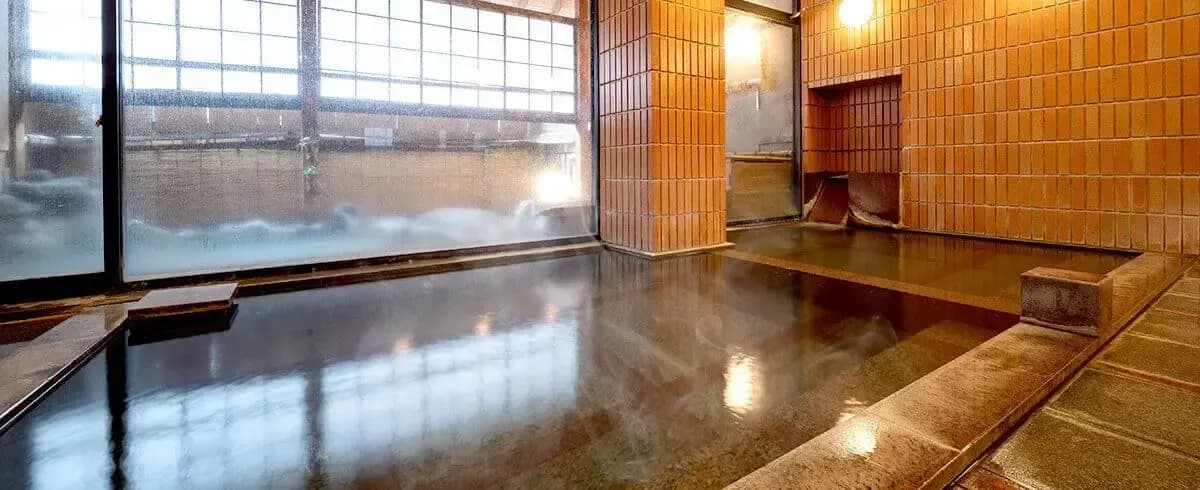
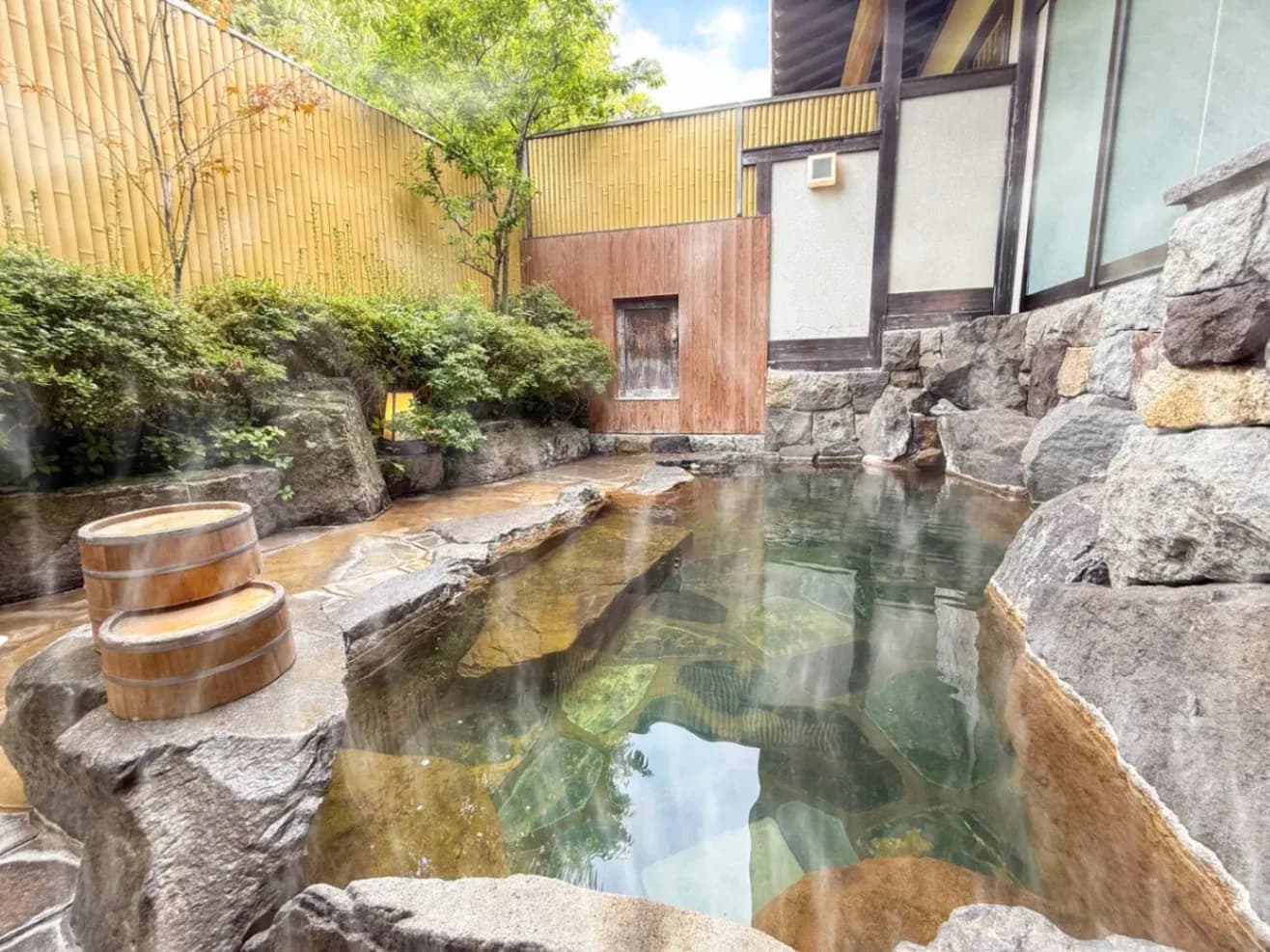
Renovated in the autumn of 2012, the open-air bath Taikan-no-yu offers an unobstructed view of the Pacific horizon and the sound of waves crashing below. The large indoor bath also looks out over the ocean through expansive windows, letting guests enjoy the view regardless of weather. For a quieter soak, two private baths, Tsubaki-no-yu and Hamagiku-no-yu, are available for 2,200 yen per 45-minute session. Overnight guests can even stay in a special room relocated from Yokoyama Taikan's former villa, paired with kaiseki cuisine built around Ibaraki's seafood.
Day-trip bathing costs 1,100 yen for adults and 600 yen for children, offered in two sessions: 11:00 to 15:00 (last entry 14:30) and 18:00 to 21:00 (last entry 20:30). Dining at the on-site restaurant, Tsubaki, earns visitors a 500 yen discount on the bathing fee. Access is convenient, about 15 minutes by car from Kitaibaraki IC on the Joban Expressway, or 5 to 15 minutes by car or taxi from Otsuko Station on the JR Joban Line. Combined with a stroll to Rokkakudo and the nearby Tenshin Historical Park, a visit here offers both the roots of modern Japanese art and a spectacular stretch of Pacific coastline in a single trip.
3. Osuge Onsen Motoyu Ryokan (大菅温泉 元湯旅館) — Hitachiota City
Tucked along the Satogawa river valley deep in the Okukuji region of Hitachiota City, Ibaraki Prefecture, Osuge Onsen Motoyu Ryokan is a secluded single-inn hot spring. The spring is said to have been opened roughly 300 years ago and has been cherished since the Edo period as a therapeutic bath for ailments such as neuralgia. As one of the two inns of Osuge Onsen, it is known as a rustic retreat where guests can enjoy the water and local cuisine amid mountain quiet.
The water is a simple sulfur spring. Although the source emerges at a cold 16C, its content of fluoride ions, total sulfur, and metasilicic acid qualifies it as an onsen under Japanese hot spring law. Most striking is its high alkalinity of pH 10.2, which gives the bath a silky, skin-smoothing quality. Because the cold source must be heated to around 41C, each bath is fitted with two taps, one for heated spring water and one for the cold mineral source, letting bathers adjust the temperature and mineral strength to their own liking, a distinctive touch of this inn.
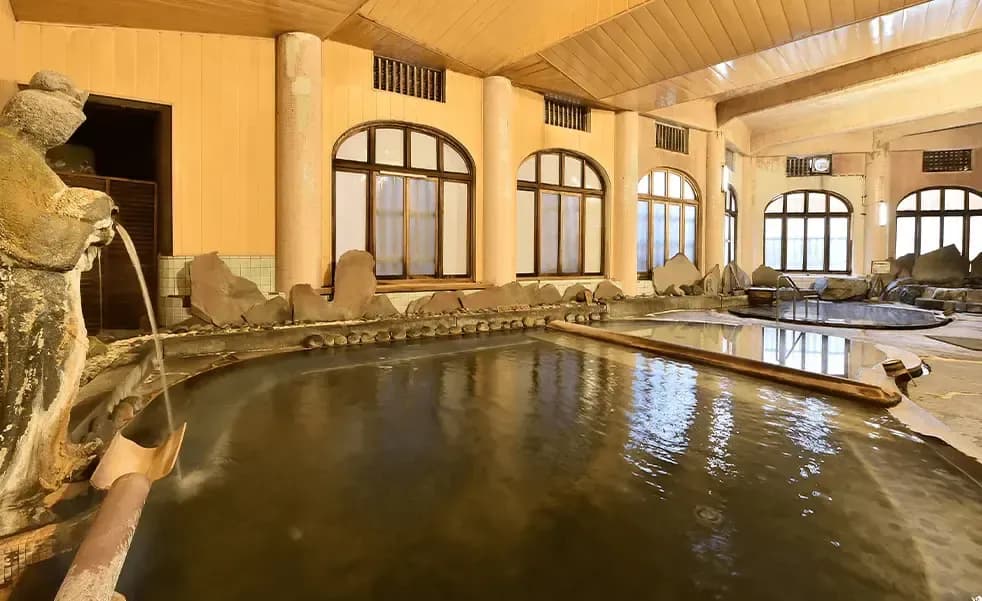
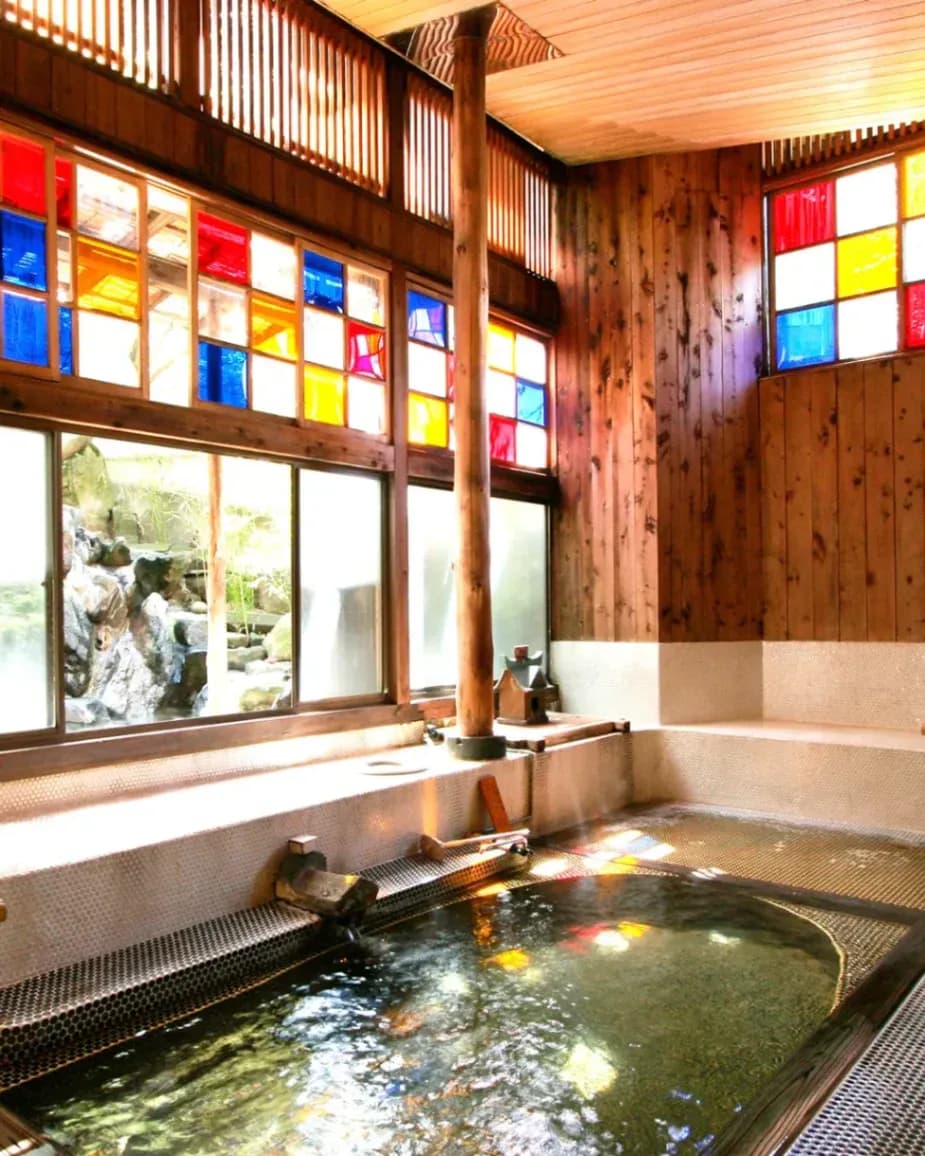
The main indoor bath looks out over the Satogawa river, and a bath that can be reserved for private use is also available. Old-fashioned details remain throughout, including a spout shaped like a lion's head, evoking the atmosphere of a traditional healing inn. Overnight guests are served dishes of locally caught river fish and mountain vegetables, and with advance reservation can sample the inn's renowned soba. All nine guest rooms offer views over the peaceful rural scenery of the Satogawa basin.
Day-trip bathing is affordable from 500 yen per adult, open 10:00 to 20:00 with no regular closing days. By car it is about 30 minutes from Hitachi-Minami-Ota IC or Naka IC on the Joban Expressway via Route 349, with parking for about seven cars. By public transport, take a bus about 40 minutes from JR Suigun Line Hitachi-Ota Station, then walk about 3 minutes. Time a visit to the autumn foliage or sweetfish season of Okukuji to make the most of the river valley and its silky sulfur water.
Yokokawa Onsen is an old hot spring welling up in the mountains of Orihashi-cho, deep in the Okukuji region of Hitachiota, Ibaraki. Among its inns, Motoyu Yamadaya Ryokan is said to have been founded in 1753 (Horeki 3), a single lodging that has accumulated more than three centuries of history. Long cherished by bathers seeking healing, the inn had its roughly 250-year-old building renovated by an architect in 2017, reborn as a space that preserves its old charm while offering modern comfort.
The water at Yamadaya is an alkaline simple sulfur cold mineral spring. What stands out is its pH of 10.1, among the highest alkalinity found anywhere in Ibaraki. Its silky, slippery quality that seems to gently envelop the skin has earned it the name beauty bath, while a faint scent of sulfur lends character to the soak. As the source is a cold spring below 25C it is heated before filling the tubs, yet its soft touch on the skin is never lost.
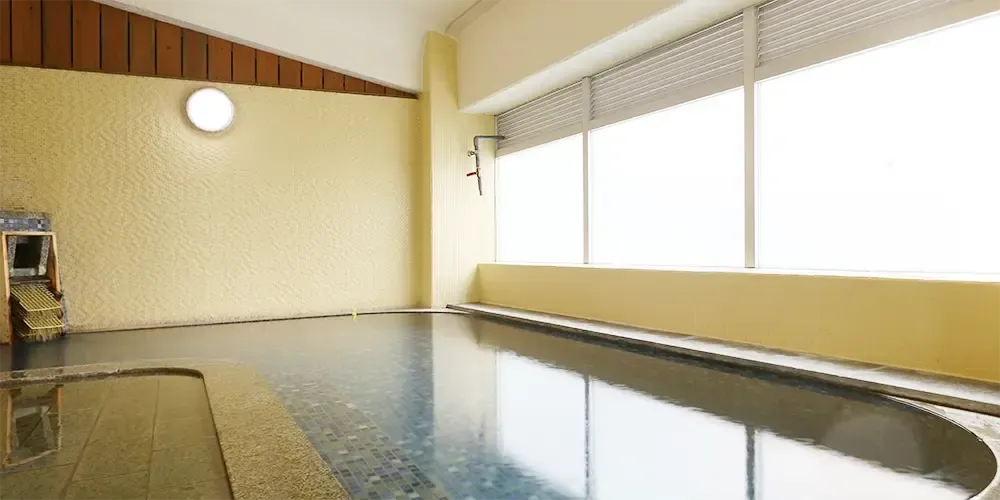
The bathhouse provides separate indoor baths for men and women overlooking a mountain stream; modest in scale, they invite a calm, unhurried soak. The inn's appeal extends beyond the water, for its kaiseki cuisine drawing on seasonal Okukuji ingredients is highly regarded, letting guests savor local flavors including Hitachi beef. All seven pure-Japanese-style rooms are wrapped in the quiet of the mountain village, ideal for a stay far from the bustle.
Overnight stays start from around 16,500 yen with two meals, an approachable price for such a historic hot spring inn. Because day-trip bathing is currently suspended, an overnight stay is the standard way to enjoy the spring. The surroundings are dotted with famous sights such as Fukuroda Falls, one of Japan's three great waterfalls, and the Ryujin Grand Suspension Bridge, especially beautiful in the autumn foliage season. By car it is about 40 minutes from Naka IC on the Joban Expressway heading north on Route 349, and by public transport it can be reached by bus from JR Suigun Line Hitachiota Station.
Fukuroda Falls, one of Japan's three great waterfalls, is famed for its four distinct seasonal faces, but if you follow the river further upstream along National Route 461, you will find a small, single inn cared for by the local community: Tsukiori Onsen Shirakiso. The story of this inn began in 1992, when hot spring water unexpectedly gushed out during drilling work for a nearby golf course development. Since then, residents of the district have banded together to build and maintain the baths and guest rooms, running the inn as a modest hot-spring retreat under the motto of being "loved by, and contributing to, the local community."
The spring here is classified as an alkaline simple hot spring, with a source temperature of 41.8°C and a pH of 8.9, making it distinctly alkaline. The water is colorless, clear, and notably gentle on the skin, and is said to help with neuralgia, muscle pain, lower back pain, poor circulation, and general fatigue. Locals speak with pride of the quality of Shirakiso's water. It is worth noting, however, that the inn does not claim a pure source-fed (kakenagashi) flow: instead, each bath is fed with a combination of fresh source water and recirculated water that is filtered and disinfected. The water is not intended for drinking, so it should be enjoyed for bathing only.
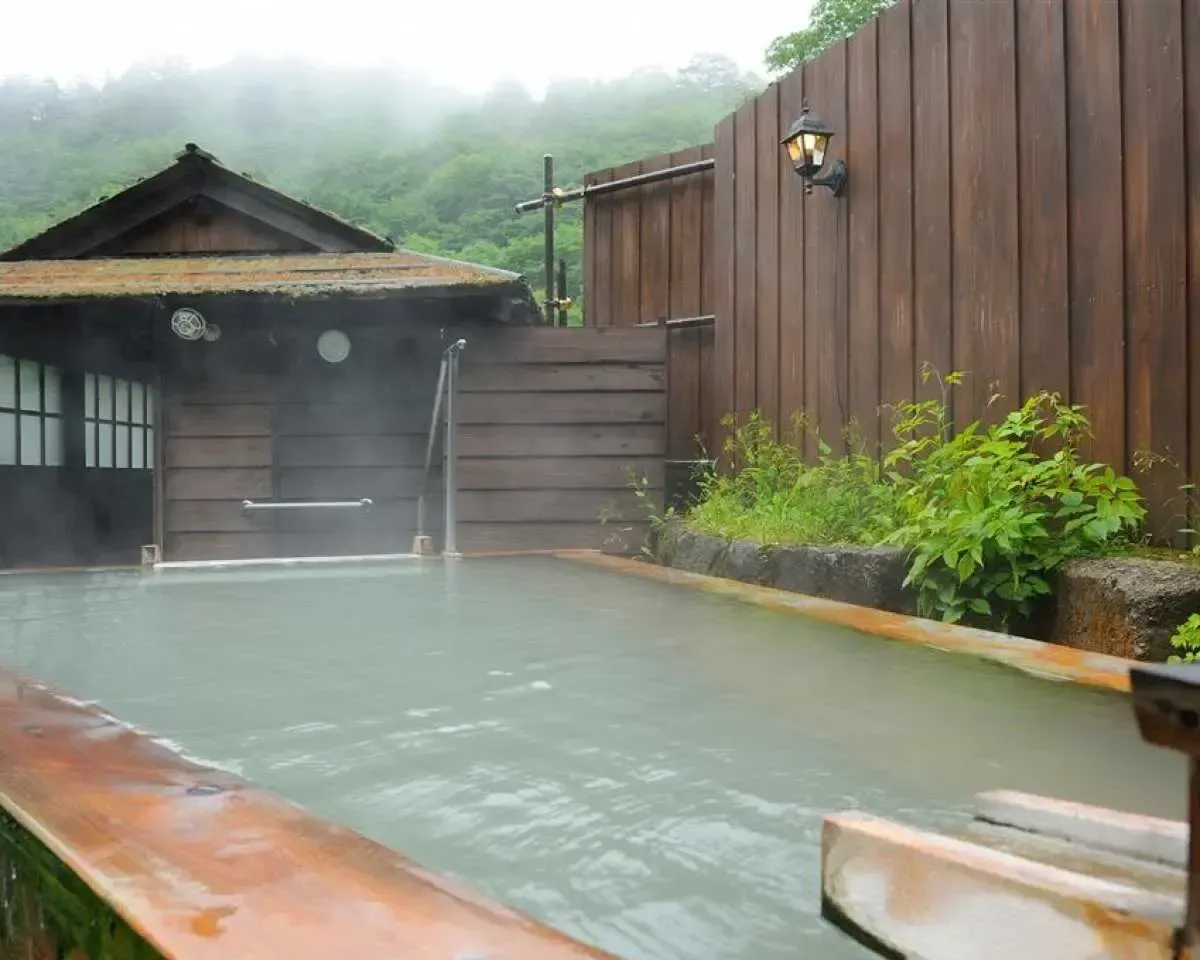
Two types of baths await guests: an indoor bath finished in tile and stone, and an outdoor rock bath enclosed by a wooden fence, from which bathers can take in the green, gently rising hills that press close to the highway. The wooden, tile-roofed inn has 13 rooms in total, and its interior retains a distinctly nostalgic, Showa-era hot-spring-resort atmosphere. Home-style Japanese meals made with local ingredients help soothe the fatigue of travel, and it is this unpretentious yet warm hospitality that defines the character of the inn.
Day-trip bathing costs 600 yen for adults and is available from 8:00 to 18:00, while an overnight stay with two meals starts at 9,150 yen per person (meal-plan pricing was revised in July 2025). Many travelers stop by while sightseeing at Fukuroda Falls, and the inn is especially popular in autumn, when the colors of the falls and the surrounding mountain village can be enjoyed together. Roads can occasionally freeze in winter, so drivers should watch for icy or snowy conditions. Access is relatively convenient, at about 60 minutes by car from Naka Interchange on the Joban Expressway, or about 10 minutes by taxi from Fukuroda Station on the JR Suigun Line.
Mt. Tsukuba, twin-peaked with Nantai-san and Nyotai-san, has long been revered as a sacred mountain and is celebrated in the saying 'Fuji in the west, Tsukuba in the east' as one of Japan's 100 Famous Mountains. Partway up its slopes stands Tsukuba Onsen Hotel, a single standalone inn. In 1974, after drilling deep underground, the inn struck Mt. Tsukuba's very first hot spring vein at a depth of 1,353 meters, and for nearly half a century since, it has remained the mountain's only inn with its own private source.
The spring, drawn from the source known as 'Tsukuba Onsen Waraku R1,' is an alkaline simple hot spring with a temperature of 37–42°C. It is delivered as a genuine source-fed bath with no dilution, added heating, circulation filtering, or chemical disinfection, leaving the clear, colorless water with a smooth, faintly silky texture. Rising through the geology of the Mt. Tsukuba range, its gentle, mild character has long made it a favorite stop for hikers washing off the sweat of the climb.
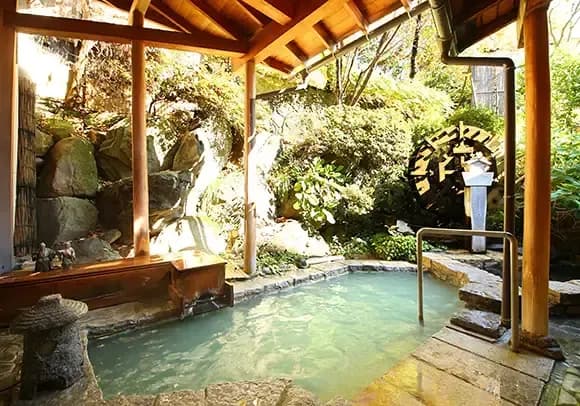
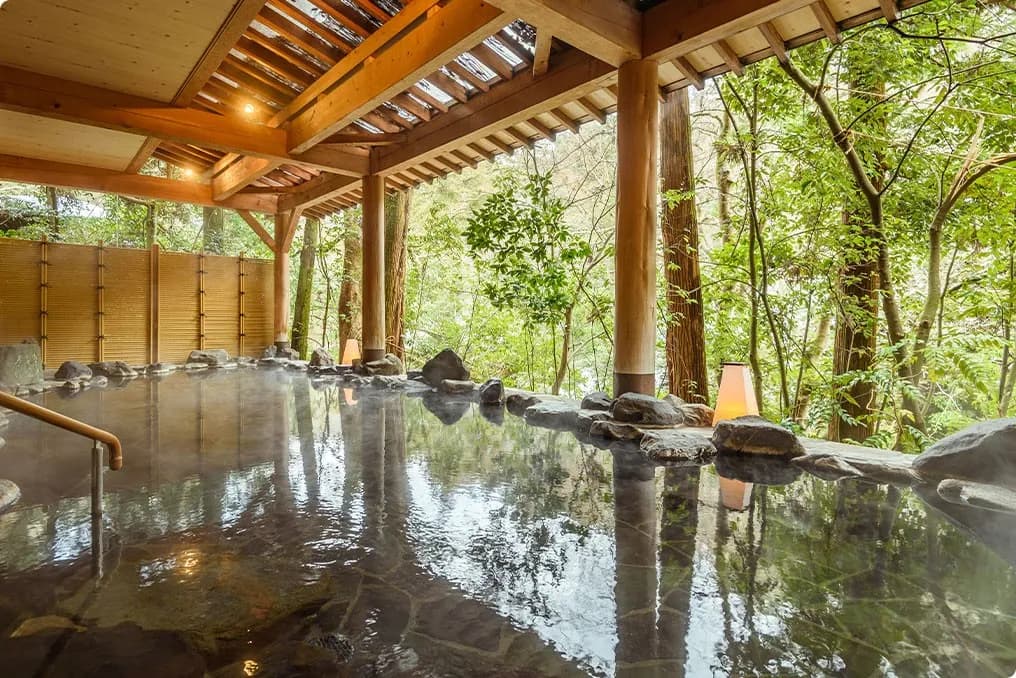
The bathing area centers on an open-air bath shaded by the trees of Mt. Tsukuba, with a small tsubo-buro jar bath tucked quietly within it and an indoor bath scented with hinoki cypress. In the tsubo-buro, visitors can listen to the sound of the private spring flowing in as they enjoy a moment alone. A private reservable bath, sauna, and hot stone bath are also available, and the Japanese- and Western-style guest rooms offer sweeping views of the Kanto Plain, with Mt. Fuji visible on clear days. Dinner features a creative kaiseki course blending Japanese, French, and Italian techniques with local Ibaraki ingredients.
Day-trip bathing is available from 13:00 to 18:00 (last entry 17:00, though reception may close as early as 16:00 during busy periods), priced at 1,100 yen for adults (1,300 yen on weekends and holidays), 700 yen for elementary school children, and 500 yen for infants. Free parking for 6 large vehicles and 50 cars makes a visit by car convenient, though the hotel is also reachable by shuttle bus from Tsukuba Station on the Tsukuba Express line. The hotel is a popular stop for those touring Mt. Tsukuba's autumn foliage or unwinding after a summer hike, though it may close over the New Year and Golden Week holidays, so checking opening status in advance is recommended.
7. Yukoku Kakuretadaato Onsen (幽谷隠田跡温泉), Izura — Kitaibaraki City
The Izura coast in Kitaibaraki City, Ibaraki Prefecture, is known as the stretch of shoreline that art movement leader Okakura Tenshin loved dearly in the Meiji era; the hexagonal pavilion Rokkakudo, which he designed himself, still stands at the water's edge. On September 30, 2024, a new hot spring facility, Yukoku Kakuretadaato Onsen, opened on the site of former forest-embraced terraced rice paddies along this coast. Conceived together with teamLab's nighttime forest museum of the same theme, which opened the same day, it quickly drew nationwide attention as the only place in Japan where visitors can soak in a hot spring while surrounded by large-scale digital light art.
The facility's pride is a sodium chloride spring with a source temperature of 60.9C, served completely free-flowing without any addition of water -- a concentrated, distinctly salty spring. This chloride-rich water in fact shares its source with the Taikan-no-yu bath at the nearby historic Izura Kanko Hotel Annex Taikanso (source temperature 68.8-71C, pH 7.9-8.01), both drawing from the same deep geothermal vein running beneath the Izura coast, making this new facility a rare opportunity to experience the region's signature strong saline spring in a completely different setting.
The bathing facilities consist of a gender-separated indoor bath with shower booths and a large tub, alongside a co-ed open-air bath, where swimwear is required, built directly into the uneven contours of the former rice terraces. After dark, countless teamLab lamps rise from the outdoor bath, creating a dreamlike field of light through the rising steam. The grounds also host 20 glamping tents and two cottages overlooking the forest and terraces, along with a campfire area (open until 23:00) and walking paths, making an overnight stay an immersive escape from the everyday.
Day-trip bathing is a newer offering that launched on February 18, 2025, operating from 18:00 to 20:00 (hours vary by season), priced at 1,800 yen for adults and 500 yen for children and visitors with disabilities (plus 200 yen if purchased on-site). It is typically bundled with admission to the teamLab exhibition and requires advance reservation online. Access is convenient, about 15 minutes by car from Kitaibaraki IC on the Joban Expressway, or roughly 5 minutes by taxi from JR Otsuko Station. Visiting after sunset lets guests enjoy the light art and the free-flowing spring water together, making both the humid summer evenings and the crisp, clear air of autumn and winter excellent seasons to visit.
In the quiet hills of Takahagi City, Ibaraki Prefecture, stands a single hot-spring lodge that the current owner describes as an inheritance received from his father. Horikawa Onsen is a private, reservation-only property built around a family-owned hot spring that has been passed down and protected for generations, now run by Terme Japan Co., Ltd. Neither a hotel nor a conventional ryokan, it operates as an unhosted, whole-property rental for travelers seeking silence and the unfiltered character of a real hot spring.
Two very different sources rise on the grounds. One is a sodium-sulfate spring that flows naturally at 32 degrees Celsius and 150 liters per minute. The other is a sulfur spring that gushes at a lower 20 degrees Celsius but a remarkable 3,000 liters per minute. Both are fed into the baths completely untreated, without dilution, heating, or chlorination, a rare practice said to be unique to this property in all of Ibaraki Prefecture. The sodium-sulfate spring has been confirmed to contain no tritium, and its purity has led Japan's Ministry of the Environment to certify it as background water for radiation research, drawing more than twenty institutions to collect samples each year. The sulfur spring, by contrast, runs crystal clear when fresh but clouds to a milky white after about two days, carrying a sulfurous aroma reminiscent of Kusatsu Onsen, with a neutral pH.
Guests choose between an eight-mat tatami room or a connected suite combining eight- and six-mat rooms, and the whole property, along with its sauna, can be rented by a single party of one to eleven people for the same price. The sauna's cold plunge is filled generously with the property's own sulfur spring water. Dining is flexible, ranging from catering by an affiliated French restaurant using local ingredients to barbecue setups or a no-meals stay, with in-room dining also available, letting guests spend unhurried time with the spring water, free from the presence of other guests.
The property is available from a 15:00 check-in to a 10:00 checkout the next morning, and operates from April through the end of November, closing for the winter from December to March. Reservations are made through the official Reserva booking system, with payment required in advance by bank transfer or credit card. Access is straightforward by car, about 10 minutes from Takahagi IC on the Joban Expressway, though there is no nearby train station, so visitors should plan to arrive by car. For those craving a private soak in genuinely untreated spring water, Horikawa Onsen is a hidden gem tucked into the hills of Ibaraki.
Summary: What to Know Before Exploring Ibaraki's Hot Springs
Ibaraki's hot springs fall into three natural groupings for trip planning: the Kitaibaraki/Takahagi coast, the Okukuji mountains, and Tsukuba in the south.
Kitaibaraki and Takahagi. Taikanso, Yukoku Kakuretadaato Onsen, and Horikawa Onsen sit in this coastal and hillside area. Taikanso and Yukoku Kakuretadaato Onsen are both a few minutes apart by car in Otsu-cho, Kitaibaraki City, about 15 minutes from Kitaibaraki IC on the Joban Expressway, or 5 to 15 minutes by taxi from JR Otsuko Station. Day-trip bathing at Yukoku Kakuretadaato Onsen is normally bundled with admission to the teamLab exhibition and requires advance online booking. Horikawa Onsen, in neighboring Takahagi City, is about 10 minutes by car from Takahagi IC, but as a fully private, one-group-per-day rental, a reservation through its official booking site is mandatory before visiting.
The Okukuji Mountains. Yunosawa Kousen in Hitachiomiya City, Osuge Onsen Motoyu Ryokan and Yokokawa Onsen Motoyu Yamadaya Ryokan in Hitachiota City, and Tsukiori Onsen Shirakiso in Daigo Town are scattered through this inland range. All sit near the JR Suigun Line, but reaching them requires a bus or taxi transfer from the nearest station, and services run infrequently. By car, Naka IC on the Joban Expressway is the starting point: Yunosawa Kousen and Osuge Onsen Motoyu Ryokan are roughly 30 to 40 minutes away, while Tsukiori Onsen Shirakiso, further into the hills, takes about 60 minutes. Yokokawa Onsen Motoyu Yamadaya Ryokan currently suspends day-trip bathing and accepts overnight guests only, so booking ahead is essential. Tsukiori Onsen Shirakiso sits just upstream from Fukuroda Falls and draws visitors especially during the autumn foliage season, though roads here can ice over in winter.
Tsukuba. Tsukuba Onsen Hotel sits partway up Mt. Tsukuba, about a 36-minute shuttle bus ride from Tsukuba Station on the Tsukuba Express line, followed by a roughly 5-minute hotel transfer. By car, it is about 40 minutes from Tsuchiura-Kita IC on the Joban Expressway. The hotel occasionally closes around New Year's and Golden Week, so it is worth checking opening status before a visit.
A few practical points apply across the list. Bathing is generally separated by gender, though Yukoku Kakuretadaato Onsen's outdoor bath is mixed-gender and requires swimwear, and Horikawa Onsen is booked entirely by one group at a time, so gender separation does not apply there. As at most hot springs in Japan, visitors with visible tattoos should contact each facility in advance, since none of these eight publish an explicit tattoo policy online. Reservations are effectively required at Horikawa Onsen and strongly advised at Yukoku Kakuretadaato Onsen and the smaller Okukuji inns, several of which accept only a limited number of guests per day. Cash remains the safer default at these small, family-run baths, even though a few of the larger facilities, including Taikanso and Horikawa Onsen, accept credit cards. None of the eight is reachable entirely by public transport without a taxi, bus transfer, or hotel shuttle at the final stretch, so a rental car is the most practical way to visit more than one in a single trip, particularly across the Okukuji mountains.
The information in this article (admission fees, operating hours, water quality data, etc.) is based on research conducted at the time of writing. Details may have changed or contain errors. Please verify the latest information on each facility's official website or through the local tourism association.