Snow Onsen in Japan: 11 Ryokan With Open-Air Baths in the Snow

This guide lists 11 inns where an open-air bath (rotenburo, 露天風呂) is confirmed to be usable in the snow, either on the inn's own website or in published travel and tourism-board coverage. Every one of them takes overnight bookings through Rakuten Travel, Jalan, Ikyu or the inn's own booking page. One is in Hokkaido, four in Tohoku, three in the mountains north of Tokyo, and three in the Hida and Nagano Alps.

The baths sit between 1,126 m (Azumaya Ryokan in Yamagata) and about 1,800 m (Manza Onsen Nisshinkan) above sea level. The water ranges from strongly acidic pH 2.3 at Tokachidake to alkaline pH 9.2 at Oku-Oyasukyo. Two of the inns cannot be reached by private car in winter, and a few close their outdoor baths on the coldest or snowiest days, so read the practical section before you book.

What this guide covers

  • When the snow is reliably there
  • 11 inns with outdoor baths in the snow, each linked to a detail page with spring data and access
  • Tattoos, mixed bathing, cash-only inns and getting there by train and bus

When to go for an onsen in the snow

Three of the 11 inns have a published snow season, and all three run from December into March or April:

  • Yarimi no Yu Yarimikan (槍見の湯 槍見館), Gifu: mid-December to late March (Walkerplus, 2017)
  • Shintakayu Onsen Azumaya Ryokan (新高湯温泉 吾妻屋旅館), Yamagata: December to around April (the inn's 2023 announcement)
  • Okukinu Onsen Kaniyu (奥鬼怒温泉 加仁湯), Tochigi: mid-February suggested (All About, 2019)

Higher inns hold snow longer. December and March vary from year to year, so January and February are the safest months to plan around.

How these 11 were chosen

  1. Snow bathing is documented. This site's database has no "snow view" field, so each inn was checked one by one against its official website, a tourism board, or a travel publication. Inns that could not be confirmed were left out, even in heavy-snow regions.
  2. Bookable online for an overnight stay, via one of the three big Japanese booking sites or a direct reservation page.
  3. Open in winter. Mountain inns that close for the snow season, such as Toshichi Onsen and Ubayu Onsen, are not included.
  4. An outdoor bath. Inns where you only see snow through an indoor-bath window are excluded.

They are listed roughly north to south.


1. Tokachidake Onsen Yumoto Ryounkaku (十勝岳温泉 湯元 凌雲閣), Biei, Hokkaido

Tokachidake Onsen Yumoto Ryounkaku
Tokachidake Onsen Yumoto Ryounkaku - Image 3
Quality
Calcium - Sodium - Sulfate Spring
Acidic - Iron(II)-containing - Calcium - Sulfate Spring
Temp
30℃ to 53℃
Supply
Natural Source Flow
pH
pH 2.3
pH
0714
AcidicNeutralAlkaline
Use
Stay OK/Day Trip OK
Fee
Adult 800JPY/Child 400JPY
Hours
MonTueWedThuFriSatSunHol
08:00 - 20:0008:00 - 20:0008:00 - 20:0008:00 - 20:0008:00 - 20:0008:00 - 20:0008:00 - 20:0008:00 - 20:0008:00 - 20:00
View detail page

2. Nyuto Onsen Taenoyu (乳頭温泉 妙乃湯), Semboku, Akita
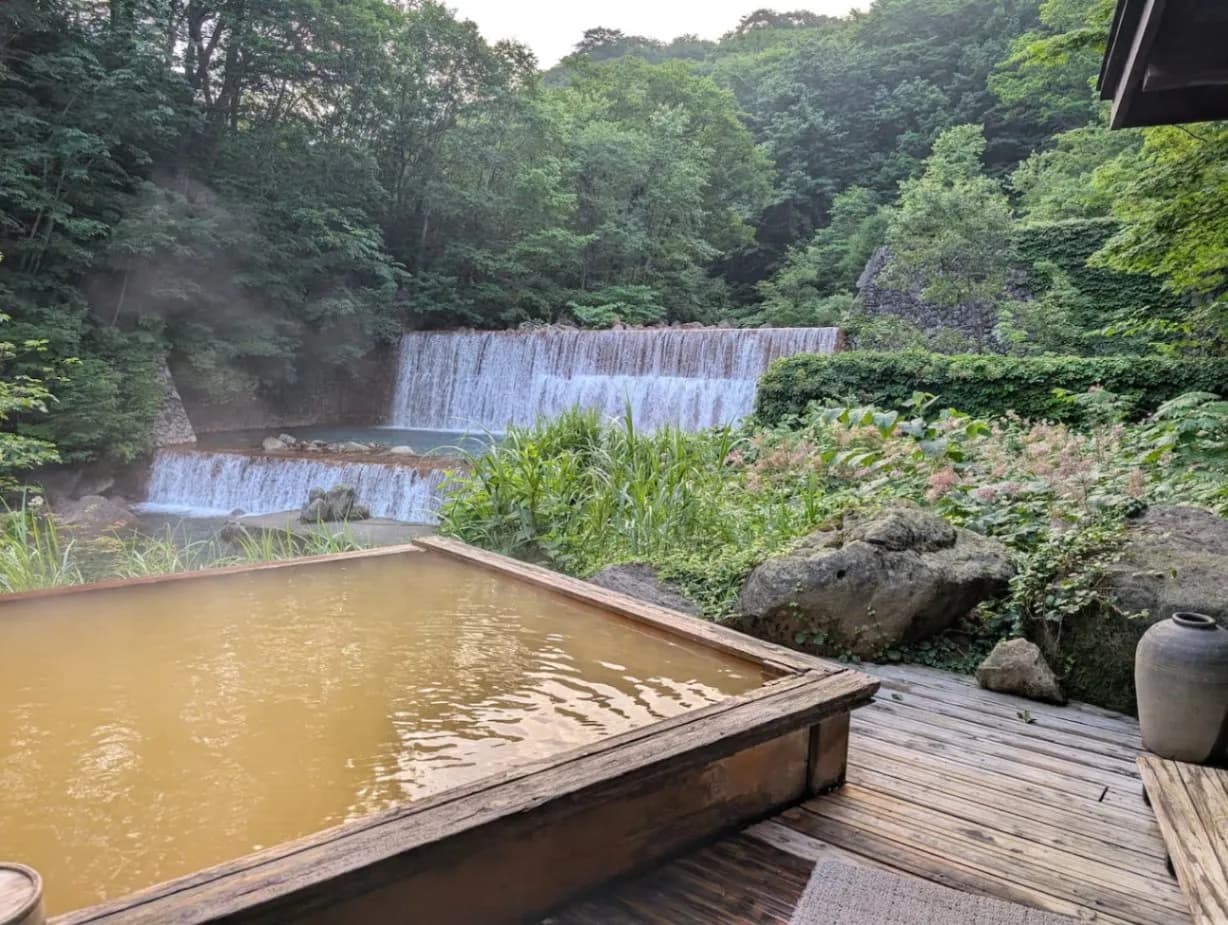
Nyuto Hot Spring Taenoyu
Nyuto Hot Spring Taenoyu - Image 5
Quality
Calcium - Magnesium - Sulfate Spring
Iron Spring
Sulfate Spring
Temp
30℃ to 85℃
Supply
Natural Source Flow
pH
pH 2.9
pH
0714
AcidicNeutralAlkaline
Use
Stay OK/Day Trip OK
Fee
Adult 1000JPY/Child 500JPY
Hours
MonTueWedThuFriSatSunHol
10:30 - 21:0010:30-15:0010:30-15:0010:30-15:0010:30 - 21:0010:30 - 21:0010:30 - 21:0010:30 - 21:0010:30 - 21:00
View detail page

3. Oku-Oyasukyo Oyu Onsen Abe Ryokan (奥小安峡 大湯温泉 阿部旅館), Yuzawa, Akita

Oku-Oyasukyo Oyu Onsen lies at the very top of the Minase River valley on the western flank of Mount Kurikoma, in the far southeast of Yuzawa City, Akita Prefecture. Abe Ryokan, further into the national forest than the better-known Oyasukyo Onsen, is the only inn here. The spring is said to date from the Bunka era (1804-1817), and local tradition connects it to soldiers of the Former Nine Years War in the Heian period. Steam still escapes from the bed of the Oyu River below the inn, and with no village or shop nearby, the only sounds are running water and the hiss of the spring. The building was rebuilt in 2003, but the owners deliberately kept it to nine rooms, and the couple still cook the meals themselves. The water is an alkaline simple sulfur spring with a pH of 9.2. It rises naturally, with no pump, at 92.3C, and the daily work here is cooling it down rather than heating it up; cold water is added to bring the tubs to a comfortable temperature. The water is clear and colorless with a slippery softness against the skin, and a faint sulfur note is a reminder of the volcano underfoot. Most tubs are fed directly from the source, while some combine a source-fed spout with in-tub recirculation and filtration to keep volume and temperature steady. Seven baths, two indoor and five open-air, is a remarkable number for a single small inn. A long corridor leads out to the stream, where Kajika-buro with its standing pool, the half-roofed Seseragi-buro built by the owner, and a stone bath of Towada and Tako stone are strung along the water. Inside are Konjaku-buro, which keeps the atmosphere of an old bath hut, Hinoki-buro with its cypress tub and Aomori hiba paneling, and a steam bath fed by the spring vapor itself. The seventh, a natural river bath formed by damming water that wells up through the riverbed, appears for just three months, from July to September. It is mixed-gender, so women should bring a swimsuit or bath towel. Day bathing costs 500 yen for adults and 200 yen for children, available from 8:30 to 17:00 with last entry at 16:00, closed Thursdays and the second Friday of the month. There are no showers: bathers rinse with a wooden pail in the old manner, and towels must be brought or bought for 330 yen. Each season has its own draw, the river bath in summer, hillsides of color from mid-October, and snow-viewing baths in winter. Note, however, that the Hanayama and Ichinoseki section of National Route 398 closes for the winter, leaving access only from the Akita side, and heavy rain can close the road at other times, so check the inn's website for road notices before setting out.
Quality
Simple Sulfur Spring
Emerge
Natural Emergence
Supply
Partial Natural Flow
Heat
Not Heated
pH
pH 9.2
pH
0714
AcidicNeutralAlkaline
Use
Stay OK/Day Trip OK
Fee
Adult 500JPY/Child 200JPY
Hours
MonTueWedThuFriSatSunHol
08:30 - 17:0008:30 - 17:0008:30 - 17:0008:30 - 17:00Closed08:30 - 17:0008:30 - 17:0008:30 - 17:0008:30 - 17:00
View detail page

4. Shintakayu Onsen Okushirabu Azumaya Ryokan (新高湯温泉 奥白布 吾妻屋旅館), Yonezawa, Yamagata

Shintakayu Onsen is the water of a lone inn welling up at 1,126 meters on the flank of Mount Nishi-Azuma in the Azuma range, in the southern part of Yonezawa, Yamagata. It lies deep in the mountains of the Mogami River headwaters, beyond Shirabu Onsen, and its name, meaning roughly 'new high spring,' reflects its position above Shirabu. The source is said to have been discovered by Abe Mataemon during the Bunsei era, who bathed in it and found his illness cured. Since opening as an inn in 1902, Azumaya Ryokan has served as a member of the Japan Secret Hot Springs Preservation Society, receiving bathers who cross the mountains to reach it. The quality of the water is the inn's foremost pride. It is a sulfur-bearing calcium sulfate spring, once classified as a gypsum hydrogen-sulfide spring, neutral at pH 7.0, with a source temperature reaching 55.6 degrees Celsius. About 170 liters per minute rise naturally from the hillside behind the inn and flow through wooden troughs into each bath. There is no reheating, no added water, no recirculation, and no chlorination; this is genuine, fully free-flowing spring water. The water runs colorless to faintly cloudy white, and the trace of sulfur that brushes the nose quietly announces that this is a mountain spring. Azumaya's signature is its five scenic open-air baths. Alongside the gender-separated indoor baths of hinoki cypress are a view bath, root baths framed by tree roots, a waterfall-view bath overlooking the Mogami headwaters, and the private Taiju-buro. From the open-air baths Mount Kabuto rises directly ahead at 1,199 meters, and the scene changes with each season, from the fresh green of early summer to autumn foliage and, in winter, snow-viewing baths ringed by two to three meters of snow. Bathing is mixed-gender by default, with women-only time slots, allowing a leisurely soak in the mountain water. To truly appreciate it, an overnight stay is best. The compact three-story wooden inn holds thirteen rooms, and dinner features Yonezawa beef and other local ingredients. Rooms with two meals start at around 17,500 yen per person. Day-use bathing of the open-air baths was offered at 700 yen for adults, but it is suspended in winter and has recently been closed until further notice, so a phone call before visiting is essential. In winter it is safest to use the inn's shuttle from the Tengendai parking lot, and a snow-viewing soak amid the deep snow is an experience unique to this hidden spring. Pair it with the town of Yonezawa, Uesugi Shrine, or a climb from the Tengendai highland to round out a visit to this mountain retreat.
Quality
Sulfur-containing - Calcium Sulfate Spring (Hydrogen Sulfide Type)
Temp
40℃ to 55℃
Emerge
Natural Emergence
Supply
Natural Source Flow
Heat
Not Heated
pH
pH 7
pH
0714
AcidicNeutralAlkaline
Use
Stay OK/Day Trip N/A
View detail page

5. Takayu Onsen Tamagoyu (高湯温泉 玉子湯), Fukushima City, Fukushima
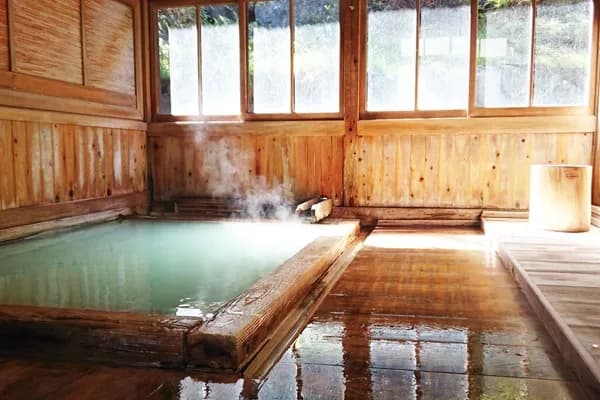
Takayu Onsen Tamagoyu
引用:高湯温泉 玉子湯 HP
Quality
Acidic - Sulfur-containing - ( Sodium ) - Sulfate Spring (Hydrogen Sulfide Type)
Temp
42℃ to 51℃
Supply
Natural Source Flow
pH
pH 2.8
pH
0714
AcidicNeutralAlkaline
Use
Stay OK/Day Trip OK
Fee
Adult 1000JPY/Child 600JPY
Hours
MonTueWedThuFriSatSunHol
11:00 - 20:0011:00 - 20:0011:00 - 20:0016:00-20:0011:00 - 20:0011:00 - 20:0011:00 - 20:0011:00 - 20:0011:00 - 20:00
View detail page

6. Okukinu Onsen Kaniyu (奥鬼怒温泉 加仁湯), Nikko, Tochigi
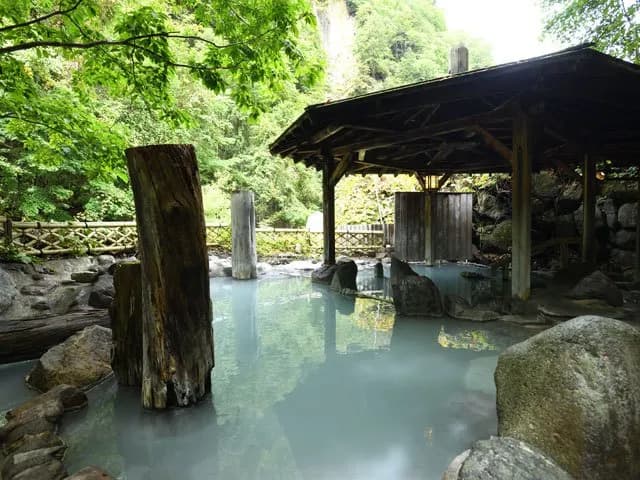
Okukinu Hot Spring Kaniyu
Okukinu Hot Spring Kaniyu - Image 1
Quality
Sulfur-containing - Sodium - Chloride - Bicarbonate Spring
Temp
---℃ to 45℃
Supply
Natural Source Flow
pH
pH 6.6
pH
0714
AcidicNeutralAlkaline
Use
Stay OK/Day Trip OK
Fee
Adult 3500JPY/Child 1000JPY
Hours
MonTueWedThuFriSatSunHol
09:00 - 21:0009:00 - 21:0009:00 - 21:0009:00 - 21:0009:00 - 21:0009:00 - 21:0009:00 - 21:0009:00 - 21:0009:00 - 21:00
View detail page

7. Takaragawa Onsen Osenkaku (宝川温泉 汪泉閣), Minakami, Gunma

Takaragawa Onsen Osenkaku, established in 1923, is a single inn nestled in the mountains of the Tanigawa mountain range, with its greatest attraction being the large-scale open-air baths scattered along the clear stream of the Takaragawa River. Beginning with "Maka-no-yu," which occupies approximately 120 tatami mats and was created in 1940, four large open-air baths have been constructed, with a combined area totaling 470 tatami mats. The milky-white water, luxuriously free-flowing at 1,800 liters per minute, carries the scent of sulfur, allowing guests to enjoy hot springs in the midst of magnificent nature. Three mixed-gender large open-air baths that can be enjoyed while wearing bathing attire, plus a women-only open-air bath, offer exceptional bathing experiences surrounded by nature's changing seasonal expressions. Dinner features colorful arrays of seasonal mountain vegetables and river fish, showcasing the flavors unique to mountain villages.
Quality
Simple Hot Spring
Temp
40℃ to 42℃
Supply
Natural Source Flow
Use
Stay OK/Day Trip OK
Fee
Adult 1500JPY/Child ---JPY
Hours
MonTueWedThuFriSatSunHol
10:00 - 16:3010:00 - 16:3010:00 - 16:3010:00 - 16:3010:00 - 16:3010:00 - 16:3010:00 - 16:3010:00 - 16:3010:00 - 16:30
View detail page

8. Manza Onsen Nisshinkan (万座温泉 日進館), Tsumagoi, Gunma
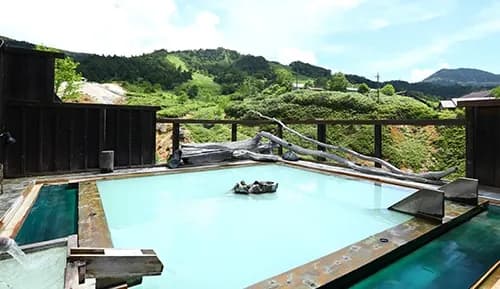
Manza Onsen Nisshinkan
Source: Manza Onsen Nisshinkan website
Manza Onsen Nisshinkan, located at an altitude of 1,800 meters, is known as the hot spring inn closest to the stars. Spring water naturally flows from within the premises, boasting an overwhelming volume of 1,800 liters per minute and 5.4 million liters per day. The spring quality is acidic sulfur spring with one of Japan's highest sulfur concentrations, characterized by milky white turbid water. The hot spring possesses all five ideal qualities: natural flow, white turbidity, high temperature, therapeutic effects, and free-flowing. There are three bathing facilities emphasizing natural wood construction, with the panoramic open-air bath "Gokuraku-no-yu" being particularly popular for its spectacular views of the Manza mountains and starry sky. The large bath "Choju-no-yu" offers six types of bathtubs including 100% pure spring water "Uba-yu," "Niga-yu" for large groups, and "Taki-yu" with waterfall massage. Meals are buffet-style for both breakfast and dinner, featuring balanced menus of over 40 Japanese, Western, and Chinese dishes emphasizing "ma-go-wa-ya-sa-shi-i" (balanced nutrition).
Quality
Acidic Sulfur Spring
Temp
40℃ to 44℃
Supply
Natural Source Flow
pH
pH 2.5
pH
0714
AcidicNeutralAlkaline
Use
Stay OK/Day Trip OK
Fee
Adult 1000JPY/Child ---JPY
Hours
MonTueWedThuFriSatSunHol
undefined - undefinedundefined - undefinedundefined - undefinedundefined - undefinedundefined - undefinedundefined - undefinedundefined - undefinedundefined - undefinedundefined - undefined
View detail page

9. Shirahone Onsen Awanoyu (白骨温泉 泡の湯), Matsumoto, Nagano
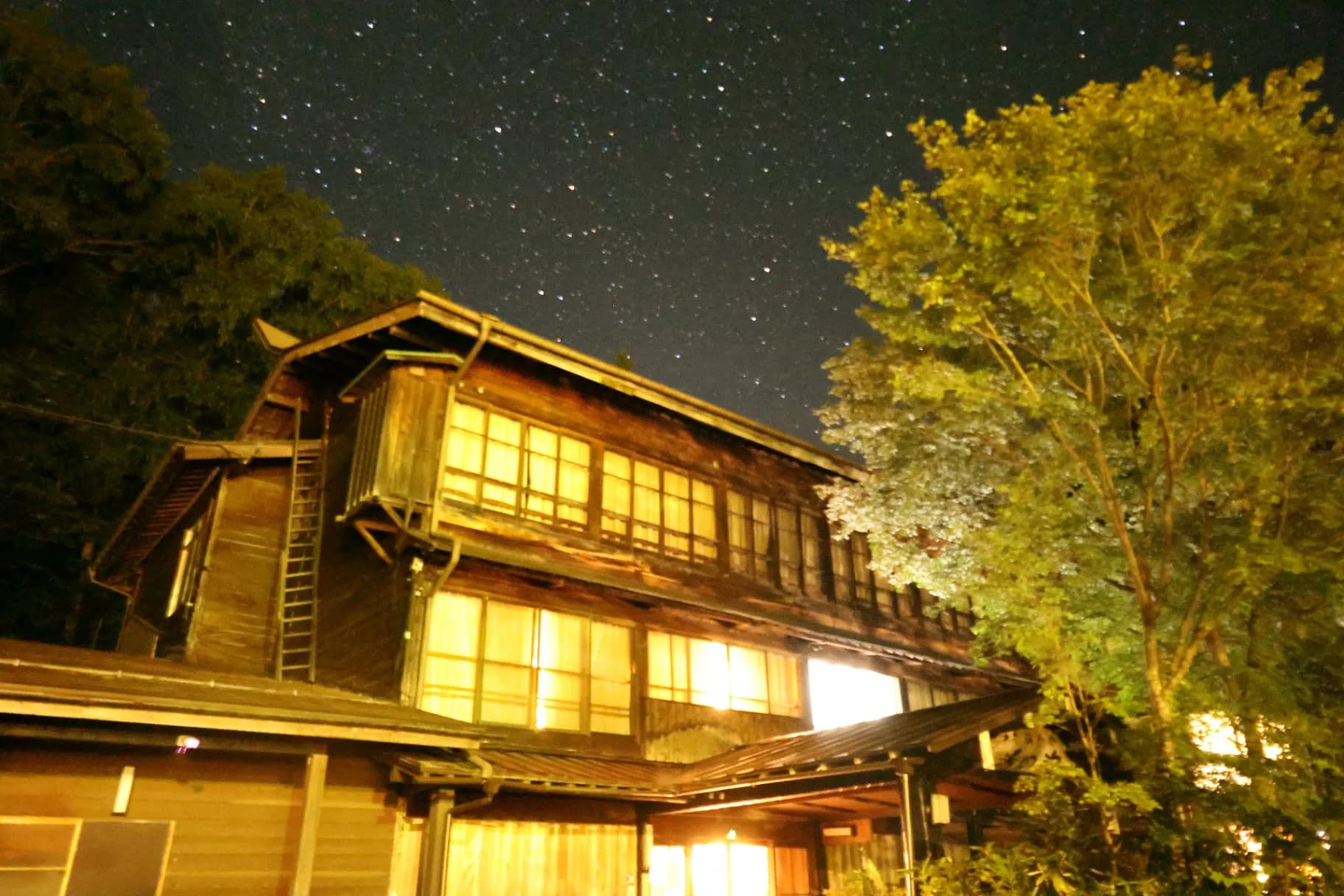
Shirahone Hot Spring Awanoyu
Shirahone Hot Spring Awanoyu - Image 1
Quality
Sulfur-containing - Calcium ( - Magnesium ) - Bicarbonate Spring (Hydrogen Sulfide Type)
Temp
37℃ to 37℃
Supply
Natural Source Flow
pH
pH 6.3
pH
0714
AcidicNeutralAlkaline
Use
Stay OK/Day Trip OK
Fee
Adult 1000JPY/Child 600JPY
Hours
MonTueWedThuFriSatSunHol
10:30 - 14:0010:30 - 14:0010:30 - 14:0010:30 - 14:0010:30 - 14:0010:30 - 14:0010:30 - 14:0010:30 - 14:0010:30 - 14:00
View detail page

10. Yarimi no Yu Yarimikan (槍見の湯 槍見館), Takayama, Gifu
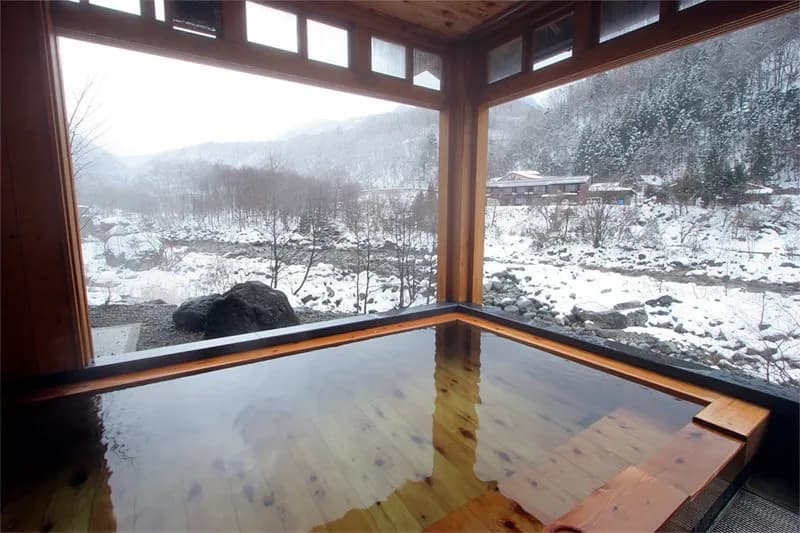
Yarimi no Yu Yarimikan
Source: Yarimi no Yu Yarimikan website
Few baths in Japan offer a view quite like this: from the rotenburo of Yarimikan, a solitary inn in Shinhotaka Onsen deep in the Okuhida hot spring villages, bathers can gaze up at the spear-like summit of Mt. Yarigatake, one of the great peaks of the Northern Japan Alps. The inn was founded in 1925, when its first owner discovered hot water welling up from the bed of the Gamata River and opened it to mountaineers and local villagers. Long known as Yarimi Onsen, 'the spring with a view of the spear,' it served for decades as both a climbing base and a therapeutic bathing retreat. The main building is a magnificent former village headman's manor, more than two centuries old, relocated and restored as a traditional folk house where an open hearth and dark timber beams welcome travelers. The inn proudly belongs to the Japan Association of Secluded Hot Spring Inns. The baths are fed by two sources, one private and one shared, delivering a simple hot spring classified as hypotonic, neutral and high-temperature, with a pH of about 6.9. The water flows directly from the source without circulation or chlorine disinfection; because it emerges hot, some tubs are tempered with added water in summer. Colorless and crystal clear, the fresh, abundant water is known for a silky, lotion-like touch that is gentle enough for long, unhurried soaks, ideal for easing legs weary from mountain trails. What sets Yarimikan apart is its remarkable collection of baths scattered along the riverbank. The signature bath is the mixed-gender open-air 'Yarimi no Yu,' which gave the inn its name; on clear days bathers can see the pointed crown of Mt. Yarigatake rising above the valley (the bath is reserved for women from 7:00 to 9:00 in the morning). There is also 'Manten no Yu,' a mixed open-air bath open around the clock and perfect for stargazing, the women-only 'Iwami no Yu,' gender-separated indoor baths, and four private-use rotenburo, including 'Banryu no Yu,' named after the monk Banryu who first climbed Yarigatake. In all, the inn counts seven open-air baths, and overnight guests may use the private baths freely whenever they are vacant. Day-trip bathing is available from 10:00 to 14:00 (last entry 13:30) for 800 yen for adults and 500 yen for elementary-age children; closures are irregular, so calling ahead is advisable. Overnight stays in the 15 guest rooms start from around 19,800 yen with two meals, featuring mountain cuisine of Hida and a beloved morning mochi-pounding ritual. Access is about 90 minutes by Nohi Bus from Takayama Station to the Nakao Kogenguchi stop, then an 8-minute walk. Early summer pairs fresh greenery with snow lingering on Yarigatake, autumn wraps the murmuring Gamata River in colored leaves, and winter brings the quiet luxury of snow-viewing baths. Combined with a ride on the nearby Shinhotaka Ropeway, Yarimikan makes an unforgettable base for savoring Okuhida's finest waters.
Quality
Simple Hot Spring
Temp
45℃ to 67℃
Supply
Natural Source Flow
Heat
Not Heated
pH
pH 6.9
pH
0714
AcidicNeutralAlkaline
Use
Stay OK/Day Trip OK
Fee
Adult 800JPY/Child 500JPY
Hours
MonTueWedThuFriSatSunHol
10:00 - 14:0010:00 - 14:0010:00 - 14:0010:00 - 14:0010:00 - 14:0010:00 - 14:0010:00 - 14:0010:00 - 14:0010:00 - 14:00
View detail page

11. Fukuji Onsen Yumoto Choza (福地温泉 湯元長座), Takayama, Gifu

Among the five hot spring villages of Okuhida in the Northern Japan Alps, Fukuji Onsen preserves the quietest mountain-hamlet atmosphere. The springs are nicknamed the Emperor's Spring, for Emperor Murakami of the Heian period is said to have recuperated in these waters, and legends of Heike clan refugees linger in the valley. The village's flagship inn is Yumoto Choza. When it opened in 1969, farmhouses more than 150 years old were dismantled in Toyama and elsewhere and reassembled across expansive grounds. A great irori hearth greets guests at the entrance, and the soaring ceilings and massive smoke-blackened beams envelop visitors in the gravitas of traditional Japanese mountain architecture. The waters are a gift of the active volcanoes Yakedake and Norikuradake. In addition to a communal source, the inn maintains several private wells, with source temperatures ranging from about 63 to 95 degrees Celsius. The springs are classified as simple hot spring and sodium bicarbonate spring, and every tub is supplied kakenagashi style, flowing straight from the source. Notably, the scalding water is never diluted; instead it is cooled by cascading through the air from wooden flumes. Bathers stay warm long after soaking, which is why locals call it atatamari-yu, the warming bath. The variety of baths is a highlight in itself. The gender-separated main bathhouse offers indoor tubs and rustic open-air baths, while the private open-air bath Sanyaso-no-yu can be reserved free of charge. There is also Shizuku-no-yu with its row of five tubs and Kawara-no-yu, an outbuilding bathhouse with basins carved from natural stone. In the evening, dinners of Hida beef, river fish, and mountain vegetables are grilled over charcoal around the hearth, embodying the inn's motto of a bath followed by drinks at the fireside. Day-trip bathing is not offered, so these baths remain the privilege of overnight guests. Rates start at around 39,600 yen for two people with dinner and breakfast. Access is easy by Nohi Bus from Takayama Station bound for Shin-Hotaka Onsen, about 70 minutes to the Fukuji Onsen-kami stop, a one-minute walk from the inn. Drivers should allow about an hour from Takayama IC, with snow tires essential in winter. Every season has its charm, but winter, when snow blankets the open-air baths and the hearth fire crackles, shows this inn at its finest.
Quality
Simple Hot Spring
Sodium - Bicarbonate Spring
Temp
40℃ to 95℃
Supply
Natural Source Flow
Heat
Not Heated
Use
Stay OK/Day Trip N/A
View detail page

Before you book

Getting there without a car

All 11 can be reached by public transport, either a scheduled bus or the inn's own shuttle. Snow delays buses, so leave slack in any connection.

  • Taenoyu: about 50 minutes by Ugo Kotsu bus from JR Tazawako Station (Akita Shinkansen)
  • Tamagoyu: about 40 minutes by Fukushima Kotsu bus from the west exit of JR Fukushima Station
  • Osenkaku: about 30 minutes on the inn's free shuttle from JR Minakami Station; reserve it in advance
  • Yumoto Choza: about 70 minutes by Nohi Bus from JR Takayama Station
  • Ryounkaku: about 45 minutes by town bus from JR Kamifurano Station, three round trips a day
  • Nisshinkan: about 40 minutes by Seibu Kanko Bus from Manza-Kazawaguchi Station on the JR Agatsuma Line

Two inns you reach by shuttle in winter

At Azumaya Ryokan, the last stretch of mountain road is unsafe from late November to April. Drivers leave the car at the free lot in Tengendai and ride the inn's shuttle; bus travellers take the Yamako bus from JR Yonezawa Station to the Shirabu Onsen terminus (about 40 minutes) and are picked up there. Only overnight guests are accepted in this period.

At Kaniyu, private cars can only go as far as the Meotobuchi parking area all year round. From there the inn's shuttle takes about 25 minutes and runs at fixed times, so confirm the schedule when you book.

If you are driving

  • Oku-Oyasukyo Oyu Onsen: Route 398 toward Ichinoseki and Hanayama closes in winter; approach from the Akita side
  • Tamagoyu: the Bandai-Azuma Skyline is closed in winter; use Prefectural Route 5 from Fukushima-Nishi IC (about 25 minutes)
  • Awanoyu: the road climbs to about 1,400 m and freezes from mid-November to early April. Carry tyre chains as well as winter tyres and aim to arrive before 17:00
  • Ryounkaku: roads are snow- and ice-covered from early November to late May and can close in blizzards
  • Yarimikan: the inn asks guests to use winter (studless) tyres

Days when the outdoor bath is closed

  • Ryounkaku states that the outdoor bath can be too cool to use on some winter days
  • Tamagoyu changes outdoor-bath hours on days when snow is cleared from the roofs
  • At Yumoto Choza, as of October 2026, the rock section of the large outdoor bath is out of use because of a problem with the shared spring source. The separate riverside bath, Kawara no Yu, is the one facing the snowfield

Tattoos

None of these inns publishes a clear tattoo policy in English. Ask when you book rather than at check-in. If you have visible tattoos, a private bath (kashikiri) is the simplest workaround where one is offered; check each detail page.

Mixed bathing and swimwear

Japanese baths are normally separated by gender and entered naked, but several inns here keep konyoku (混浴) mixed baths. At Osenkaku, the mixed outdoor baths Maka no Yu and Kodakara no Yu are entered wearing a bathing gown provided by the inn, and there is a women-only outdoor bath, Maya no Yu. At Awanoyu, the large mixed outdoor bath has a separate entrance for women. Azumaya Ryokan is mostly mixed but sets women-only hours. Taenoyu, Abe Ryokan, Kaniyu and Yarimikan also have mixed baths; rules on towels and gowns differ, so check each detail page.

Cash

According to this site's records, Taenoyu, Azumaya Ryokan, Kaniyu and Awanoyu do not accept credit cards. ATMs are scarce in the mountains, so bring enough yen.

Day visits

Azumaya Ryokan and Yumoto Choza do not take day bathers. Azumaya accepts only overnight guests in winter, so you need to stay to use its snow bath.

More guides by prefecture

  • Hokkaido https://www.tan-ken.com/en/blog/lau9w8gyw2ws
  • Akita https://www.tan-ken.com/en/blog/lfr1_7ywj5
  • Yamagata https://www.tan-ken.com/en/blog/ds2y_mqv3
  • Fukushima https://www.tan-ken.com/en/blog/8fzlg2vi08fu
  • Tochigi https://www.tan-ken.com/en/blog/1sor55vhq66i
  • Gunma https://www.tan-ken.com/en/blog/ztslg16f7onk
  • Nagano https://www.tan-ken.com/en/blog/1asu9knjv5
  • Gifu https://www.tan-ken.com/en/blog/txqxuturj

Four of these inns (Tamagoyu, Kaniyu, Nisshinkan and Awanoyu) also appear in our guide to milky-white onsen: https://www.tan-ken.com/en/blog/ooj8-5665m51

FAQ

Q. When is the best time for a snow onsen in Japan?

January and February. Yarimikan's snow season is given as mid-December to late March and Azumaya Ryokan's as December to around April, but early and late winter depend on the year.

Q. Can I reach a snow onsen without renting a car?

Yes. Osenkaku runs a free shuttle from JR Minakami Station (reservation required), Tamagoyu is a 40-minute bus ride from JR Fukushima Station, and Taenoyu is 50 minutes by bus from JR Tazawako Station. Azumaya Ryokan and Kaniyu, which private cars cannot reach in winter, are reached by the inns' own shuttles.

Q. I don't want to bathe naked with strangers. Which inn suits me?

Osenkaku, where the mixed baths are entered in a bathing gown and there is a women-only outdoor bath. Awanoyu has a women's entrance into its mixed bath, and Azumaya Ryokan sets women-only hours.

Q. Do I need to book?

Yes for the shuttles: Osenkaku's station shuttle needs a reservation, and Azumaya Ryokan and Kaniyu are only practical in winter as overnight stays with the inn's transfer.

Q. Can snow close the outdoor bath?

Yes. Ryounkaku's outdoor bath can be too cool to use on some winter days, and Tamagoyu changes bath hours when roofs are being cleared. Phone the inn before setting out if the outdoor bath is the reason for your trip.

The information in this article (admission fees, operating hours, water quality data, winter road closures, etc.) is based on research conducted at the time of writing. Details may have changed or contain errors. Please verify the latest information on each facility's official website or through the local tourism association.
Recommended Hot Springs

Popular hot springs from Hitou Map

HomeMapSearchBlogMy Page