Nishiho-Maruyama Hike: 4.7 km via the Shinhotaka Ropeway

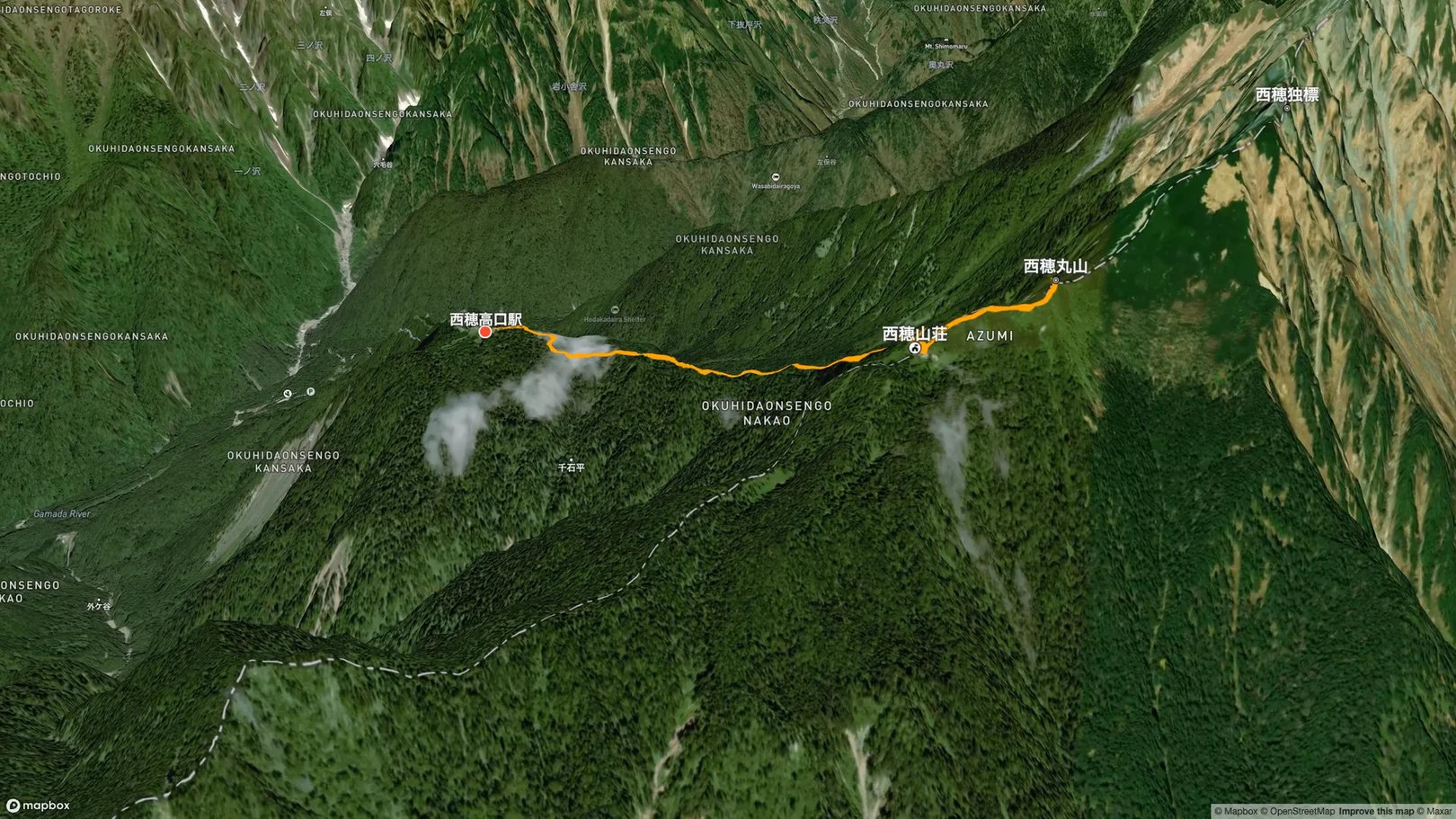
Route map from Nishihotakaguchi Station via Nishiho Sanso to Nishiho-Maruyama and back

On Sunday, October 19, 2025, I rode the Shinhotaka Ropeway in Takayama, Gifu, up to Nishihotakaguchi Station (2,156 m), then hiked past Nishiho Sanso hut to Nishiho-Maruyama (2,452 m) and back. The walk came to about 4.7 km and took about 3 h 15 min, breaks included. It was a misty, drizzly morning, but halfway up on the second ropeway we broke through the mist and came out above the clouds! At Nishiho-Maruyama, clouds filled the valleys, and on the way back we stopped at Nishiho Sanso for a bowl of shoyu ramen.

I didn't stop at an onsen this time, so at the end I've listed day-use hot springs you can drive to from Shinhotaka Onsen Station, along with places to stay nearby.

Route Data

Item

Record

Date

Sunday, October 19, 2025

Distance

approx. 4.7 km (excluding the ropeway)

Total time

approx. 3 h 15 min (incl. breaks)

Elevation gain

approx. +360 m

High point

approx. 2,450 m (Nishiho-Maruyama)

Route

Nishihotakaguchi Sta. → Nishiho Sanso → Nishiho-Maruyama (out and back) → Nishiho Sanso → Nishihotakaguchi Sta.

Here is how it broke down. These numbers come from my own YAMAP record, so treat them as a rough guide.

Section

Distance

Time

Nishihotakaguchi Sta. → Nishiho Sanso

approx. 1.8 km

approx. 50 min

Nishiho Sanso → Nishiho-Maruyama

approx. 0.4 km

approx. 20 min

Nishiho-Maruyama (stop)

approx. 20 min

Nishiho-Maruyama → Nishiho Sanso

approx. 0.4 km

approx. 25 min

Nishiho Sanso (lunch)

approx. 20 min

Nishiho Sanso → Nishihotakaguchi Sta.

approx. 2.0 km

approx. 1 h

You go up and come back down on the same trail. The elevation gain stays small because the ropeway lifts you straight to Nishihotakaguchi Station at 2,156 m.

Access & Parking

You reach Nishihotakaguchi Station by changing between the two Shinhotaka Ropeway lines. Take the 1st ropeway from Shinhotaka Onsen Station to Nabedaira Kogen Station, walk a short way to Shirakabadaira Station (1,308 m), and ride the 2nd ropeway up to Nishihotakaguchi Station.

For parking, there are paid lots at Shinhotaka Onsen (approx. 160 cars) and Nabedaira Kogen (approx. 550 cars), among others.

The adult round-trip fare between Shinhotaka Onsen and Nishihotakaguchi is ¥3,800. Note that this is the figure on the official website as of October 2026, not what the fare was when I rode it in October 2025. Extra cars apparently run when it's busy, and priority boarding for the uphill ride costs ¥300 per person.

Clothing & Gear

The morning was drizzly. From Nishihotakaguchi Station to Nishiho Sanso, the trail climbs through a mossy conifer forest, and past the hut it becomes a ridge of rock and creeping pine.

Up to Nishiho-Maruyama, I think the route is beginner-friendly. That said, this is my impression from walking it in October with no snow on the ground. Beyond Nishiho-Maruyama, the trail toward Nishiho-Doppyo and Mt. Nishihotaka turns rocky, so plan for your gear and experience.

Hike Log

Up by the Shinhotaka Ropeway (1st and 2nd ropeways)

In the drizzle, we took the 1st ropeway from Shinhotaka Onsen Station and walked over to Shirakabadaira Station. According to the official website, the 2nd ropeway runs Japan's only double-decker gondolas.
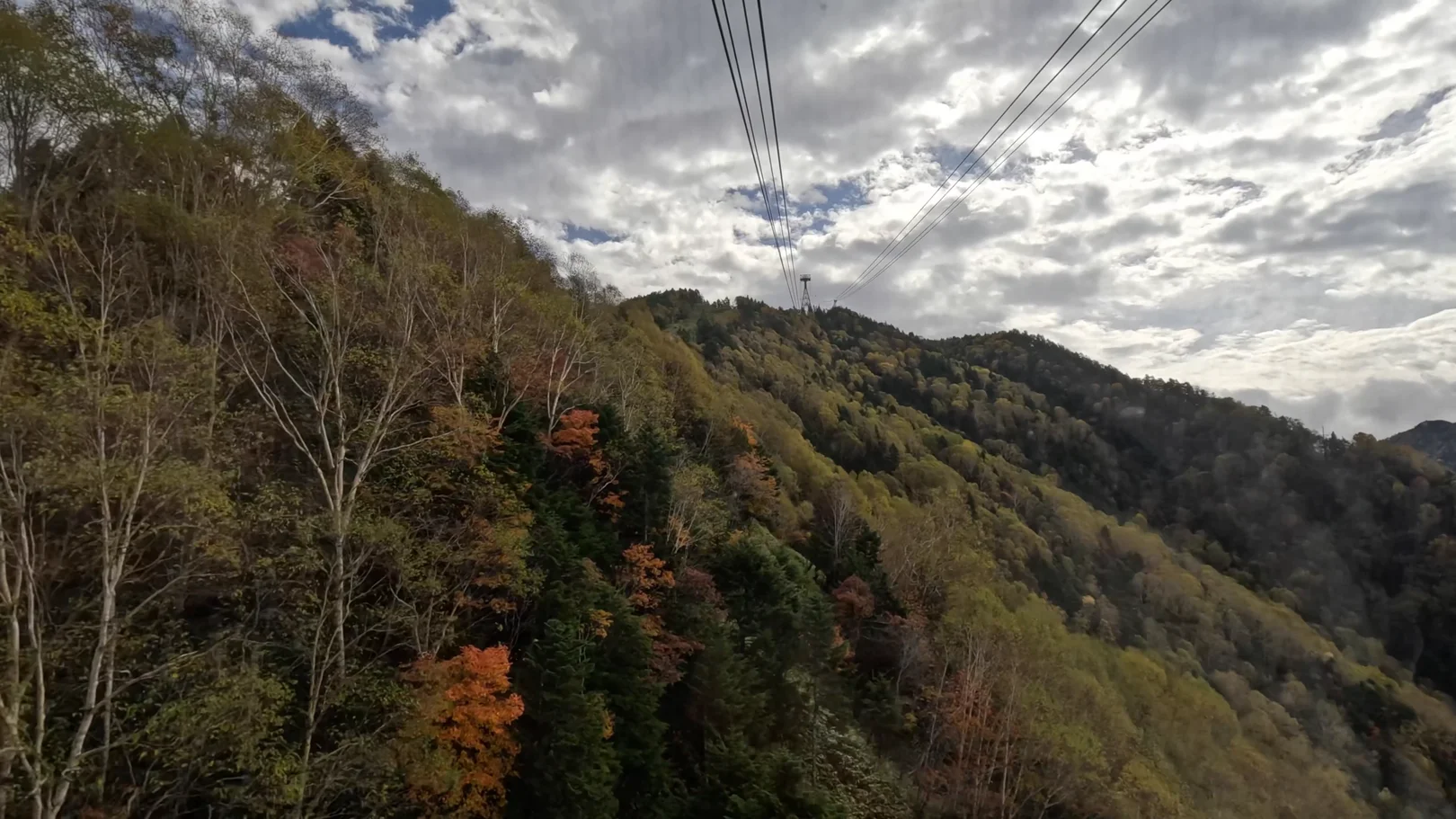
View from a 2nd Shinhotaka Ropeway gondola of slopes starting to turn autumn colours, with the cable

Partway up, we broke through the mist and found ourselves above the clouds!

Nishihotakaguchi Station sits at 2,156 m. The station roof is an observation deck with a 360° view of the Northern Alps.

Nishihotakaguchi Sta. → Nishiho Sanso (approx. 1.8 km, approx. 50 min)

I set off from Nishihotakaguchi Station around 10:42 a.m. Near the station, a rocky ridge rises beyond trees in yellow leaf.
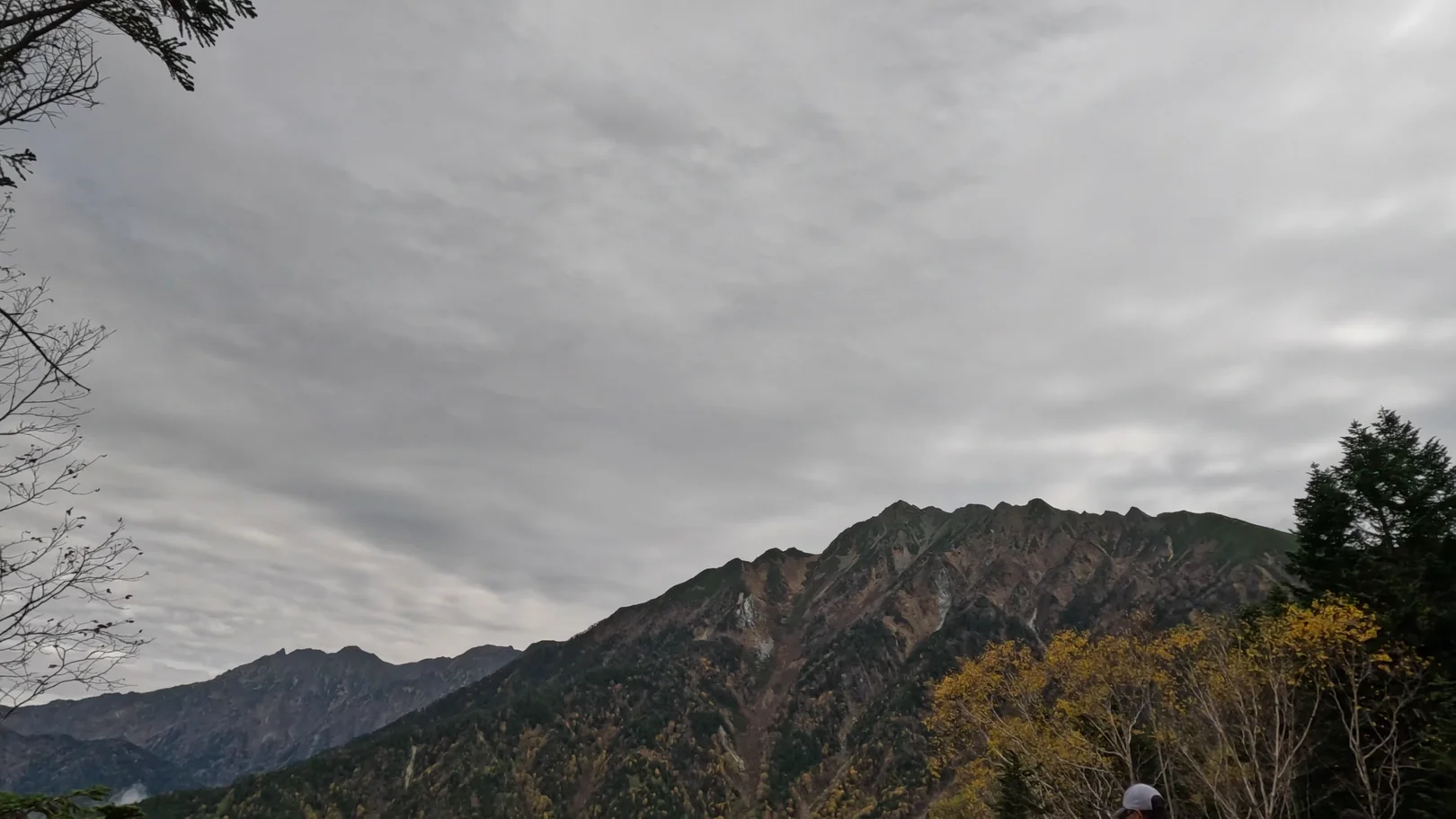
Rocky ridge seen beyond yellow autumn trees near Nishihotakaguchi Station

The hiking trail starts here. For a while the elevation barely changes, and the climbing comes in the second half. The path was covered in fallen leaves.
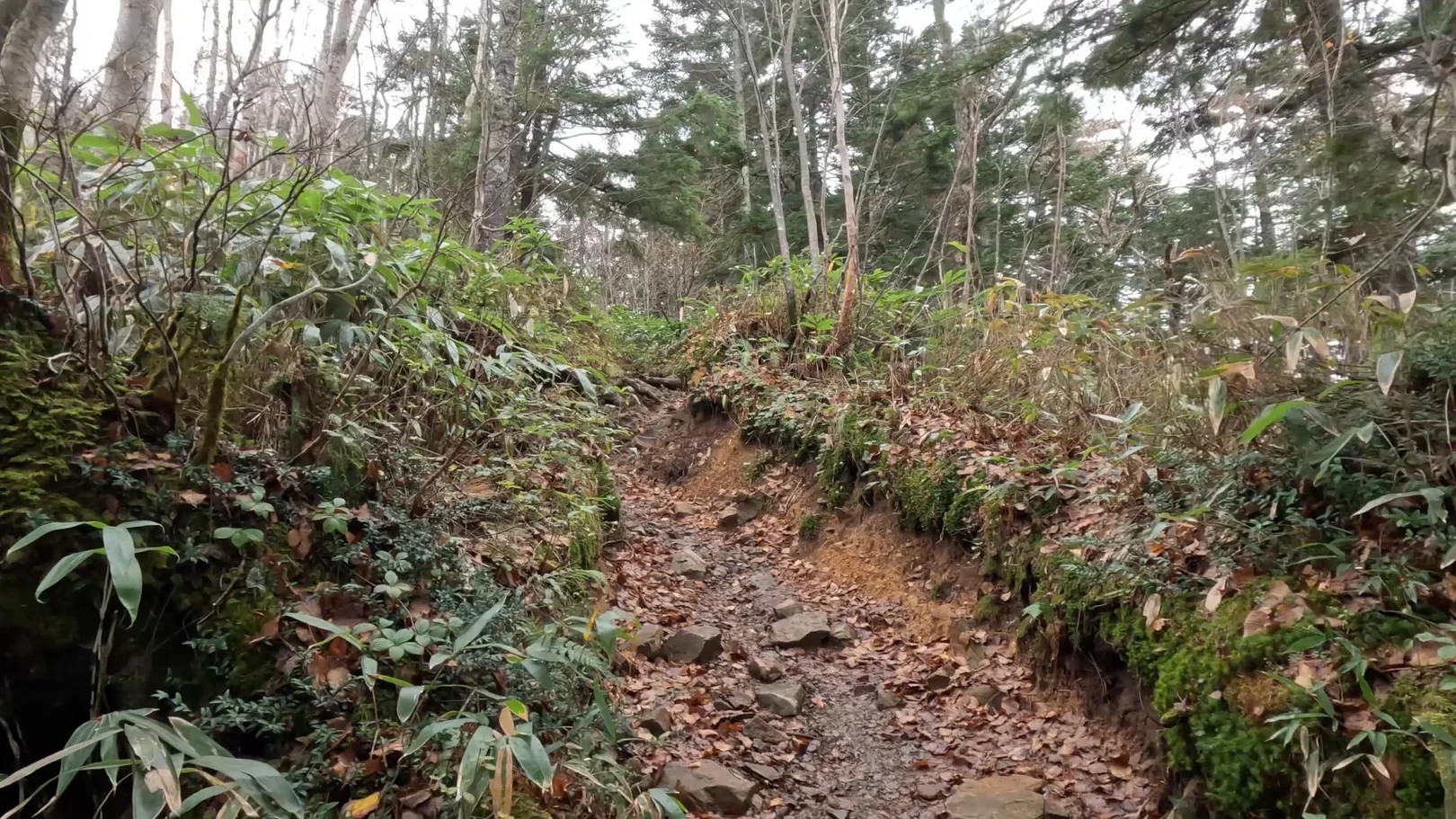
Leaf-covered forest trail between Nishihotakaguchi Station and Nishiho Sanso

The trail climbs through a mossy conifer forest, weaving between moss-covered rocks and bamboo grass.
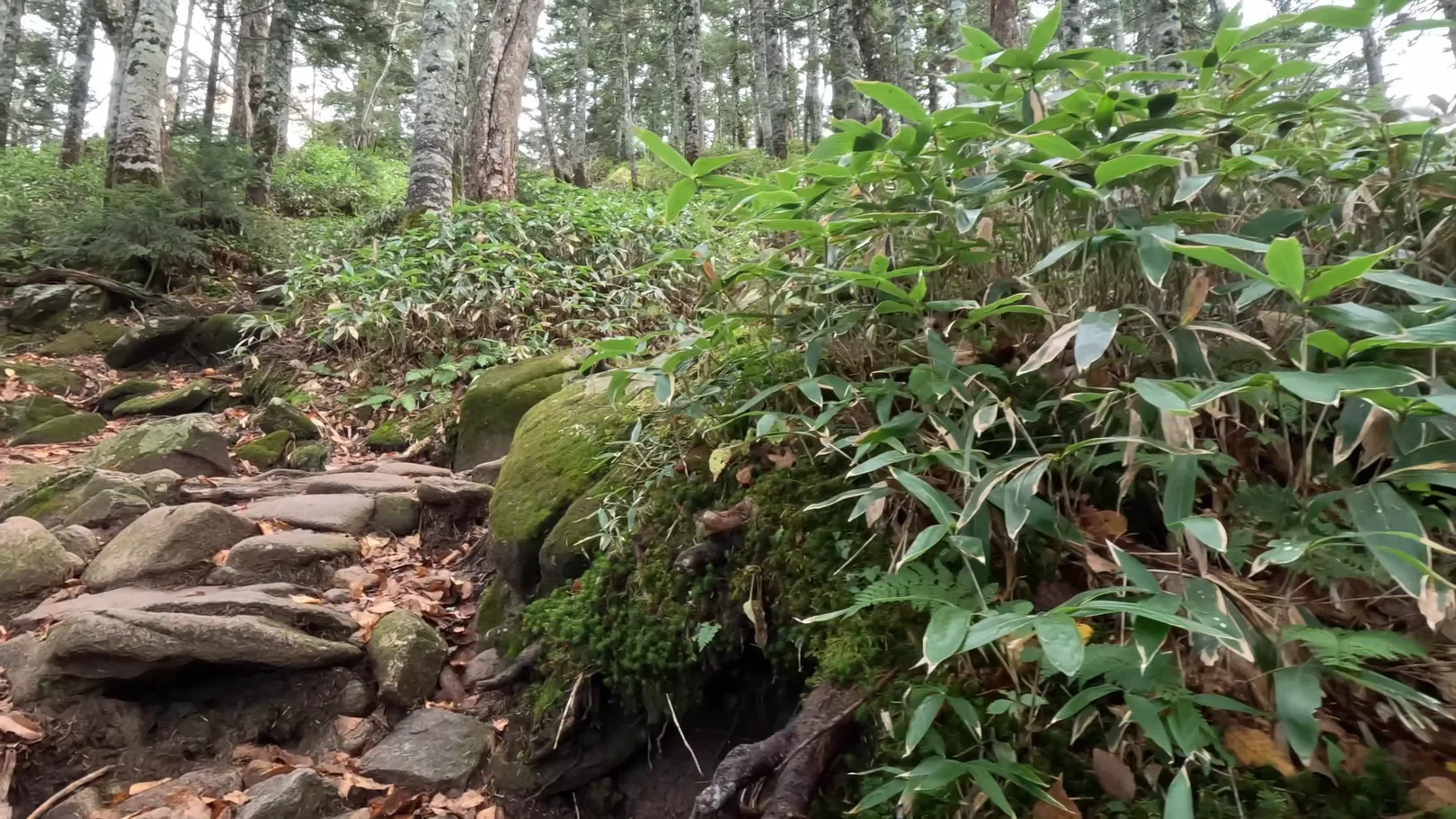
Trail with moss-covered rocks and bamboo grass on the way to Nishiho Sanso

Through the trees I could see autumn-tinted slopes, and clouds had pooled in the valleys.

Before long Nishiho Sanso came into view, and I reached it around 11:32 a.m. The hut stands at 2,367 m and is the only year-round mountain hut in the southern Northern Alps.

By the way, the hut's official website gives 1 h 30 min on foot from the ropeway. It took me about 50 minutes, but I'd leave yourself some margin when planning.

Nishiho Sanso → Nishiho-Maruyama (approx. 0.4 km, approx. 20 min)

The trail forks above the hut, and you head on toward Maruyama. Out of the forest, you step onto a ridge of rock and creeping pine.
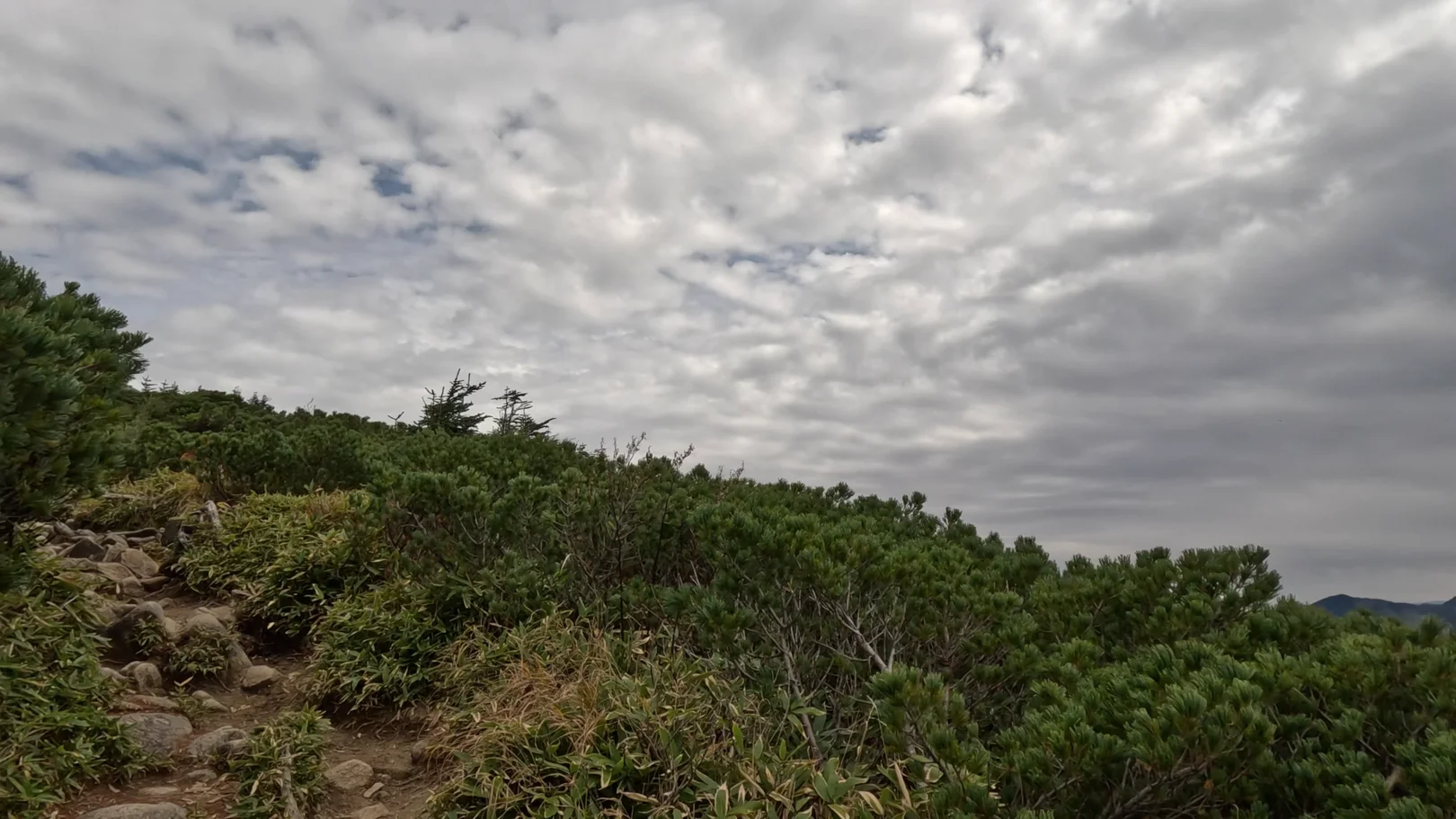
Creeping-pine ridge trail and sky between Nishiho Sanso and Nishiho-Maruyama

Up on the ridge, there was a sea of clouds below, with mist rising from the valley.
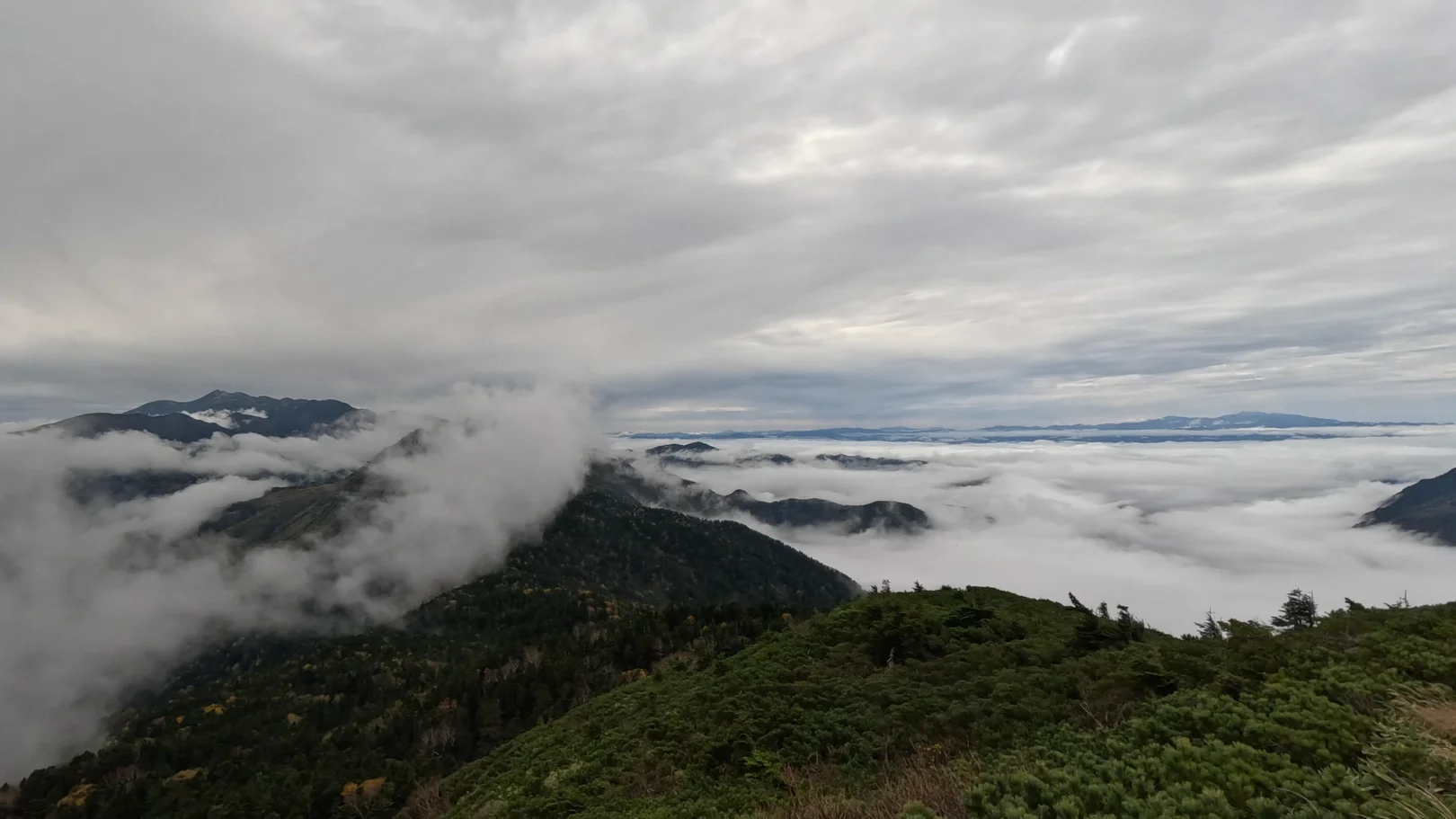
Sea of clouds and mist rising from the valley, seen from the ridge toward Nishiho-Maruyama

Beyond the creeping pine, green mountains carried on into the distance.
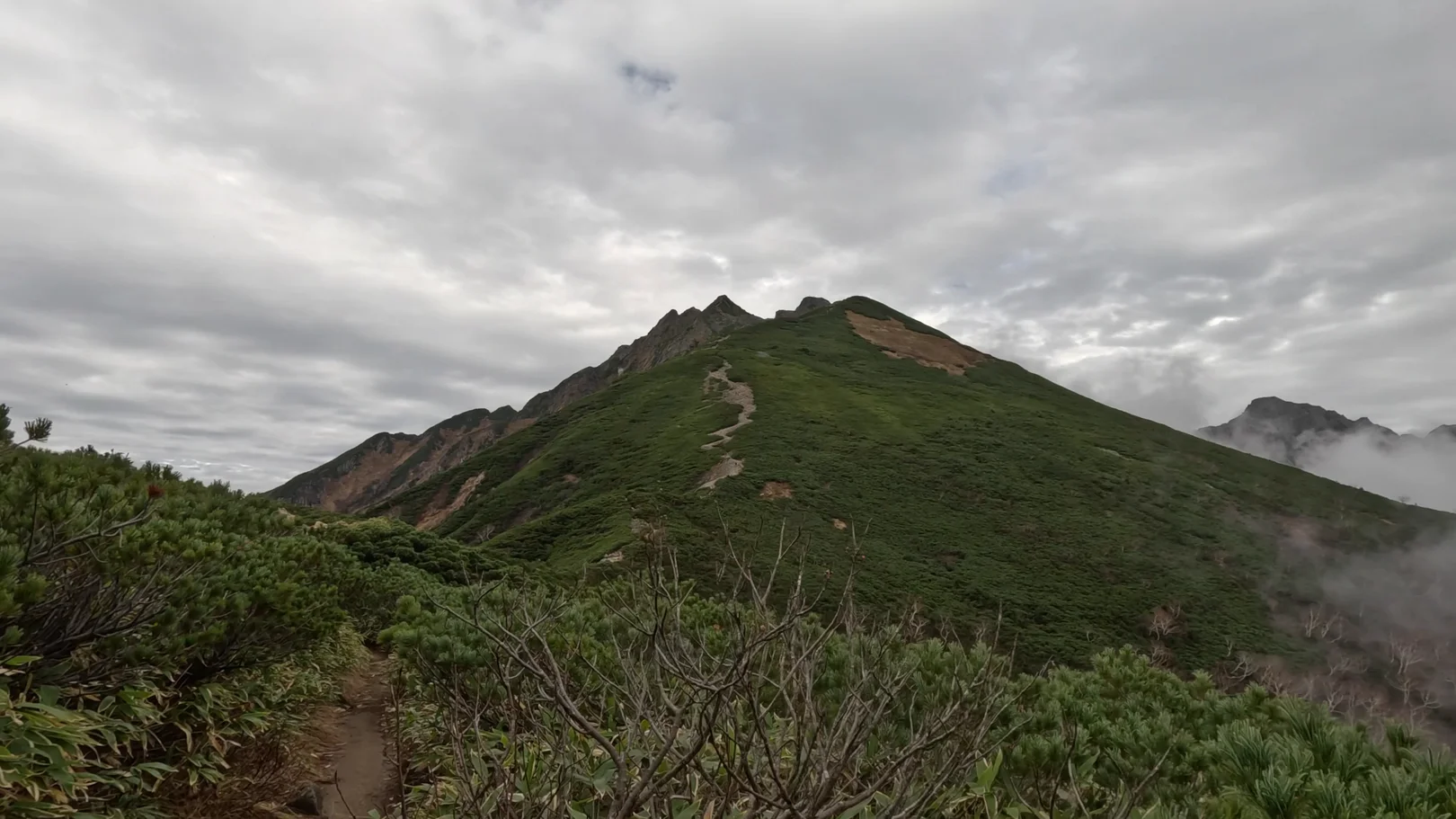
Creeping-pine ridge toward Nishiho-Maruyama with a green mountain beyond

I reached Nishiho-Maruyama around 11:52 a.m. The hut's official website puts it about 15 minutes from the hut, while the ropeway's site says about 30 minutes. This time it took me about 20.

Summit of Nishiho-Maruyama (2,452 m, approx. 20 min stop)

Nishiho-Maruyama stands at 2,452 m. Clouds filled the valleys, with ranges of mountains stretching beyond.
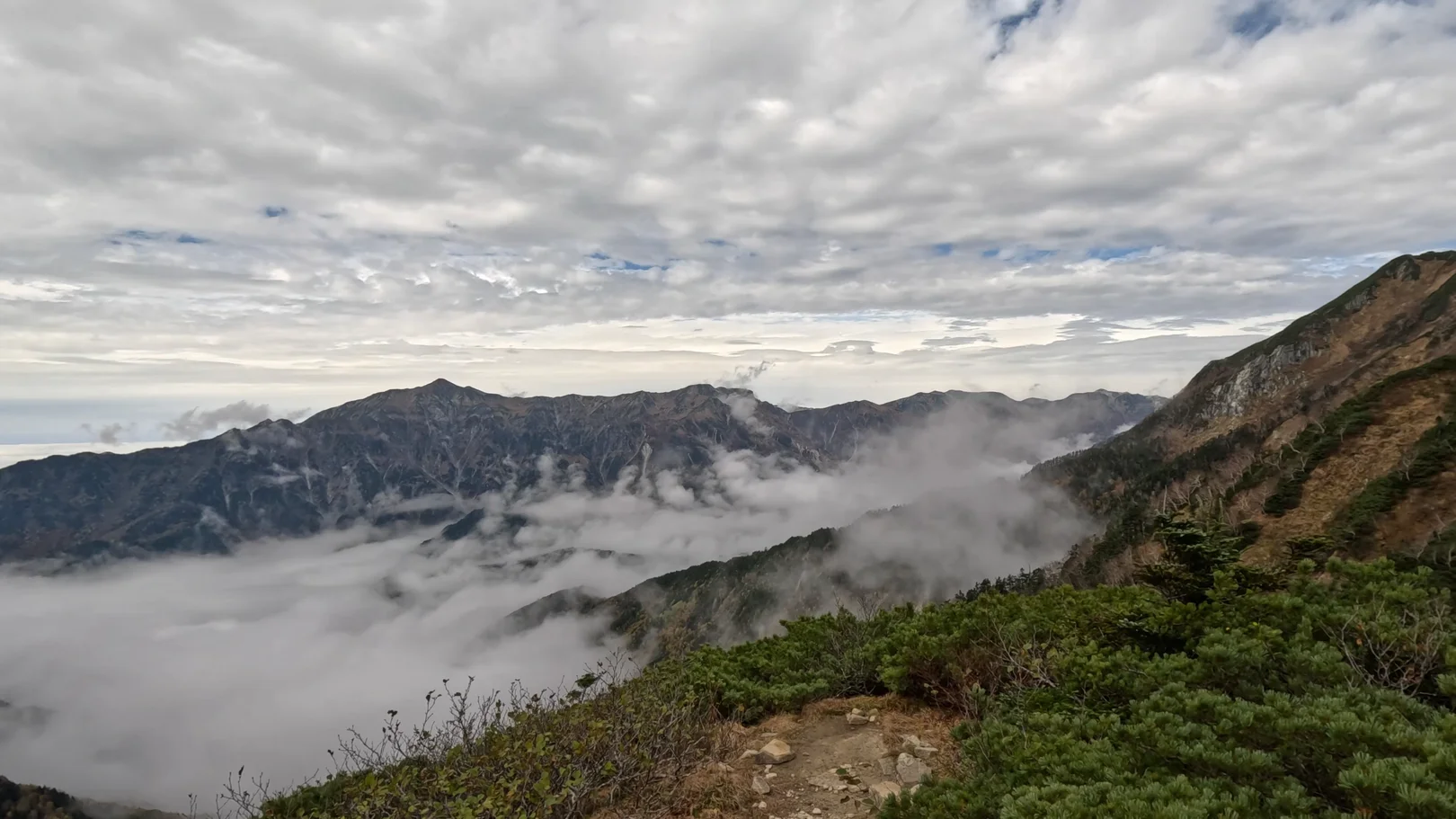
Clouds filling the valleys below Nishiho-Maruyama, with mountain ranges beyond

Ahead, the ridge climbs on toward Nishiho-Doppyo. This was our turnaround point. While we were there, a helicopter flew past with a sling load.

Nishiho-Maruyama → Nishiho Sanso (approx. 0.4 km, approx. 25 min)

On the way down, Kamikochi lay far below. To the left was Mt. Kasumizawa, Mt. Norikura in the distance, and Mt. Yake on the right.
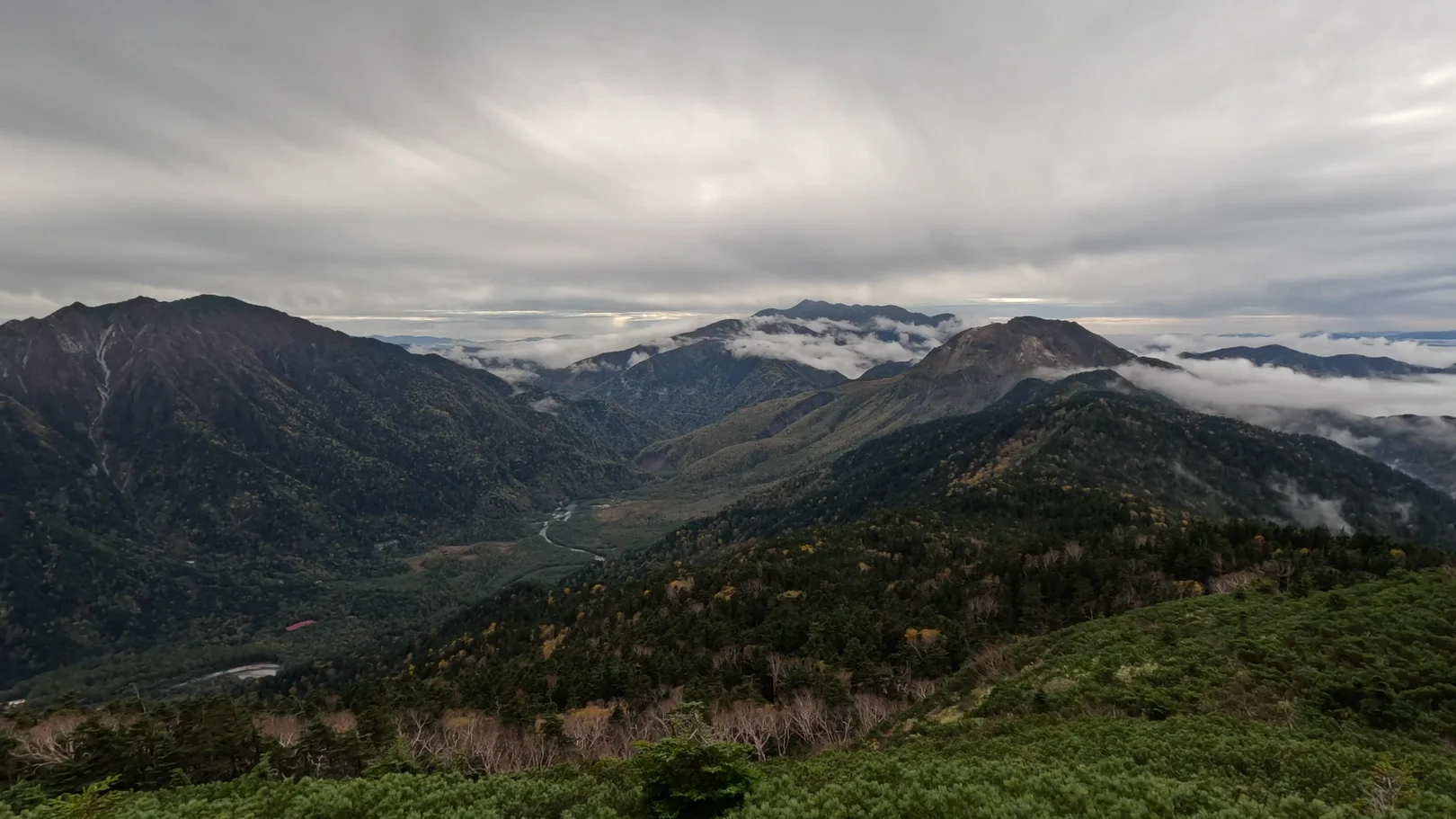
Valley and river far below on the descent from Nishiho-Maruyama, with mountains beyond

Peaks floated like islands in a sea of clouds.
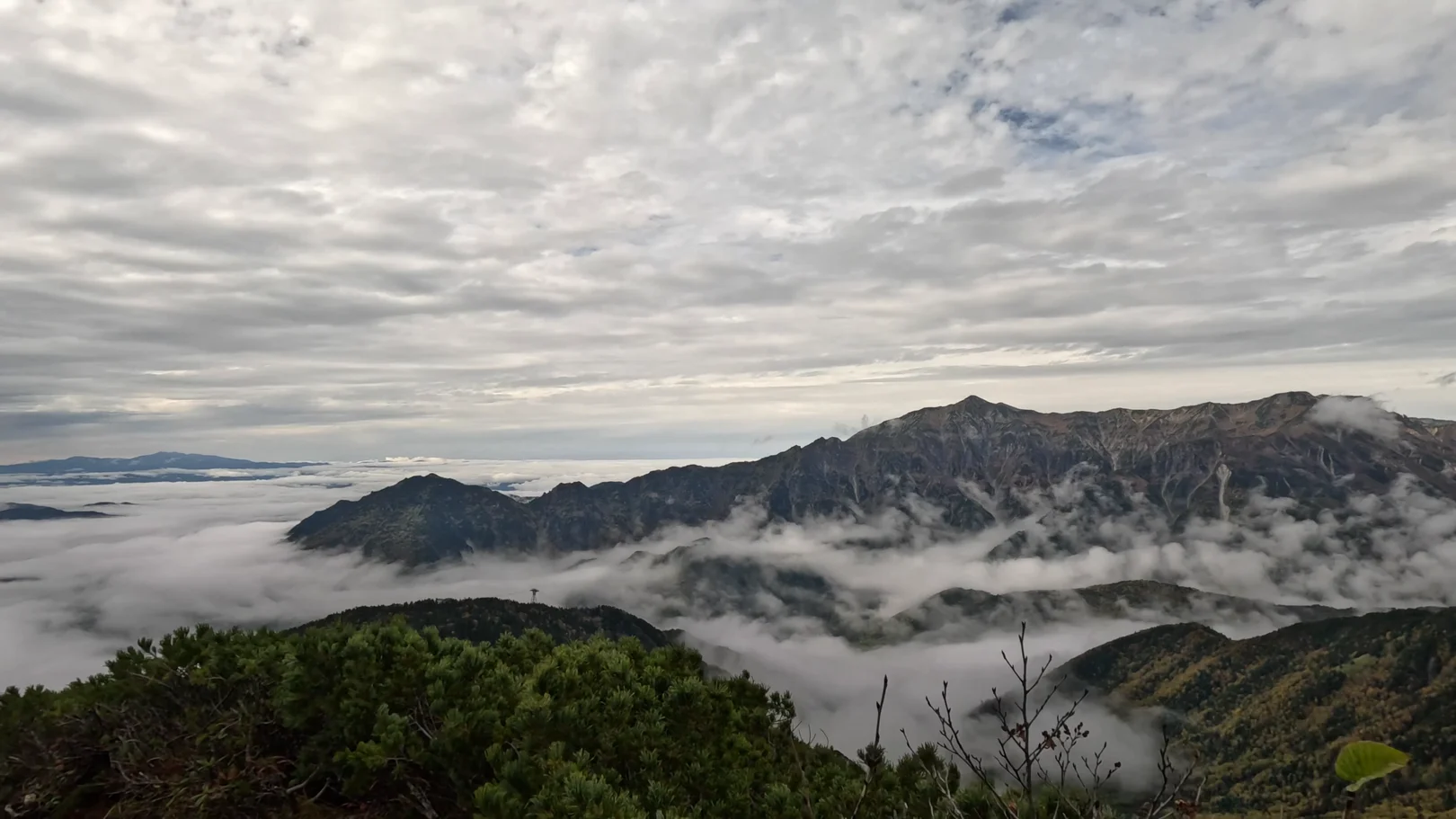
Mountains floating in a sea of clouds on the way down to Nishiho Sanso

Looking down, the red roof of Nishiho Sanso came into view.
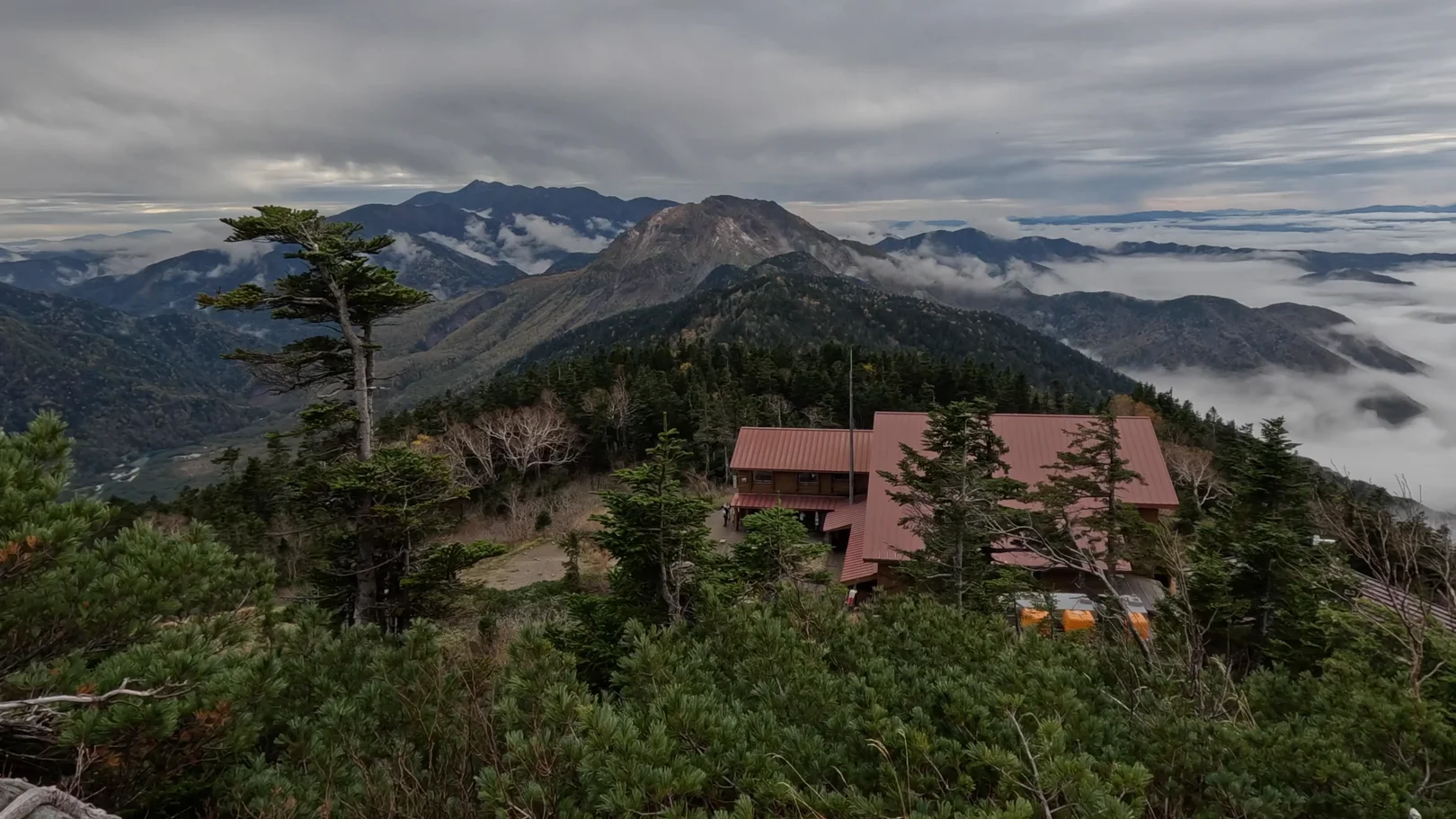
Red roof of Nishiho Sanso seen from above on the descent, with mountains behind

We were back at Nishiho Sanso around 12:34 p.m. and stopped there for lunch: shoyu ramen. After a break of about 20 minutes, we left the hut around 12:54 p.m.

Nishiho Sanso → Nishihotakaguchi Sta. (approx. 2.0 km, approx. 1 h)

The way back follows the same trail. Beyond the mist, a rust-red ridge came into view.
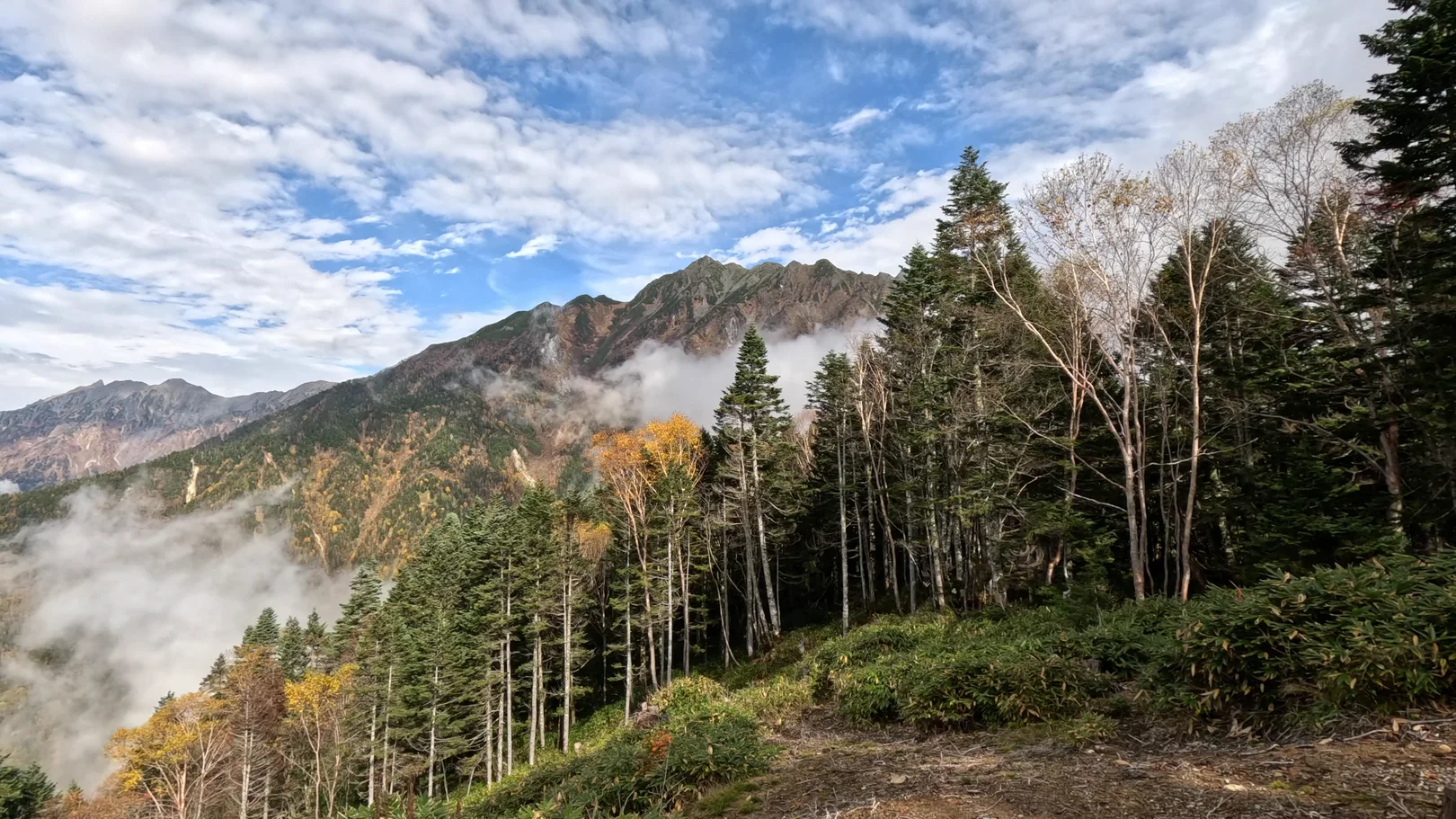
Yellow leaves and blue sky near Nishihotakaguchi Station, with mist over a rocky ridge

We were back at Nishihotakaguchi Station around 1:57 p.m., completing 4.7 km in about 3 h 15 min.

On the ride down, the gondola sank back into the clouds, with autumn colours on the slopes below.
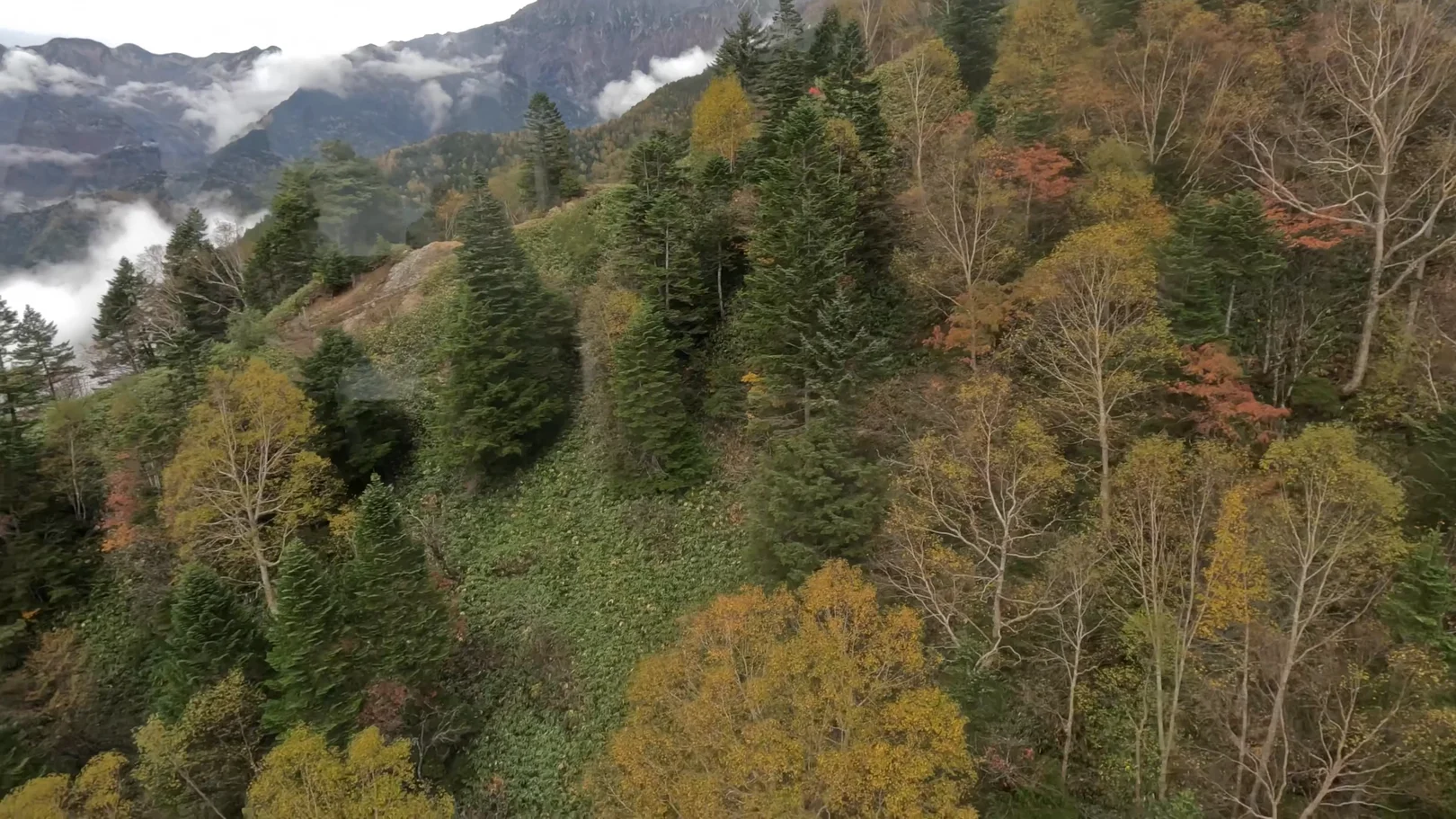
Autumn forest seen from a gondola on the way down the Shinhotaka Ropeway

Onsen After the Hike

A hot spring is a great way to end a hike! I didn't stop at one this time, so here are day-use onsen you can drive to from Shinhotaka Onsen Station, where the ropeway starts. Driving times come from a map route search on November 8, 2026, and are approximate.

Onsen

Drive from Shinhotaka Onsen Sta.

Options

Okuhida Hot Spring Kojin-no-Yu

approx. 10 min

Day visit

Hirayu Hot Spring Hirayu no Yu

approx. 20 min

Day visit

Shinhotaka Onsen Shinhotaka-no-Yu

approx. 5 min

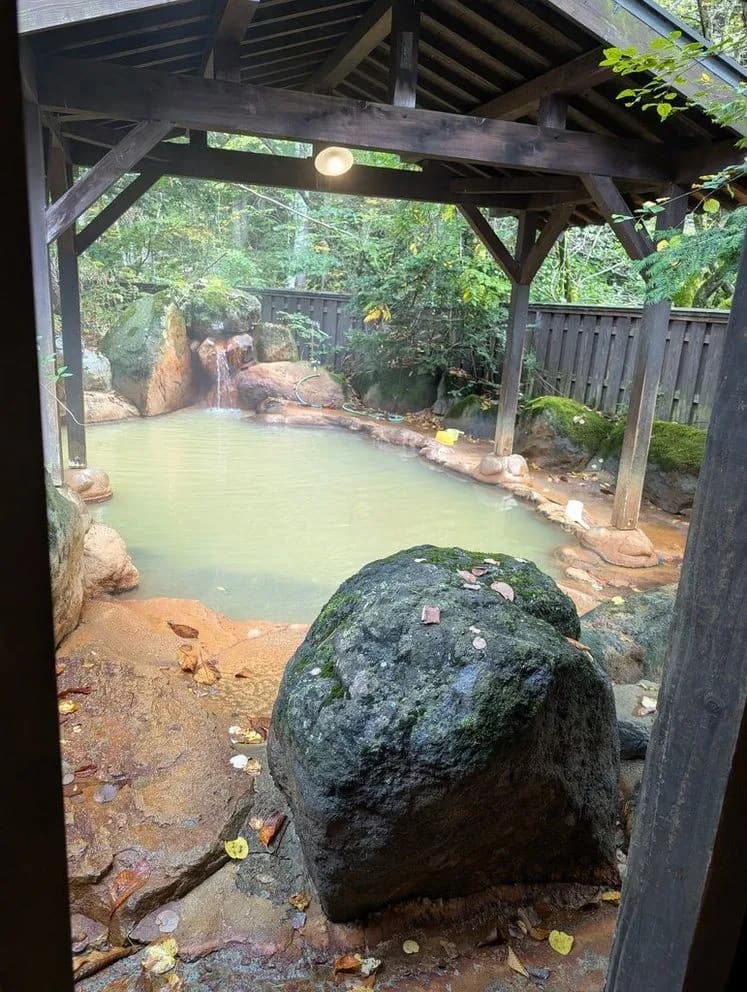
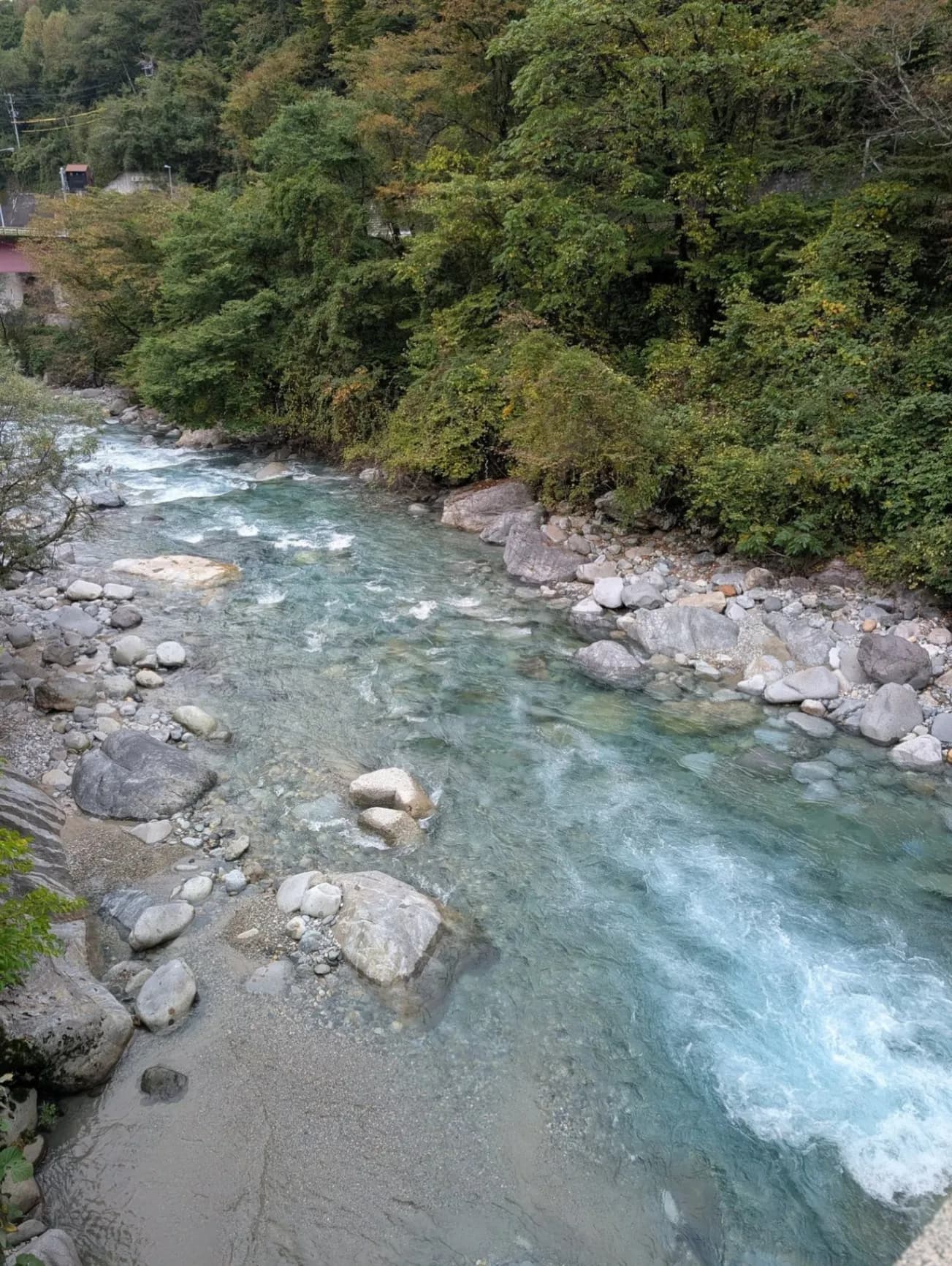
Day visit, riverside open-air bath, closed in winter (seasonal)

Shinhotaka-no-Yu is open seasonally and closed through the winter.

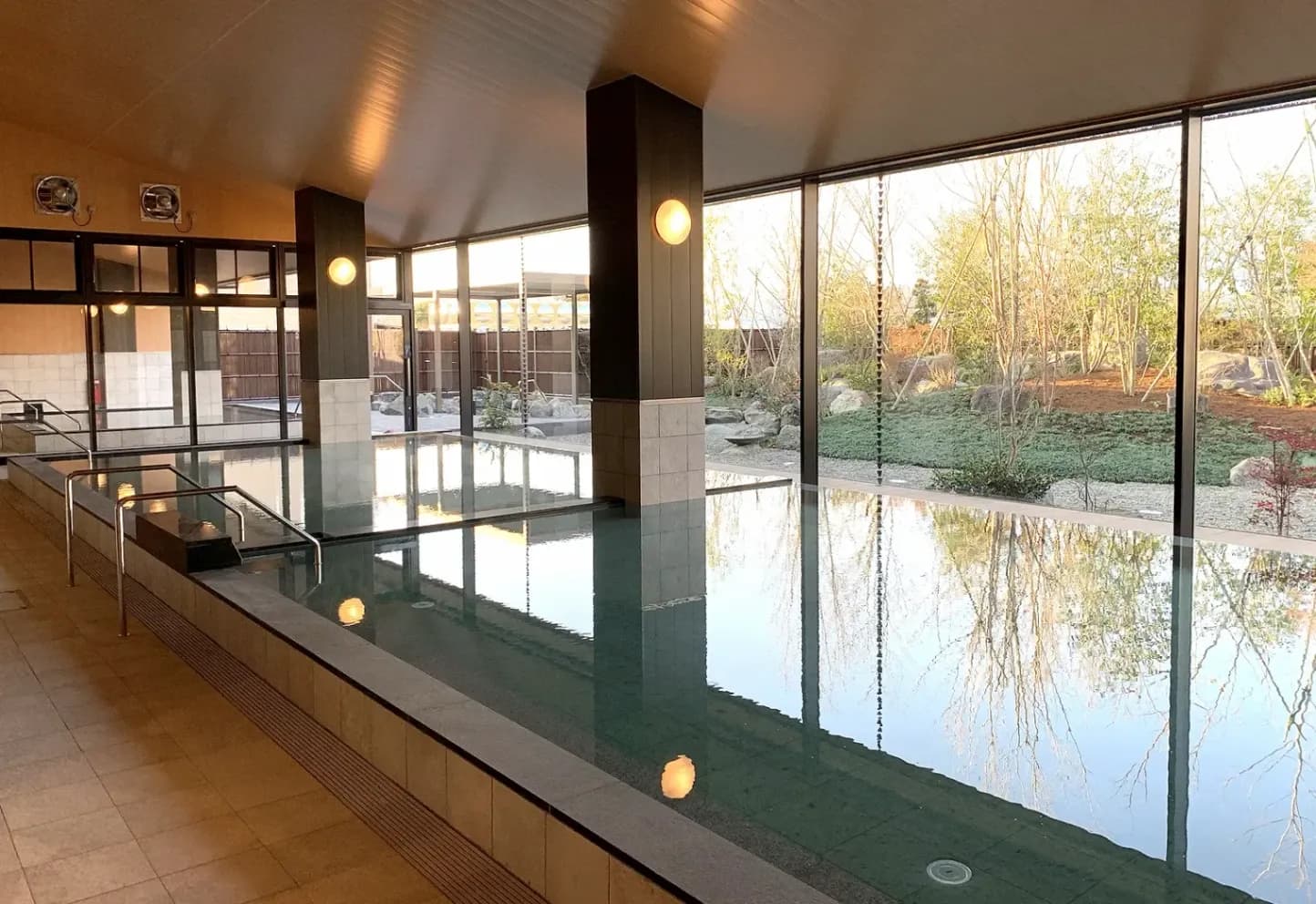
Okuhida Hot Spring Kojin-no-Yu
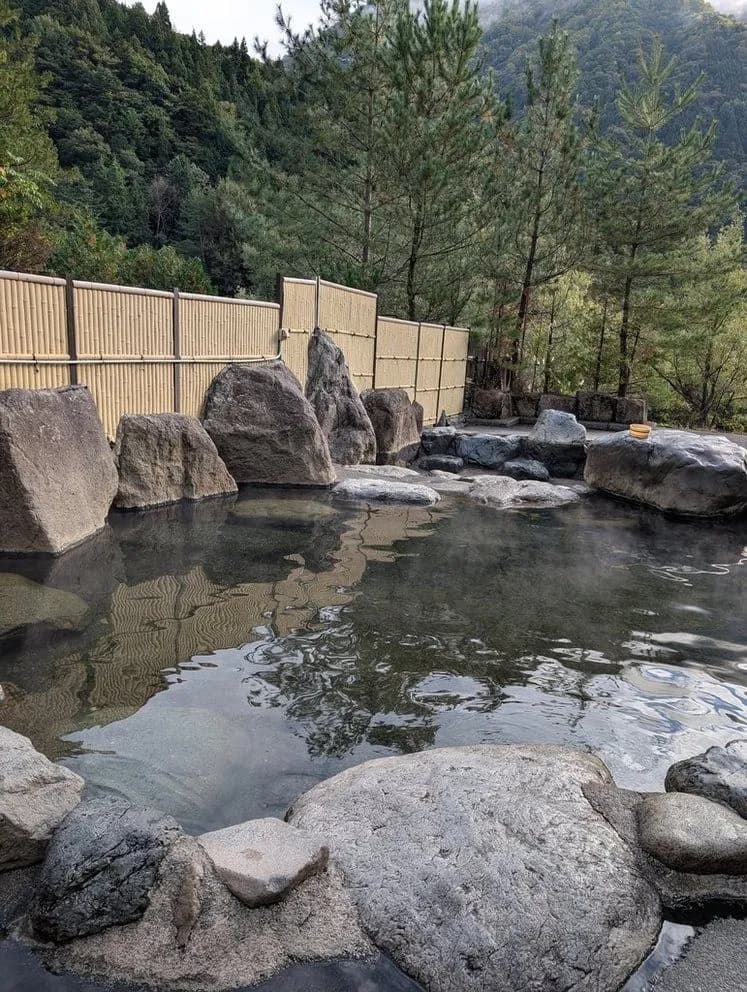
Okuhida Hot Spring Kojin-no-Yu
Okuhida Hot Spring Kojin-no-Yu - Image 5
Quality
Simple Hot Spring
Temp
---℃ to 69℃
Supply
Natural Source Flow
pH
pH 7.2
pH
0714
AcidicNeutralAlkaline
Use
Stay N/A/Day Trip OK
Fee
Adult 300JPY/Child 300JPY
Hours
MonTueWedThuFriSatSunHol
05:00 - 22:0005:00 - 22:0005:00 - 22:0005:00 - 22:0005:00 - 22:0005:00 - 22:0005:00 - 22:0005:00 - 22:0005:00 - 22:00
View detail page

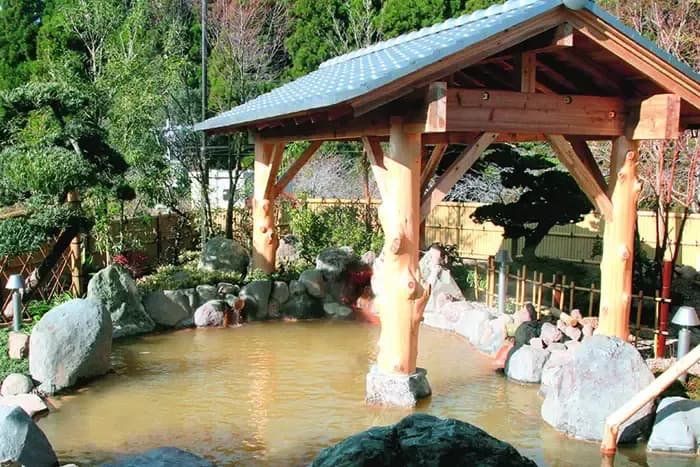
Hirayu Hot Spring Hirayu no Yu

Hirayu Hot Spring Hirayu no Yu
Hirayu Hot Spring Hirayu no Yu - Image 1
Quality
Simple Hot Spring
Temp
---℃ to 47℃
Supply
Natural Source Flow
pH
pH 6.2
pH
0714
AcidicNeutralAlkaline
Use
Stay N/A/Day Trip OK
Fee
Adult 300JPY/Child 300JPY
Hours
MonTueWedThuFriSatSunHol
07:00 - 21:0007:00 - 21:0007:00 - 21:0007:00 - 21:0007:00 - 21:0007:00 - 21:0007:00 - 21:0007:00 - 21:0007:00 - 21:00
View detail page

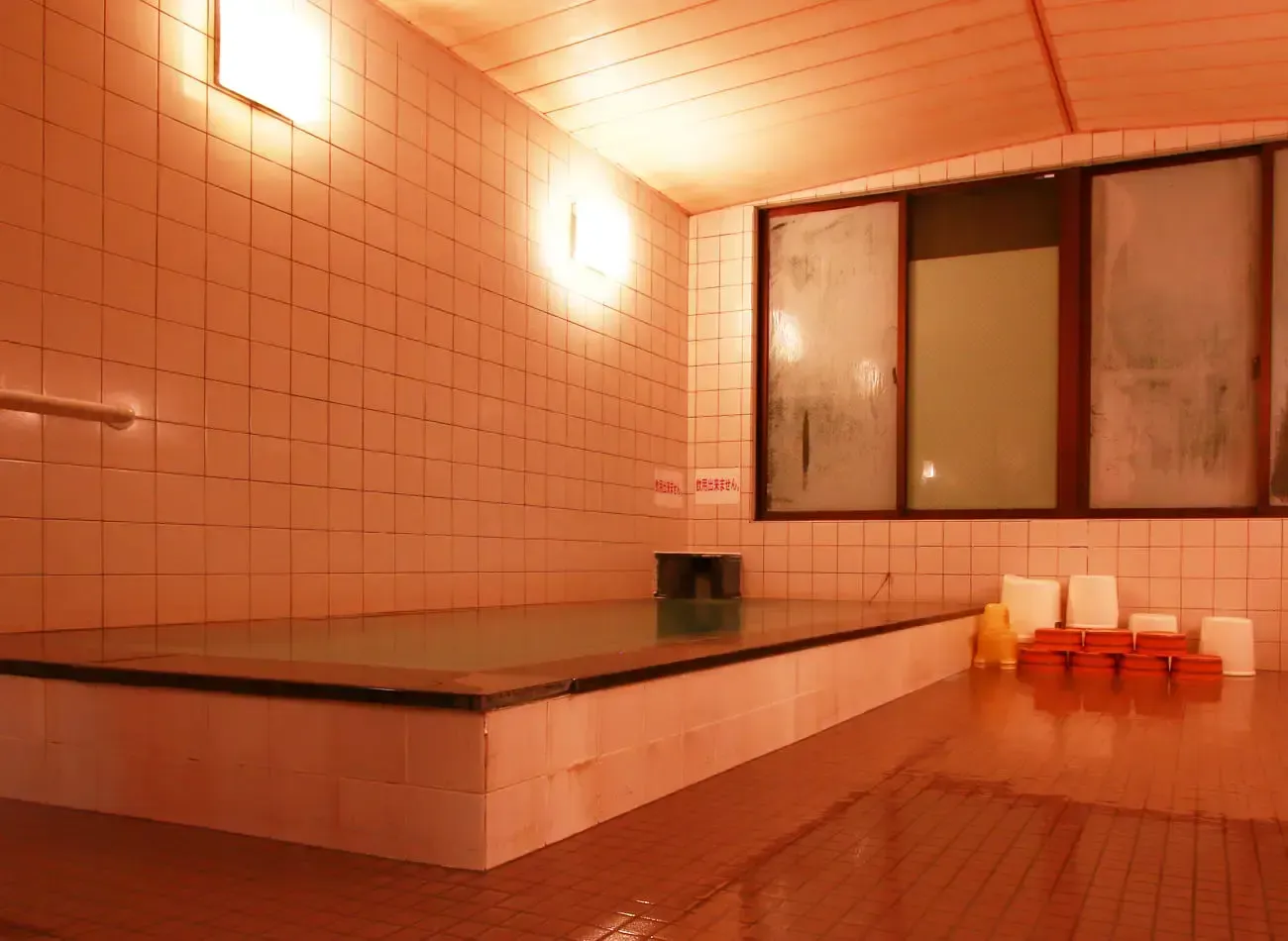
Shinhotaka Onsen Shinhotaka-no-Yu

Shinhotaka Onsen Shinhotaka-no-Yu
Shinhotaka Onsen Shinhotaka-no-Yu - Image 1
Quality
Simple Hot Spring
Temp
38℃ to 61℃
Supply
Natural Source Flow
pH
pH 7
pH
0714
AcidicNeutralAlkaline
Use
Stay N/A/Day Trip OK
Fee
Adult 300JPY/Child 300JPY
Hours
MonTueWedThuFriSatSunHol
08:00 - 18:0008:00 - 18:0008:00 - 18:0008:00 - 18:0008:00 - 18:0008:00 - 18:0008:00 - 18:0008:00 - 18:0008:00 - 18:00
View detail page

Where to Stay Nearby

These work for a night before catching an early ropeway, or for taking it easy after the hike. Driving times are from Shinhotaka Onsen Station and are approximate.

Place

Drive from Shinhotaka Onsen Sta.

Options

Yarimi no Yu Yarimikan

approx. 5 min

Overnight

Shinhotaka Onsen Nonohana Sanso

approx. 5 min

Overnight

Fukuji Onsen Yamazato no Iori Soene

approx. 15 min

Overnight

Fujiya Farmhouse Inn (Shinhirayu Onsen)

approx. 15 min

Overnight

Fukuji Onsen Yumoto Choza

approx. 15 min

Overnight only

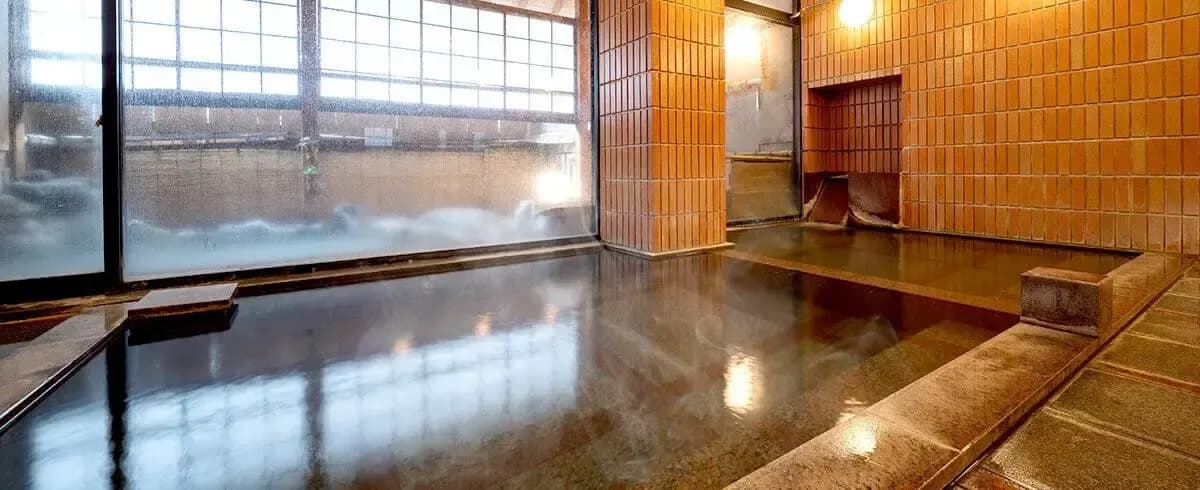
Yarimi no Yu Yarimikan

Yarimi no Yu Yarimikan
Source: Yarimi no Yu Yarimikan website
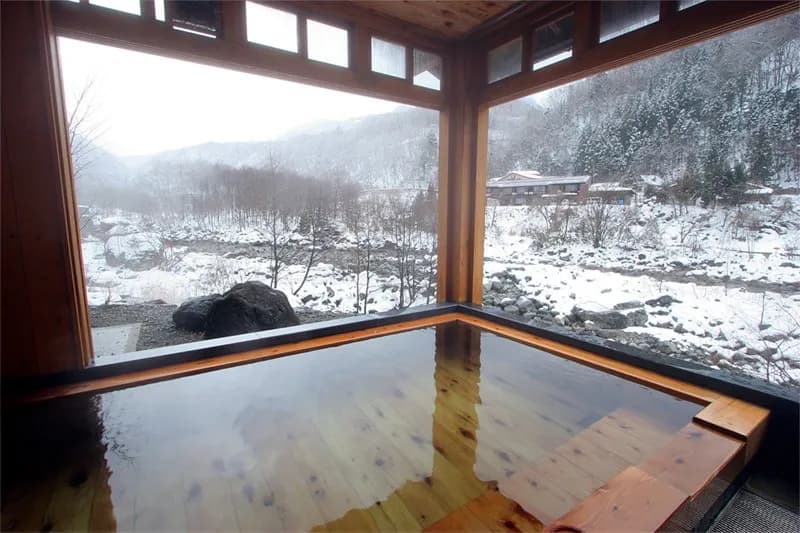
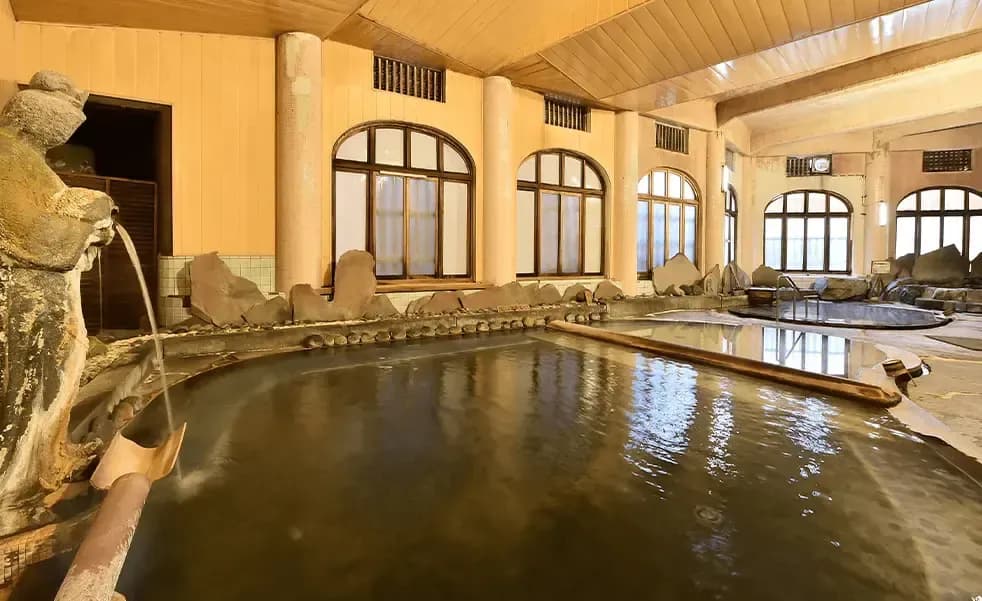
Few baths in Japan offer a view quite like this: from the rotenburo of Yarimikan, a solitary inn in Shinhotaka Onsen deep in the Okuhida hot spring villages, bathers can gaze up at the spear-like summit of Mt. Yarigatake, one of the great peaks of the Northern Japan Alps. The inn was founded in 1925, when its first owner discovered hot water welling up from the bed of the Gamata River and opened it to mountaineers and local villagers. Long known as Yarimi Onsen, 'the spring with a view of the spear,' it served for decades as both a climbing base and a therapeutic bathing retreat. The main building is a magnificent former village headman's manor, more than two centuries old, relocated and restored as a traditional folk house where an open hearth and dark timber beams welcome travelers. The inn proudly belongs to the Japan Association of Secluded Hot Spring Inns. The baths are fed by two sources, one private and one shared, delivering a simple hot spring classified as hypotonic, neutral and high-temperature, with a pH of about 6.9. The water flows directly from the source without circulation or chlorine disinfection; because it emerges hot, some tubs are tempered with added water in summer. Colorless and crystal clear, the fresh, abundant water is known for a silky, lotion-like touch that is gentle enough for long, unhurried soaks, ideal for easing legs weary from mountain trails. What sets Yarimikan apart is its remarkable collection of baths scattered along the riverbank. The signature bath is the mixed-gender open-air 'Yarimi no Yu,' which gave the inn its name; on clear days bathers can see the pointed crown of Mt. Yarigatake rising above the valley (the bath is reserved for women from 7:00 to 9:00 in the morning). There is also 'Manten no Yu,' a mixed open-air bath open around the clock and perfect for stargazing, the women-only 'Iwami no Yu,' gender-separated indoor baths, and four private-use rotenburo, including 'Banryu no Yu,' named after the monk Banryu who first climbed Yarigatake. In all, the inn counts seven open-air baths, and overnight guests may use the private baths freely whenever they are vacant. Day-trip bathing is available from 10:00 to 14:00 (last entry 13:30) for 800 yen for adults and 500 yen for elementary-age children; closures are irregular, so calling ahead is advisable. Overnight stays in the 15 guest rooms start from around 19,800 yen with two meals, featuring mountain cuisine of Hida and a beloved morning mochi-pounding ritual. Access is about 90 minutes by Nohi Bus from Takayama Station to the Nakao Kogenguchi stop, then an 8-minute walk. Early summer pairs fresh greenery with snow lingering on Yarigatake, autumn wraps the murmuring Gamata River in colored leaves, and winter brings the quiet luxury of snow-viewing baths. Combined with a ride on the nearby Shinhotaka Ropeway, Yarimikan makes an unforgettable base for savoring Okuhida's finest waters.
Quality
Simple Hot Spring
Temp
45℃ to 67℃
Supply
Natural Source Flow
Heat
Not Heated
pH
pH 6.9
pH
0714
AcidicNeutralAlkaline
Use
Stay OK/Day Trip OK
Fee
Adult 800JPY/Child 500JPY
Hours
MonTueWedThuFriSatSunHol
10:00 - 14:0010:00 - 14:0010:00 - 14:0010:00 - 14:0010:00 - 14:0010:00 - 14:0010:00 - 14:0010:00 - 14:0010:00 - 14:00
View detail page

Shinhotaka Onsen Nonohana Sanso

Shinhotaka Onsen Nonohana Sanso
Source: Shinhotaka Onsen Nonohana Sanso website
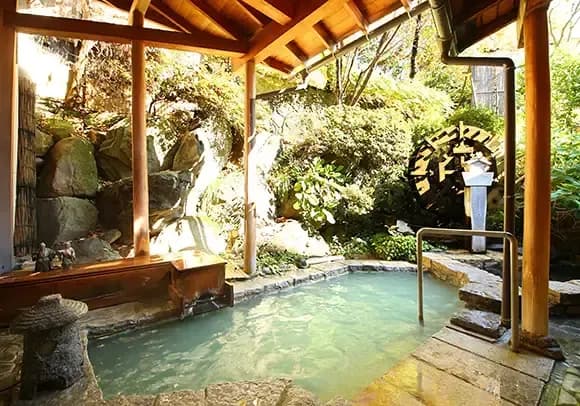
Nonohana Sanso is a secluded hot spring inn nestled at the foot of Mt. Shakujo in the Northern Japanese Alps, within the Chubu Sangaku National Park. Standing at approximately 1,050 meters above sea level, this modern mountain lodge sits on a vast 12,000-tsubo (approximately 40,000 square meters) property surrounded by pristine nature. The inn is a proud member of the Japan Association of Secluded Hot Spring Inns (Nihon Hitou wo Mamoru Kai). Shinhotaka Onsen has a long history dating back to the Sengoku period, when retainers of the feudal lord Takeda Shingen are said to have bathed in its waters. The area developed as a base for Northern Alps mountaineering during the postwar climbing boom. Nonohana Sanso features its own private hot spring source at approximately 80 degrees Celsius, cooled through a heat exchanger to provide 100% free-flowing natural hot spring water. The water is a simple hot spring (neutral hypotonic high-temperature spring) with clear, colorless, and odorless qualities. The facility offers separate indoor and outdoor baths for men and women, plus two private open-air baths with magnificent views of Mt. Shakujo.
Quality
Simple Hot Spring
Temp
40℃ to 45℃
Supply
Natural Source Flow
pH
pH 7
pH
0714
AcidicNeutralAlkaline
Use
Stay OK/Day Trip OK
Fee
Adult 1000JPY/Child 500JPY
Hours
MonTueWedThuFriSatSunHol
10:00 - 19:0010:00 - 19:00ClosedClosed10:00 - 19:0010:00 - 19:0010:00 - 19:0010:00 - 19:0010:00 - 19:00
View detail page

Fukuji Onsen Yamazato no Iori Soene

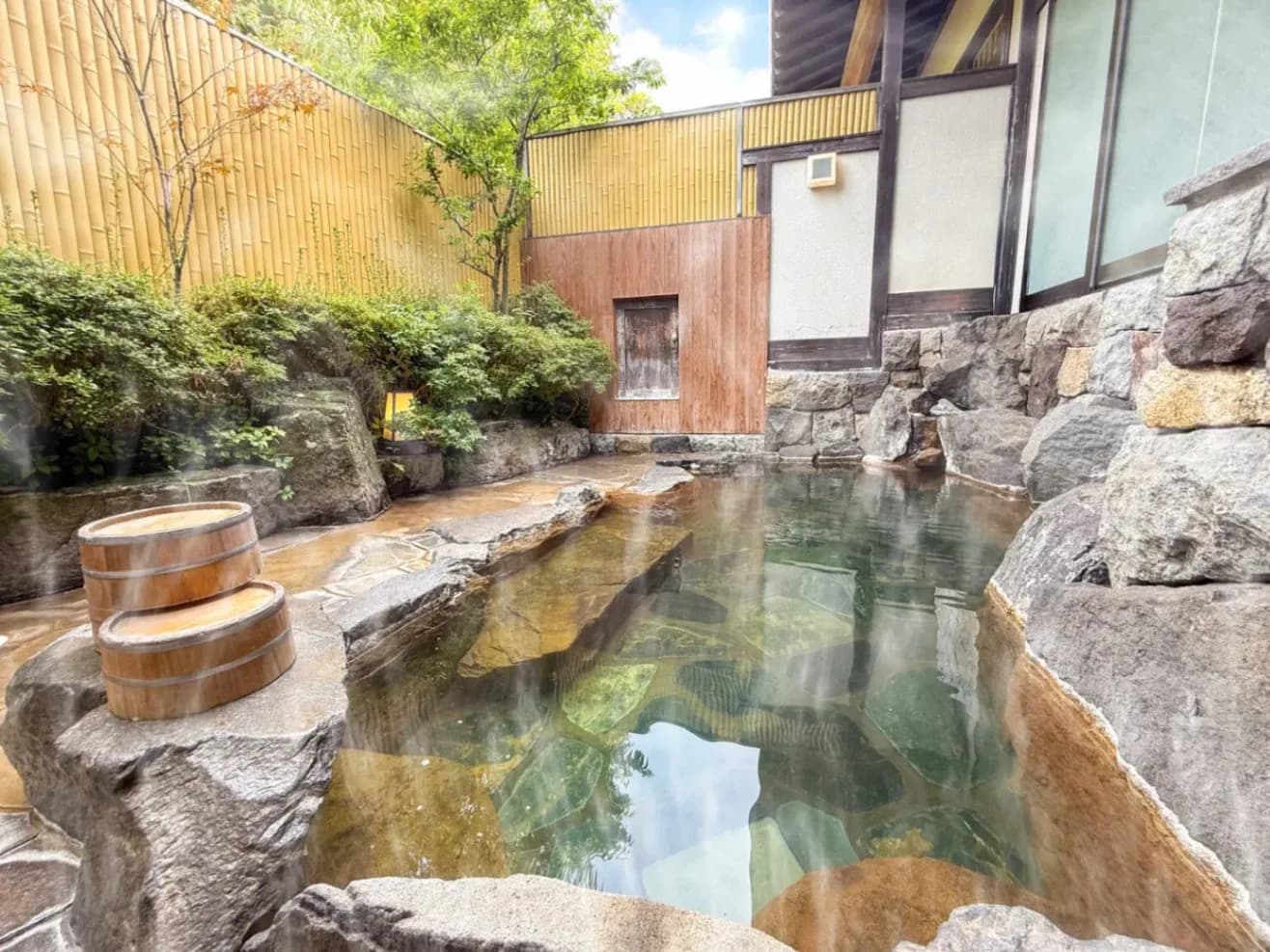
Fukuji Onsen, tucked into a mountain fold at the southern gateway to the Okuhida hot spring villages, is an ancient spa nicknamed the 'Emperor's Spring' after Emperor Murakami, who is said to have come here incognito for healing in the Heian period. In this quiet hamlet, where legends of Heike clan refugees still linger, stands Yamazato no Iori Soene, an irori-hearth ryokan created in 2004 by relocating and restoring the magnificent former Futamura family farmhouse, built in 1836 in the Hida countryside. The 180-plus-year-old main building is a registered National Tangible Cultural Property, its lacquer-black beams and earthen-floored doma preserving the memory of Hida mountain life. The baths are fed by three springs with a combined flow of roughly 290 liters per minute: the inn's own sources 'Fuku no Yu' and 'Arita no Yu', pumped from 300 meters underground, plus a source shared by the Fukuji Onsen community. The water is mainly a simple hot spring (hypotonic, neutral, pH 7.0), supplemented by skin-softening sodium bicarbonate water, and the main bath and private baths flow free and undiluted straight from the source. Though clear and gentle, it is renowned as an 'attamari-yu' that keeps you warm long after you leave the tub, and the inn belongs to the Japan Association of Genuine Source Hot Spring Inns. The highlight is 'Mori no Yu', an open-air bathing garden reserved for overnight guests, where the circular 'Kamayu' - a bath fashioned from an iron cauldron once used at the Kamioka mine - and the boulder-built 'Iwayu' sit beside the murmuring Hirayu River amid fresh greenery, autumn colors, or snow. The main bathhouse 'Fuku no Yu', a wooden hut roofed with traditional split shingles, adds a negative-ion-rich footbath sauna, and three private open-air bath cottages with indoor tubs are free for guests around the clock. Dinner is served around the irori hearth, featuring Hida mountain cuisine and rice cooked over a traditional kamado stove. Day-trip bathing runs 15:00-21:00 at 1,100 yen for adults and 500 yen for children (subject to change; calling ahead is recommended), while overnight stays with two meals start from around 18,800 yen. By car it is about an hour from Takayama IC via Routes 158 and 471; by public transport, take the Nohi Bus bound for Shinhotaka Ropeway from Takayama Station for about an hour and alight at Fukuji Onsen Kami, right by the inn. Soene makes an ideal base for touring Okuhida - the Shinhotaka Ropeway, Kamikochi, and Hirayu Great Falls are all nearby - with snow-view baths in winter and a charming morning market held in front of the inn. From November to late April, snow tires or chains are essential for drivers.
Quality
Simple Hot Spring
Sodium - Bicarbonate Spring
Temp
35℃ to 70℃
Emerge
Pumped
Supply
Natural Source Flow
Heat
Not Heated
pH
pH 7
pH
0714
AcidicNeutralAlkaline
Use
Stay OK/Day Trip OK
Fee
Adult 1100JPY/Child 500JPY
Hours
MonTueWedThuFriSatSunHol
15:00 - 21:0015:00 - 21:0015:00 - 21:0015:00 - 21:0015:00 - 21:0015:00 - 21:0015:00 - 21:0015:00 - 21:0015:00 - 21:00
View detail page

Fujiya Farmhouse Inn (Shinhirayu Onsen)

Okuhida Onsen-go is the collective name for five hot spring villages deep in the Northern Japan Alps: Hirayu, Fukuji, Shinhirayu, Tochio and Shinhotaka. Shinhirayu sits near the middle of the valley along Route 471, and Fujiya stands in its Ichie-ga-ne district. The inn occupies a hyakusho-zashiki, a farmhouse parlor building well over a century old. Unlike the relocated folk houses common in Japan today, this one has been used on this very spot for generations, and its sunken hearth, soot-darkened beams and thick pillars preserve the atmosphere of old rural Okuhida. The owner belongs to an association of innkeepers pledged to full disclosure of hot spring sources, and publishes the complete water analysis reports on the inn's website. The baths blend two private sources. Fujiya Source No. 1 is a 36.1C simple spring (pH 6.88) with a faint brown tint and iron taste, pumped at 450 liters per minute. Source No. 3 is an 89.2C sodium-bicarbonate spring (pH 8.30), colorless, odorless and free-flowing at about 250 liters per minute. Mixing the cool and hot springs brings the tubs to 39-43C without any added tap water, reheating, circulation or chlorination - genuine 100% kakenagashi. Bicarbonate springs are prized in Japan as bihada-no-yu, or beautifying waters, for the way they gently cleanse the skin. The main bath, Iyashi-no-Yu, is built entirely of premium hinoki cypress, from the tub to the washing area and walls, and the living knots swelling from the aged boards give it a texture no new bathhouse can imitate; the hinoki is renewed every twenty years, timed to the rebuilding of Ise Grand Shrine. Outside are rock-lined open-air baths and two private open-air baths in the garden, free for overnight guests and open around the clock. In the changing room waits Sansho-sui, calcium-rich spring water from the foot of Mt. Yakedake, for drinking before and after a soak. Dinner is served around the hearth, featuring the owner's own pesticide-free vegetables and Hida beef in the signature Okuhida farmers' hotpot. Stays with two meals start at 17,600 yen per person on weekdays (plus 150 yen bathing tax), and with only seven rooms the inn fills quickly. Day-trip bathing is available from 10:00 to 15:00 for 500 yen. Access is about 60 minutes by car from Matsumoto IC via the Abo Tunnel, or about 60 minutes from JR Takayama Station by Nohi Bus toward Shinhotaka Ropeway, alighting at Furuyagane, three minutes on foot from the inn. Fujiya makes an excellent base for the Shinhotaka Ropeway and Hirayu Great Falls; autumn foliage and snow-viewing baths in winter are the highlights, though winter drivers must carry snow tires.
Quality
Simple Hot Spring
Sodium - Bicarbonate Spring
Temp
36℃ to 89℃
Supply
Natural Source Flow
Heat
Not Heated
pH
pH 8.3
pH
0714
AcidicNeutralAlkaline
Use
Stay OK/Day Trip OK
Fee
Adult 500JPY/Child 500JPY
Hours
MonTueWedThuFriSatSunHol
10:00 - 15:0010:00 - 15:0010:00 - 15:0010:00 - 15:0010:00 - 15:0010:00 - 15:0010:00 - 15:0010:00 - 15:0010:00 - 15:00
View detail page

Fukuji Onsen Yumoto Choza

Among the five hot spring villages of Okuhida in the Northern Japan Alps, Fukuji Onsen preserves the quietest mountain-hamlet atmosphere. The springs are nicknamed the Emperor's Spring, for Emperor Murakami of the Heian period is said to have recuperated in these waters, and legends of Heike clan refugees linger in the valley. The village's flagship inn is Yumoto Choza. When it opened in 1969, farmhouses more than 150 years old were dismantled in Toyama and elsewhere and reassembled across expansive grounds. A great irori hearth greets guests at the entrance, and the soaring ceilings and massive smoke-blackened beams envelop visitors in the gravitas of traditional Japanese mountain architecture. The waters are a gift of the active volcanoes Yakedake and Norikuradake. In addition to a communal source, the inn maintains several private wells, with source temperatures ranging from about 63 to 95 degrees Celsius. The springs are classified as simple hot spring and sodium bicarbonate spring, and every tub is supplied kakenagashi style, flowing straight from the source. Notably, the scalding water is never diluted; instead it is cooled by cascading through the air from wooden flumes. Bathers stay warm long after soaking, which is why locals call it atatamari-yu, the warming bath. The variety of baths is a highlight in itself. The gender-separated main bathhouse offers indoor tubs and rustic open-air baths, while the private open-air bath Sanyaso-no-yu can be reserved free of charge. There is also Shizuku-no-yu with its row of five tubs and Kawara-no-yu, an outbuilding bathhouse with basins carved from natural stone. In the evening, dinners of Hida beef, river fish, and mountain vegetables are grilled over charcoal around the hearth, embodying the inn's motto of a bath followed by drinks at the fireside. Day-trip bathing is not offered, so these baths remain the privilege of overnight guests. Rates start at around 39,600 yen for two people with dinner and breakfast. Access is easy by Nohi Bus from Takayama Station bound for Shin-Hotaka Onsen, about 70 minutes to the Fukuji Onsen-kami stop, a one-minute walk from the inn. Drivers should allow about an hour from Takayama IC, with snow tires essential in winter. Every season has its charm, but winter, when snow blankets the open-air baths and the hearth fire crackles, shows this inn at its finest.
Quality
Simple Hot Spring
Sodium - Bicarbonate Spring
Temp
40℃ to 95℃
Supply
Natural Source Flow
Heat
Not Heated
Use
Stay OK/Day Trip N/A
View detail page

FAQ

How long does the Nishiho-Maruyama hike take?

For me, the round trip from Nishihotakaguchi Station took about 3 h 15 min. That includes about 20 minutes at Nishiho-Maruyama and a 20-minute lunch at Nishiho Sanso.

Is Nishiho-Maruyama suitable for beginners?

Walking it in October with no snow, I found it an easy route to manage. The elevation gain is about +360 m, and the rocky sections start past Nishiho-Maruyama. Conditions change once the snow arrives, so check the latest information.

How much is the Shinhotaka Ropeway?

¥3,800 for an adult round trip between Shinhotaka Onsen and Nishihotakaguchi (official website, as of October 2026). Fares can change, so check the official website before you ride.

Where do you park for Nishiho-Maruyama?

There are paid lots near the ropeway stations at Shinhotaka Onsen and Nabedaira Kogen. Nabedaira Kogen is the larger of the two, with about 550 spaces.

Is there an onsen near Nishiho-Maruyama for after the hike?

Yes. Shinhotaka-no-Yu (seasonal) is about 5 minutes by car from Shinhotaka Onsen Station, and Kojin-no-Yu is about 10 minutes.

Wrap-up

Because the Shinhotaka Ropeway takes you up to 2,156 m, Nishiho-Maruyama puts you on a 2,452 m ridge with a round trip of only about 4.7 km. In that short distance the scenery kept changing, from mossy forest to the year-round Nishiho Sanso hut and the creeping-pine ridge. That day a drizzly morning turned into a view from above the clouds, looking out over valleys filled with cloud! Snow changes the difficulty, so check the season and your gear before you go. The onsen of Okuhida are close by for after the hike, so it's well worth a visit at least once!

Watch the Video

The video's chapters roughly follow the same sections as the Hike Log above.
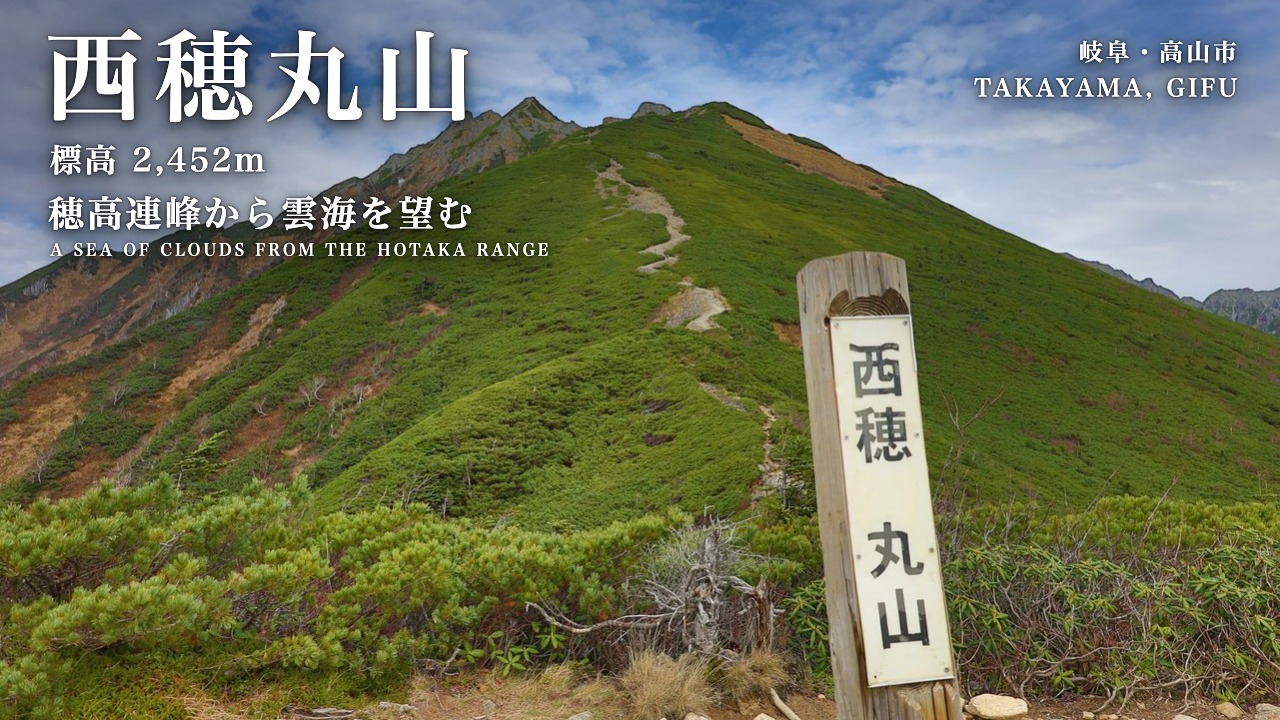
Thumbnail of the Nishiho-Maruyama hiking video

Nishiho-Maruyama Hike: Above a Sea of Clouds via the Shinhotaka Ropeway | Japan Alps 4K (YouTube)

  • 00:00 Opening
  • 00:27 Shinhotaka Ropeway
  • 02:29 Route Overview
  • 03:14 Nishihotakaguchi Sta. → Nishiho Sanso
  • 08:26 Nishiho Sanso → Nishiho-Maruyama
  • 12:32 Nishiho-Maruyama
  • 14:59 Nishiho-Maruyama → Nishiho Sanso
  • 17:31 Nishiho Sanso → Nishihotakaguchi Sta.
  • 20:04 Ropeway down & Completed

Times and distances are from my own record and are approximate. The ropeway fare is from the official website as of October 2026, and fares, hours and trail conditions may change. Driving times come from a map route search on November 8, 2026. Please check each official website for the latest information before you go.
Recommended Hot Springs

Popular hot springs from Hitou Map

HomeMapSearchBlogMy Page