12 Best Hidden & Notable Hot Springs in Okayama Prefecture — Alkaline Springs and Foot-Gushing Baths in the Heart of Mimasaka
12 Best Hidden & Notable Hot Springs in Okayama Prefecture — Alkaline Springs and Foot-Gushing Baths in the Heart of Mimasaka
Okayama Prefecture is an unsung hot spring haven, harboring some of Japan's finest alkaline thermal waters in the mountainous Mimasaka region. While the "Big Three of Mimasaka" — Yunohara, Okutsu, and Yunogo — have long been celebrated, the true allure lies in the remarkable cluster of ashimoto-yushutsu (foot-gushing) springs scattered around them. Here, hot water rises directly through the rock beneath the bathtubs — a geological rarity that guarantees the freshest possible soak. A free riverside sand bath ranked as the top open-air bath in western Japan, communal bathhouses operating since the Edo period, a reservation-only retreat limited to four groups per day — nearly all boast pH levels above 9.0, delivering the silky, skin-smoothing sensation known as bijin-no-yu, or "beauty water." The Kibi Plateau adds centuries-old cold mineral springs developed by feudal lords, while a radium spring quietly flows near the prefectural border. Here, we present 12 carefully selected destinations, each with its own distinctive character.
1. Yunohara Onsen Sunayu (Maniwa City)
引用:真庭観光WEB
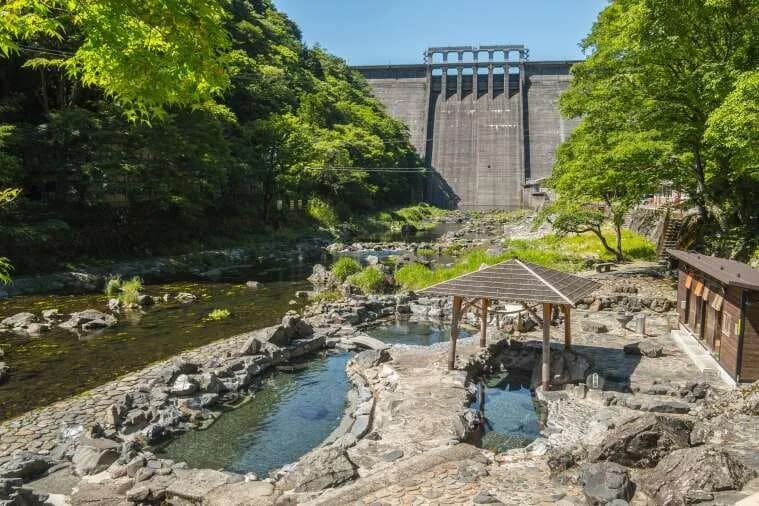
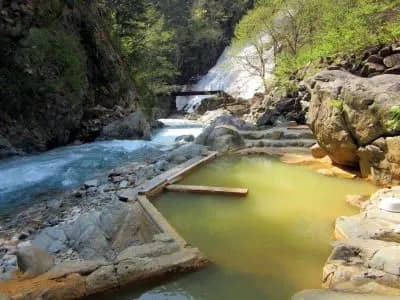
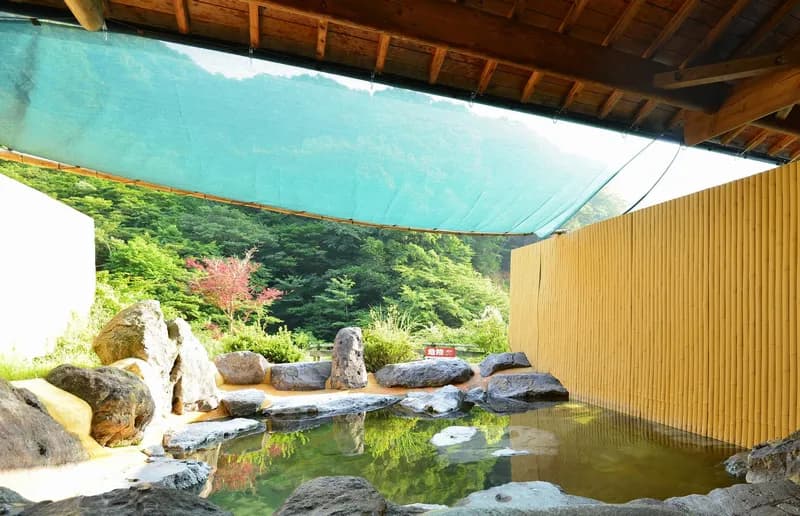
Yubara Onsen Sunayu is a magnificent natural open-air hot spring bath that gushes directly from the riverbed of the Asahi River, situated beneath the imposing Yubara Dam in Maniwa City, Okayama Prefecture. Its history stretches back over a millennium. According to legend, the renowned Heian-period monk Shoku Shonin was guided to these healing waters by a divine child who appeared in a dream during a serious illness. Upon bathing here, the monk made a full recovery, and the spring became widely celebrated for its medicinal properties. Some historians trace the use of these thermal waters even further back to the middle Yayoi period, when iron smelters are believed to have soaked here to recover from their arduous labor. The name Sunayu, meaning sand bath, derives from the distinctive way hot water erupts through the sandy riverbed.
The spring water is classified as alkaline simple hot spring with a pH of approximately 9.0, placing it firmly in the strongly alkaline category. The source temperature hovers around 45 degrees Celsius, and the water rises directly from beneath the bathers' feet in its purest form, never having been exposed to air before reaching the surface. This foot-gushing phenomenon is exceptionally rare, found at only 50 to 60 locations throughout Japan, earning Sunayu a revered status among hot spring enthusiasts. Rich in metasilicic acid, the water has a silky, almost velvety texture on the skin, and is celebrated as a beauty bath that leaves the skin remarkably soft and moisturized after bathing.
The bathing area comprises three distinct pools, each maintained at a different temperature and bearing an evocative name: Bijin no Yu (Beauty Bath), Kodakara no Yu (Fertility Bath), and Choju no Yu (Longevity Bath). As a mixed-gender open-air bath available 24 hours a day completely free of charge, Sunayu offers an experience that feels genuinely timeless. The dramatic backdrop of the towering Yubara Dam wall and the gentle sound of the Asahi River create an atmosphere of wild, unspoiled natural beauty. The bath has been honored with the title of West Yokozuna, the highest western ranking in the national open-air bath rankings compiled by the renowned hot spring critic Fuyuhito Noguchi.
For female visitors who may feel hesitant about mixed bathing, rental bathing garments called yuamigi are available at 2,000 yen for day visitors and 500 yen for hotel guests, and towel wrapping is also permitted. The bath is closed only on Wednesday mornings for cleaning and is otherwise accessible around the clock.
Tucked away along a tributary of the Asahi River in the mountainous terrain of Maniwa City, Okayama Prefecture, Maga Onsenkan is a venerable bathhouse with approximately 700 years of history. Legend holds that during the era of Emperor Go-Daigo, a samurai wounded in the Battle of Senjozan in Hoki Province came here to heal his injuries. By the Edo period, the lords of both the Katsuyama and Tsuyama domains regularly visited for therapeutic bathing. The lords would drape curtains — maku in Japanese — around the bath for privacy, giving rise to the name Maku-yu, a tradition spanning over 400 years. In the 1980 National Therapeutic Hot Spring Rankings, Maga Onsen earned the prestigious position of third maegashira on the western side, a testament to its long-recognized healing properties.
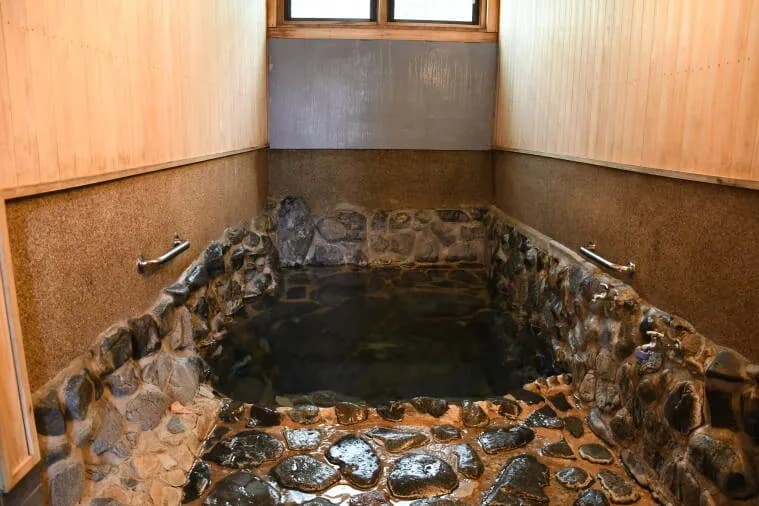
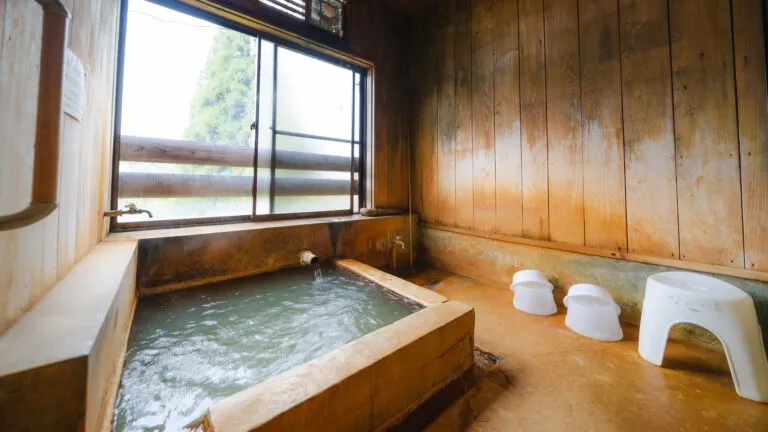
The defining feature of Maga Onsenkan is its foot-welling natural source. Hot spring water rises directly through fissures in the bedrock at the bottom of the bathing pool — an extraordinarily rare phenomenon even by Japanese hot spring standards. The water is classified as alkaline simple hot spring with a pH of 9.4 and a source temperature of approximately 39.5 degrees Celsius, flowing naturally at 205 liters per minute. Colorless, transparent, and nearly odorless, the water imparts a silky-smooth, almost velvety sensation on the skin — a natural beauty treatment requiring no additives. With absolutely no added water, heating, or recirculation, bathers enjoy the purest possible form of source-direct bathing.
The star attraction is Maku-yu, a mixed-gender rock bath measuring a mere 1.6 by 2 meters — frequently called the smallest mixed bath in Japan. At roughly 1.2 meters deep, bathers stand rather than sit, creating an intimate and unusual bathing experience. Spring water enters through bamboo pipes while bubbles percolate up through cracks in the bedrock beneath one's feet. With space for only a handful of bathers, the concentrated essence of the hot spring in this tiny space is an experience found nowhere else. The separate men's and women's baths also feature bamboo pipe inlets, and bathers can feel fine bubbles clinging to their skin like a delicate veil. Three private baths are available for families or couples seeking a more relaxed experience.
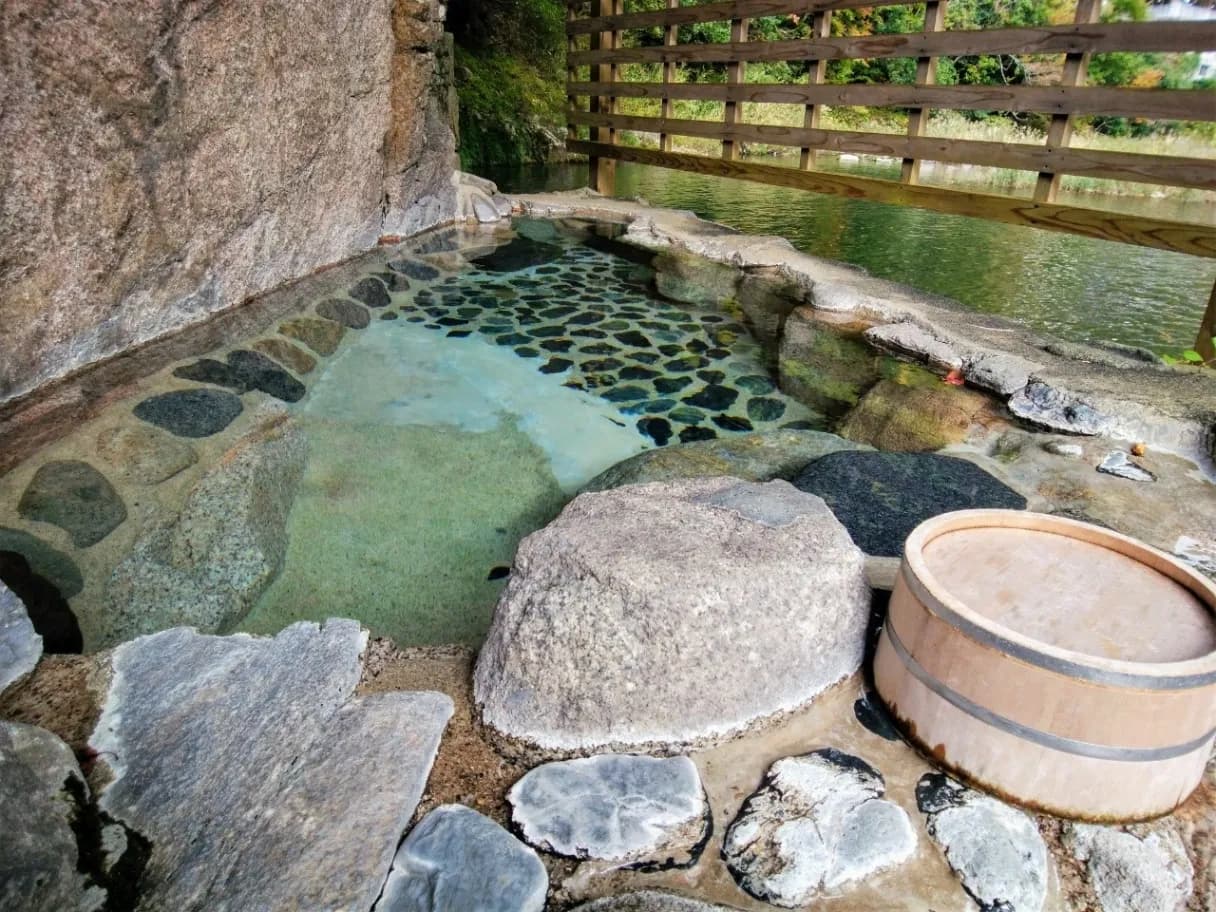
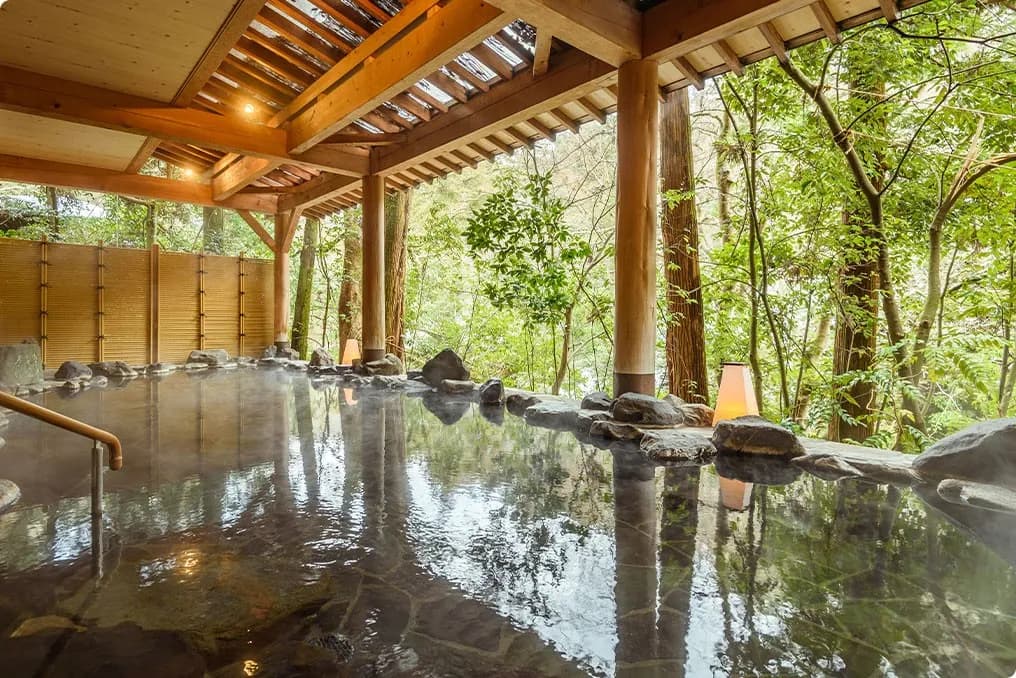
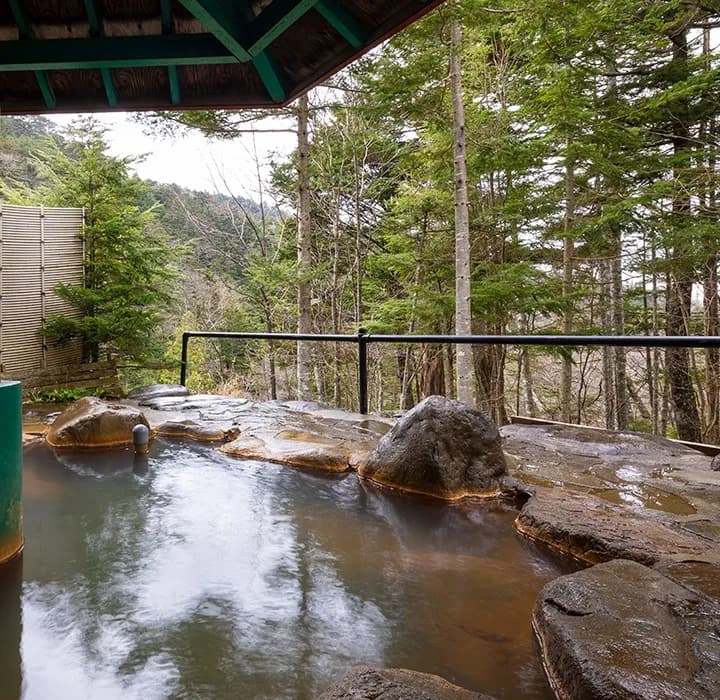
Nestled deep within the Okutsu Onsen district of Kagamino Town in Okayama Prefecture, Hannyaji Onsen traces its origins to 1871, when it was established as a lodging house for the Tendai Buddhist temple Hannyaji. For decades, the temple's monks used these thermal waters for therapeutic bathing before the facility opened to the public in 1957. Since then, this hidden gem has quietly maintained its reputation as one of the finest secret hot springs in the San'in region of western Japan. Located along a tributary of the Yoshii River, the onsen commands a privileged position directly facing Ayugaeshi Falls, one of the celebrated Eight Scenic Spots of Okutsu.
The spring water at Hannyaji Onsen is classified as alkaline simple hot spring with an impressive pH of 9.6, placing it firmly among Japan's premier bijin-no-yu, or beauty springs. The property is blessed with three private source springs, each with slightly different temperatures. The indoor bath receives a blend of naturally self-flowing springs at 39 and 40 degrees Celsius, while the outdoor bath draws from sources at 40 to 42 degrees. All water is delivered as 100 percent free-flowing source water with no dilution or artificial heating.
Goroku Onsen Gorokukan is a hidden single-inn hot spring nestled deep in the mountains of Maniwa City, Okayama Prefecture. Its origins trace back to the early Edo period, giving it a history spanning nearly four centuries. The beautiful name Goroku carries several origin stories: one suggests it derives from local farmers who would gather here to soothe their weary bodies after the exhausting rice-planting season, while another attributes it to the perpetual greenery surrounding the inn, kept lush year-round by the earth's geothermal warmth. The main building, constructed during the Meiji era, stands proudly atop magnificent stone walls that were painstakingly assembled by the cooperative effort of the entire village — a testament to how deeply this spring has been cherished by the local community.
The crowning glory of Goroku Onsen is its foot-gushing spring, where hot spring water rises directly through fissures in the natural bedrock exposed at the bottom of the bathing pool. This phenomenon has been confirmed at only 50 to 60 locations across all of Japan, making it an extraordinarily rare bathing experience. The pure source water reaches bathers without ever having been exposed to outside air, offering a level of freshness that hot spring connoisseurs consider the ultimate luxury. The water is classified as alkaline simple hot spring with a pH of 9.1 and is rich in metasilicic acid, prized for its remarkable skin-beautifying properties. At a gentle 34.2 degrees Celsius, the source temperature is ideal for prolonged, meditative soaking.
Okutsu Onsen is a celebrated hot spring nestled in the mountains of northern Okayama Prefecture, forming one of the Mimasaka Sanyu (Three Great Springs of Mimasaka) alongside Yubara Onsen and Yunogo Onsen. Its history stretches back to the early Edo period, when the first lord of the Tsuyama domain, Mori Tadamasa, was so captivated by the quality of the waters that he ordered the bath locked to prevent anyone else from using it — giving rise to the name Kagiyu, meaning Key Bath. Okutsuso was established in 1927 and has faithfully preserved this legendary spring for over 90 years. In November 2018, the original wooden structure dating from 1927 was designated a National Registered Tangible Cultural Property, embodying a living connection to the past.
The crowning feature of Okutsuso is its ashimoto yushutsu, or underfoot spring — a phenomenon found in only 20 to 30 facilities among the approximately 35,000 hot spring establishments across Japan. Alkaline simple hot spring water at 42.6 degrees Celsius wells up naturally through crevices in the granite riverbed at the bottom of the bathtub, producing 247 liters per minute. With a pH of 9.1, this strongly alkaline water softens the skin and is celebrated as a bijin-no-yu, or beauty spring. The water is delivered with absolutely no heating, dilution, or recirculation — a completely free-flowing source experience where the water envelops the body before it has even touched the air, a luxury exclusive to underfoot spring baths.
Okutsu Onsen is one of the Mimasaka Sanyu, the Three Great Hot Springs of the Mimasaka region in northern Okayama Prefecture. Its origins reach back to the age of Japanese mythology, with legend attributing the discovery to the deity Sukunahikona no Mikoto. During the Edo period, the lord of Tsuyama Domain, Mori Tadamasa, valued the spring so highly that he established a private bathing retreat here. The hot spring town began to develop in earnest during the Taisho era, and Towaro was founded in 1928. This modest three-story wooden inn has preserved its unpretentious character through nearly a century of continuous operation.
The true treasure of Towaro lies in its underground rock bath. Guests descend a staircase within the inn and pass through an atmospheric plaster-walled tunnel to reach a small bathing chamber hewn directly from natural bedrock. From cracks in the rock floor, hot spring water bubbles up in a steady, gentle flow. This is an alkaline simple hot spring with a pH of 9.2 and a source temperature of approximately 41.7 degrees Celsius, requiring neither dilution nor additional heating. The water carries a faint ramune-like tint within its otherwise colorless transparency.
Okutsu Onsen is a renowned hot spring rising along the upper reaches of the Yoshii River in northern Okayama Prefecture, forming one of the Mimasaka Sanyu (Three Great Springs of Mimasaka) alongside Yubara Onsen and Yunogo Onsen. Legend traces its discovery to the deity Sukunahikona-no-Mikoto, who found the spring while touring the provinces. During the Edo period, the first lord of the Tsuyama domain, Mori Tadamasa, established an exclusive bathing facility here, reserved solely for domain officials — a testament to the spring's esteemed status. Kajika-en was founded in 1929 on the site of Lord Mori's former villa and was beloved by many literary figures and artists. Although it closed in 2012, the inn was reborn in April 2018 as Ikedaya Kajika-en, carrying forward the tradition of this storied hot spring.
The waters of Ikedaya Kajika-en are classified as alkaline simple hot spring with a pH of 9.3, placing them firmly in the strongly alkaline category. The source temperature ranges from 38.5 to 42.0 degrees Celsius, with an abundant flow rate of 300 liters per minute from the inn's own private source, delivered as completely free-flowing spring water. The colorless, transparent, and silky water gently dissolves old skin cells, leaving the skin remarkably smooth and earning the spring its reputation as a bijin-no-yu, or beauty spring.
Genroku Hatago Aburaya is a historic inn established in 1688, the first year of the Genroku era, in Maniwa City, Okayama Prefecture. In its heyday, Yubara thrived as a post town on the highway connecting the San-in Road with Mount Daisen and Kurayoshi, serving as a vital waypoint for countless travelers. The inn earned the name Aburaya, meaning oil house, by keeping its lanterns burning through the night and providing oil for travelers' journey torches. After more than 330 years, the spirit of welcoming weary travelers endures. The Yubara hot spring district itself boasts an even older pedigree, with some historians tracing its use back to the middle Yayoi period as a therapeutic bathing site for iron smelters, and it is home to the famed Sunayu open-air bath ranked as the West Yokozuna in Japan's national open-air bath rankings.
The waters of Aburaya are classified as a low-tension alkaline high-temperature spring, specifically an alkaline simple hot spring. With a pH above 9.0, the water exhibits a distinctly silky, slippery texture on the skin even without the use of soap. This remarkable smoothness is a testament to the water's skin-beautifying properties, leaving bathers with noticeably moisturized and supple skin. The Shokutokan bathhouse channels its underground source water directly into every tub in an authentic kakenagashi free-flowing style, ensuring that guests bathe in the freshest possible water moments after it emerges from the earth.
Yubara Onsen is a celebrated hot spring nestled along the Asahi River gorge in the mountains of northern Okayama Prefecture. Together with Yunogo Onsen and Okutsu Onsen, it forms the Mimasaka Sanyu — the Three Great Hot Springs of Mimasaka — and stands as one of Okayama Prefecture's most distinguished thermal destinations. Its history stretches back approximately 1,700 years to the late Yayoi period, when the springs were already being used alongside the ancient tatara iron-smelting operations of the region. In the Heian period, the renowned monk Shoku Shonin of Enkyoji Temple on Mount Shosha in Harima was guided to these waters by a celestial being who appeared in a dream during a grave illness; upon bathing, the monk was miraculously cured. During the Warring States period, the warlord Ukita Hideie, one of Toyotomi Hideyoshi's five great retainers, is said to have established a bathhouse here for his ailing mother Lady Ofuku, further cementing the spring's longstanding reputation as a medicinal bath of the highest order.
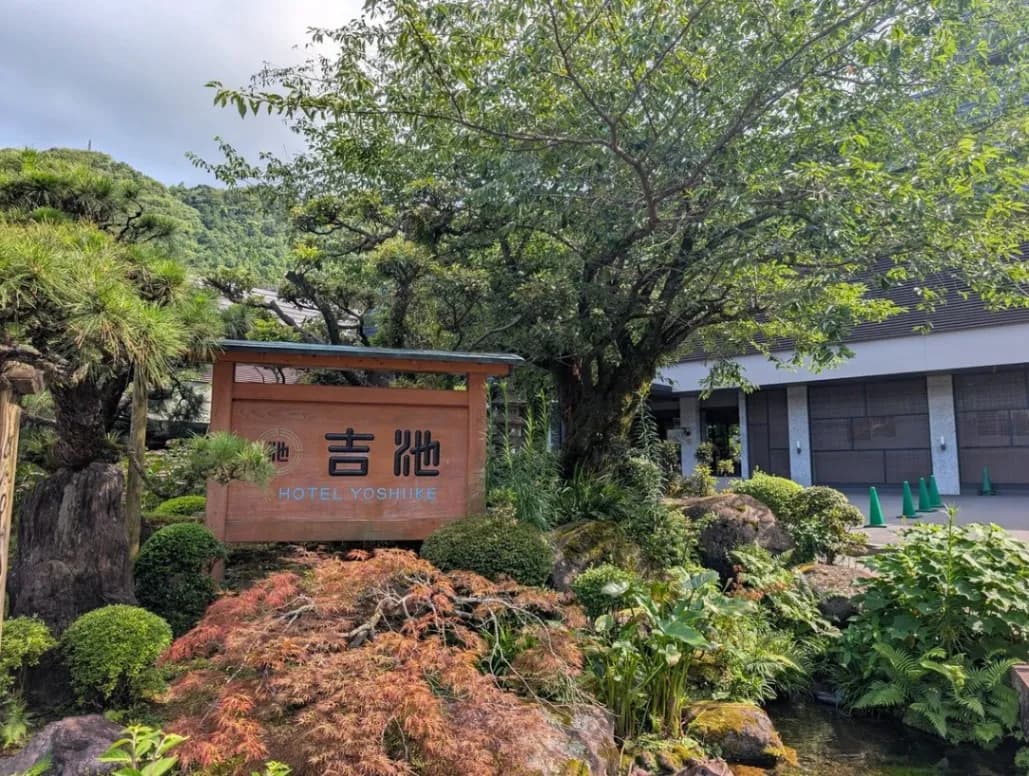
The waters of Hakkei are classified as alkaline simple hot spring with an impressively high pH of 9.3. The source temperature reaches 50.1 degrees Celsius, and the water is colorless, transparent, odorless, and tasteless, with a distinctively silky, enveloping texture that clings gently to the skin. Delivered as completely free-flowing source water, the genuine hot spring feeds not only the main bathhouse but also the open-air baths and unit baths in individual guest rooms — a remarkable luxury.
Komori Onsen is a secluded single-inn hot spring tucked away in the mountains of Kibichuo Town, near the geographic center of Okayama Prefecture. Its origins trace back to 1732 (Kyoho 17) during the mid-Edo period, when Ikeda Tsugumasa, lord of the Okayama domain, developed the site as a therapeutic bathing retreat. The discovery of the spring itself is believed to be far older — local legend recounts that villagers once observed a heron soaking its wounds in the naturally warm water. A Yakushi-do temple was erected on the hillside above the source, and the spring came to be revered as a sacred healing water. The domain invested heavily in constructing a formal bathhouse, but when fresh groundwater infiltrated the source, the facility was forced to close after only a few years of operation. Following a long period of dormancy, the onsen was revived around 1953, and it has carried forward its nearly 290-year legacy to the present day.
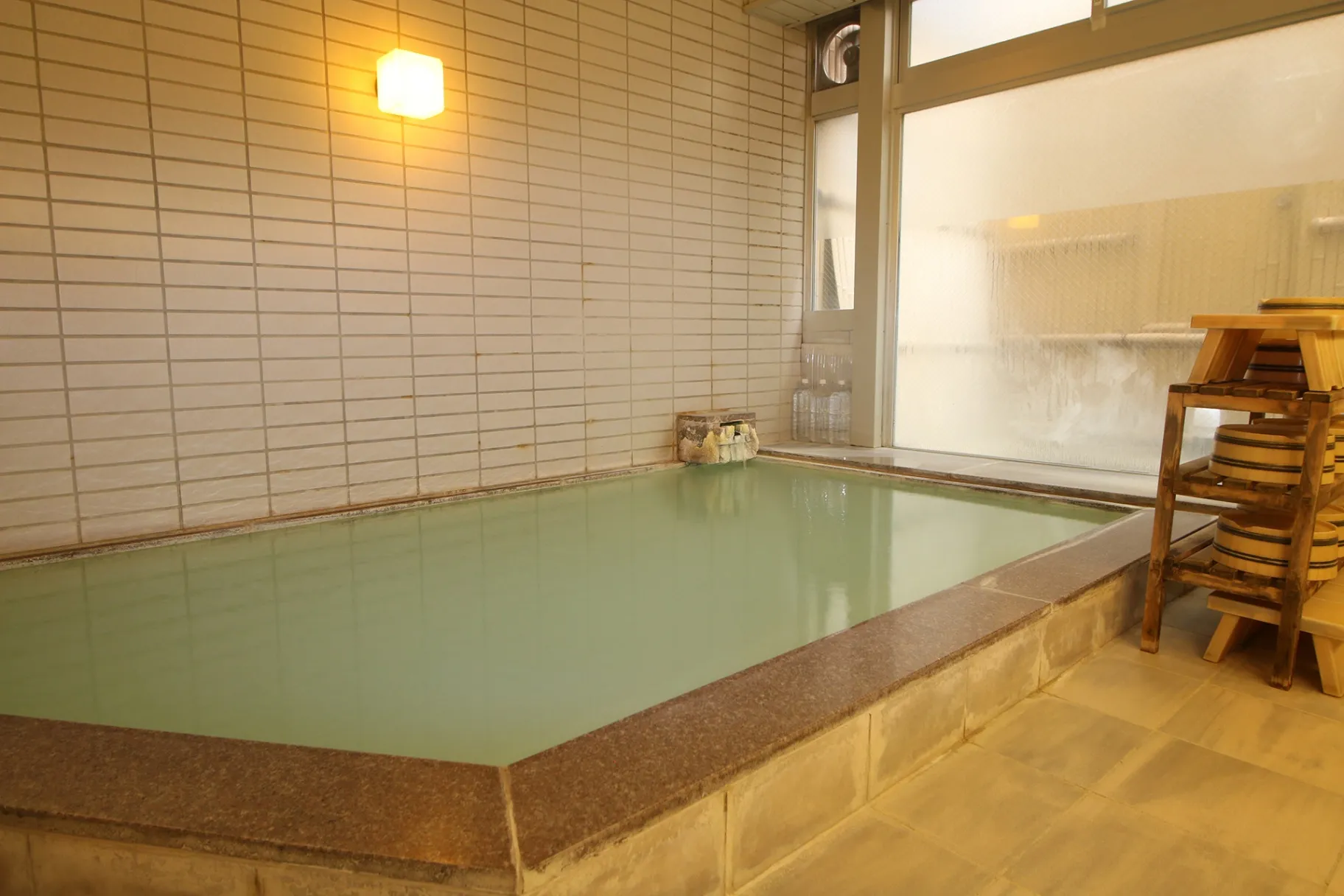
The water is classified as alkaline simple hot spring with a notably high pH of 9.4, placing it firmly among the most alkaline springs in the region. The source temperature is 28.1 degrees Celsius, technically a cold mineral spring that is heated to a comfortable bathing temperature. The colorless and transparent water has a remarkably silky texture, earning it a reputation as a bijin-no-yu, or beauty spring, for the way it leaves the skin feeling smooth after bathing. Delicate white mineral deposits known as yu-no-hana drift across the surface of the bath, a hallmark of authentic natural hot spring water. Even the faucets at the washing stations deliver spring water, a testament to the generous flow that allows for a genuine kakenagashi, or free-flowing source, experience. The water is traditionally valued for its therapeutic effects on atopic dermatitis, neuralgia, muscle pain, and joint ailments.
Yunose Onsen is a solitary inn hot spring situated along the Toyooka River in the mountainous interior of Kibichuo Town, Kaga District, Okayama Prefecture. Established in 1921 during the Taisho era, the spring has been carefully maintained for over a century. The source water wells up naturally from the riverbed, and the inn is now operated by a second-generation female proprietor who carries on the tradition. Embraced by the deep green valleys of the Kibi Plateau, this tranquil mountain retreat has long been cherished by regular visitors from Okayama City and beyond who seek respite from the bustle of urban life.
The spring water is classified as alkaline simple hot spring with a remarkably high pH of 9.7. Although the source temperature is relatively low at 27.1 to 29 degrees Celsius, requiring the water to be heated for bathing, the spring water is delivered entirely unfiltered — not only to the bathtubs but also to every faucet and shower in the facility. The slightly cloudy water has a distinctively slippery texture and carries a faint sulfur aroma.
12. Awakura Onsen Motoyu (Nishiawakura Village, Aida District)
Awakura Onsen is a hot spring located in Nishiawakura Village, positioned at the far northeastern corner of Okayama Prefecture near the border with Tottori Prefecture. Its discovery is said to date back to the Kamakura period, with a local legend telling of villagers who noticed a tanuki (raccoon dog) returning to the mountains in full health just days after being shot by a hunter. Following the animal's trail to the riverbank, they discovered hot water bubbling up from the ground. An additional legend recounts that a red bull once thrashed about at the spring source, causing the water temperature to drop and transforming it into a cold spring. Motoyu long served as the village's municipal hot spring until it ceased operations in November 2011. It reopened in 2015 under private management and was boldly renovated into a hot spring guesthouse centered around the experience of bonfire bathing — a creative reimagining of a building more than 50 years old.
The spring is classified as a simple weak radioactive spring, commonly known as a radium spring. Its radon content registers at 40 Mache units, the highest figure in Okayama Prefecture. Radium springs are valued for the hormesis effect of low-dose radiation, with therapeutic indications including gout, hypertension, arteriosclerosis, and chronic skin conditions. The source temperature ranges from 14 to 15 degrees Celsius, placing it firmly in the cold spring category. Heating is accomplished through a wood-fired boiler fueled by thinned timber harvested from Nishiawakura Village's abundant forests — an environmentally conscious approach to hot spring management that has attracted attention for its sustainability. The water has a notably smooth, silky texture, and the warmth it imparts persists long after bathing.
Summary — What to Know Before Exploring Okayama's Hot Springs
The hot springs of Okayama Prefecture can be efficiently explored by dividing them into four areas.
Yunohara Area: Six of the twelve springs — Sunayu, Maga Onsen, Hannyaji Onsen, Goroku Onsen, Aburaya, and Hakkei — are concentrated here, making it the prefecture's richest hot spring zone. From Yunohara IC on the Yonago Expressway, Sunayu and Hakkei are within walking distance, Maga Onsen is about five minutes by car, Hannyaji Onsen is just a few minutes away, and Goroku Onsen lies roughly 15 minutes upstream along the Asahi River. Aburaya sits in the center of the Yunohara district. A rewarding 1-night/2-day itinerary might start with an early morning soak at the free Sunayu, followed by a midday visit to Maga Onsen's foot-gushing Maku-yu, an afternoon reservation at Hannyaji Onsen for gorge-side bathing, and an evening stay at Aburaya or Hakkei. Goroku Onsen, slightly more remote, works best as a morning stop the following day.
Okutsu Area: Okutsu-so, Towaro, and Ikedaya Kajika-en are all clustered within the compact Okutsu hot spring district, making it possible to visit all three on foot in a single half-day. From Innosho IC on the Chugoku Expressway, head north on Route 179 for about 30 minutes. Each inn offers its own distinct spring character, from the historically prestigious Kagi-yu to the rustic standing bath at Towaro. The Okutsu and Yunohara areas are roughly one hour apart by car, making a 2-night/3-day circuit of both areas an excellent plan. Mid-April to early May brings fresh greenery to Okutsu Gorge, while late October to mid-November offers spectacular autumn foliage — both ideal seasons for combining hot springs with natural scenery.
Kibi Plateau Area: Komori Onsen and Yunose Onsen are both located in the mountains of Kibichuo Town, about one hour by car from central Okayama City. The two facilities are approximately 20 minutes apart, making a half-day excursion feasible. Public bus service is extremely limited, so a rental car is essential. Both are within day-trip range of Okayama City and Kurashiki, and pair well with sightseeing along the Kibi Road — sites such as Bitchu Kokubunji Temple and Kinojo Castle.
Border Area: Awakura Onsen Motoyu is in Nishiawakura Village, roughly 15 minutes by car from Ohara Station on the Chizu Express line. It makes a convenient stop en route to Tottori, though bus connections are sparse and a rental car is advisable. Beyond the hot spring, Nishiawakura offers forest therapy walks and local woodcraft workshops. A wider-ranging itinerary combining Awakura with Yumura Onsen in Hyogo Prefecture or Misasa Onsen in Tottori Prefecture is also well worth considering.
Overall, a rental car is indispensable for exploring Okayama's hot springs. The most efficient approach is to pick up a car at JR Okayama Station and spend two to three days touring the Yunohara and Okutsu areas. During winter (December through February), mountain roads in the Chugoku Range are subject to snowfall and ice, requiring snow tires. Some facilities — such as the reservation-only Hannyaji Onsen or Towaro, which has suspended overnight stays — operate under special conditions, so always confirm current availability before visiting.
The information in this article (admission fees, operating hours, water quality data, etc.) is based on research conducted at the time of writing. Details may have changed or contain errors. Please verify the latest information on each facility's official website or through the local tourism association.