Okinawa Hot Springs: 7 Fossil-Seawater Baths on a Volcano-Free Island
Okinawa has no volcanoes. Most of Japan's hot springs are heated by volcanic geothermal activity, but the Ryukyu Islands have neither active volcanoes nor volcanic springs. The water that rises here comes from something else entirely: "fossil seawater" (化石海水), ancient ocean trapped deep underground and warmed slowly by the earth's heat.
Sea that was here millions of years ago remains sealed in the rock strata, and it is drawn up still dense with salt and minerals. That is why so many Okinawan baths run brown or amber and taste distinctly salty. In origin, they have nothing in common with the volcanic springs of the mainland — and that fossil seawater is what sets Okinawa's hot springs apart from anywhere else in the country.
One thing to be honest about: true source-fed (kakenagashi) baths are rare here. Limited flow and water temperature mean most facilities heat and recirculate their water, and only a handful anywhere on the islands claim 100% source-fed baths. Sashiki no Enjin no Yu in Nanjo City is one of those few. Shimanchu no Yu and Ryujin no Yu are resort-linked baths overlooking the sea near Naha; Chura-umi no Yu in Motobu draws on the town's ancient strata; and Shigira Ougon Onsen on Miyako Island is known as one of Japan's southernmost hot springs. Below are 7 of the prefecture's most distinctive baths.
1. Sashiki no Enjin no Yu (さしきの猿人の湯) — Nanjo City
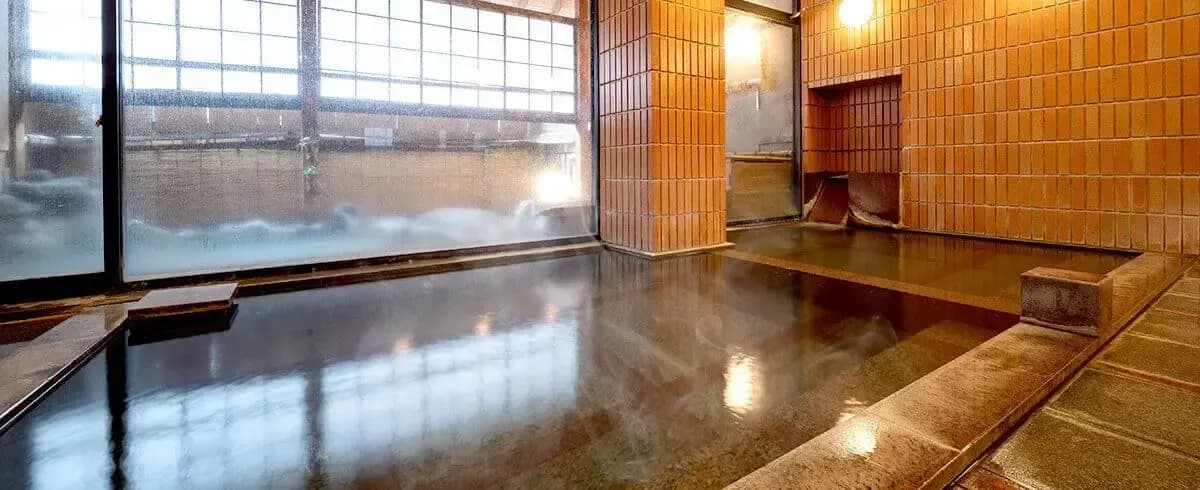
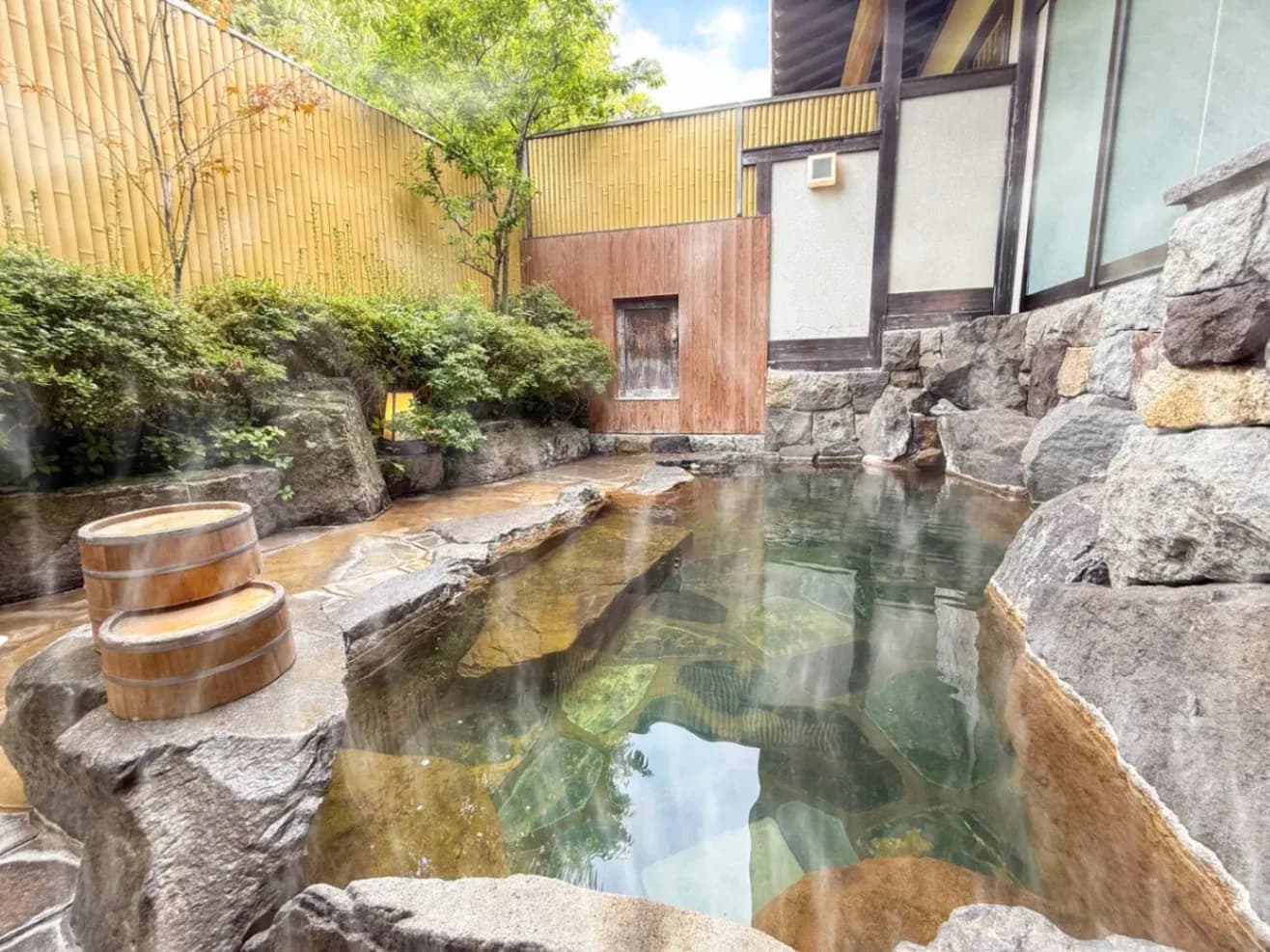
Perched on a hill in Sashiki, Nanjo City, in the south of Okinawa's main island, Yuinchi Hotel Nanjo is a wellness resort whose in-house bath, Sashiki Enjin-no-Yu, ranks among the few genuine natural hot springs on an island otherwise poor in onsen. Its curious name, meaning bath of the ape-man, points back some 5.4 million years to an age when early hominids walked the earth, for the source draws on ancient fossil seawater. Sealed in geological strata about 2,119 meters underground, that primeval sea now rises here after an almost unimaginable span of time.
The spring is fed by the resort's own bored well. Classified as an iodine-bearing sodium chloride strong-salt spring, it is hypertonic, neutral, and high in temperature. Because it originates in fossil seawater, its salinity is remarkably high, reported at roughly 80 percent that of present-day seawater. The water takes on an ochre to golden hue, tastes distinctly salty, and carries an unusual aroma. Most notably, the operator officially states that the bath is 100 percent free-flowing spring water with no filtration, no heating, and no added water, letting bathers take in the gift of an ancient sea just as it emerges. Source temperatures are cited variously from about 52 to 57.5 degrees Celsius, while the bath itself is kept near 42 degrees.
The centerpiece is a panoramic main bath overlooking the Pacific, complemented by a cascade bath, a medicated bath, and a dry sauna (a mist sauna for women). Soaking in the dense saline water while gazing over blue sea and sky is a luxury unique to a resort setting. For those who prefer a quiet soak with family or friends, a private bath is available in the annex. The building also houses a dining area and relaxation rooms, making it easy to spend an unhurried day around a visit to the bath.
Day-use bathing costs 2,200 yen for adults (junior high and up, bathing tax included), 1,200 yen for elementary students, and is free for children under six, available from 6:30 to 23:00 (last entry 22:30). With 400 free parking spaces and complimentary bath-towel rental, it is an easy stop between sightseeing. Note that visitors with tattoos may not use the main bathhouse. Paired with Nanjo's landmarks such as Sefa-utaki, Okinawa World, the Niraikanai Bridge, and Azama Sunsun Beach, a visit rounds out a journey through southern Okinawa.
2. Miegusuku Onsen Shimanchu no Yu (三重城温泉 島人の湯) — Naha City
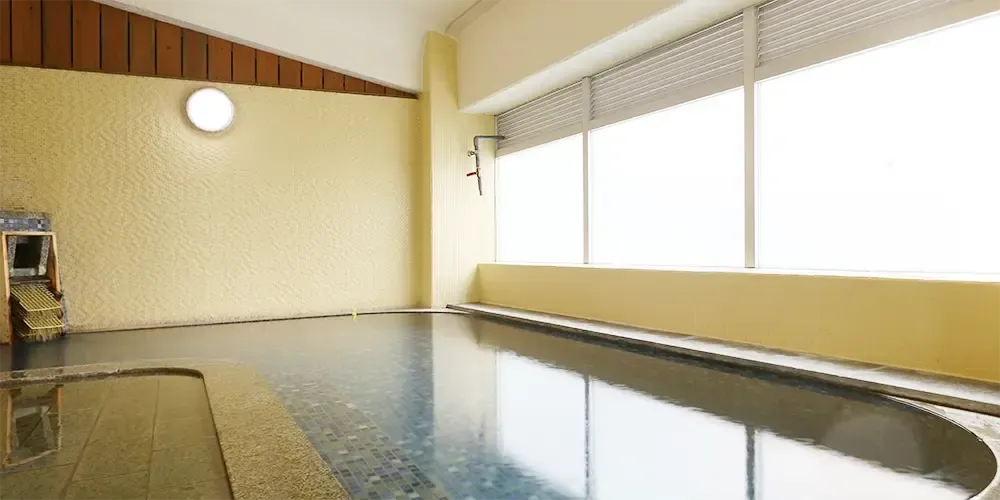
Few places on Okinawa's main island offer a genuine natural hot spring, and one of those rare spots is Shimanchu-no-Yu, part of Miegusuku Onsen on the second floor of Loisir Hotel Naha, overlooking Naha Port. The spring is named for the nearby historic site of Miegusuku, a stone fortress built in 1546 during the Ryukyu Kingdom era. Jutting out into the sea, it served both as a defensive outpost guarding Naha Port and as a place of prayer for the safe voyages of those setting out across the ocean. A bath bearing the name of this seaside landmark is fittingly a hot spring embraced by the Okinawan sea.
The water is classified as an iodine-bearing sodium chloride spring, and its defining trait is that it draws not on volcanic heat but on fossil seawater. Pumped from roughly 800 meters underground, the water is seawater some eight million years old, sealed within the strata and warmed by geothermal heat. It lacks the sulfurous odor of Honshu's volcanic springs, yet this concentrated ancient sea tastes distinctly salty. The source emerges at a mild 40.9 degrees Celsius, and the facility warms it to a comfortable 42 to 43 degrees. Rich in iodine and salt, the water leaves a veil of minerals on the skin after bathing, slowing perspiration and keeping the body warm from within.
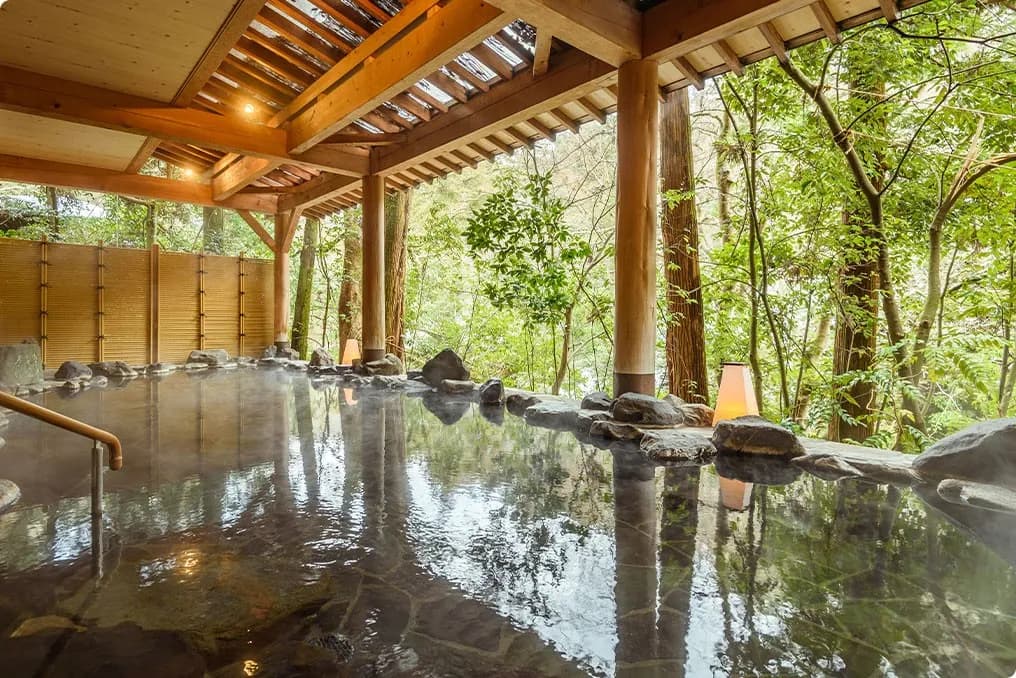
The bathing area includes both an indoor bath and an open-air bath, letting guests feel the sea breeze while soaking high within an urban hotel. Full-body showers, vanity counters, and lockers make it easy to drop in mid-journey. The hotel also features an outdoor pool shaped like butterfly wings and a year-round indoor pool, so a leisurely full day is easily spent here. Hotel guests may bathe from 6:00 in the morning until midnight, while day-trip visitors are welcome from 9:00 to 18:00.
Access is excellent: about seven minutes by car from Naha Airport and within walking distance of Asahibashi Station on the Okinawa Urban Monorail. Kokusai Street is roughly ten minutes away by car, making the bath easy to fold into a day of sightseeing or shopping. Day-trip admission is 2,500 yen for adults and 1,250 yen for children. Whether filling time before a flight or capping off a trip, it is a fine chance to wash away travel fatigue in waters born of a primordial southern sea. Note that inspection hours are held on the third Wednesday of each month, so check the timetable if visiting that day.
3. Jurassic Onsen Chura-umi no Yu (ジュラ紀温泉 美ら海の湯) — Motobu Town, Kunigami District
On the coast of Motobu Town in northern Okinawa stands the Orion Hotel Motobu Resort & Spa, and on the fifth floor of its Ocean Wing lies Jurassic Onsen "Churaumi no Yu." The name is more than a nickname. The water filling the baths is drawn from 1,500 meters underground and originates from strata over 200 million years old — the Jurassic period, when dinosaurs still walked the earth. Just steps from the Okinawa Churaumi Aquarium, bathers soak in water that carries the memory of an ancient sea. That is the great story of this spring.
The water is a sodium chloride strong-salt hot spring, with a salt concentration close to that of seawater. As you soak, the salt forms a film over the skin, and the warmth lingers long after you leave the bath. It is a classic "hot-retaining" spring said to ease neuralgia, muscle pain, sensitivity to cold, and fatigue. However, the source temperature is only about 30.9°C, too cool for bathing on its own. The hotel officially states that the water is heated and then recirculated through filtration and disinfected, so it is honestly not a free-flowing kakenagashi spring. Even so, the chance to soak in a genuine strong-salt spring in the subtropics is a rare pleasure.
The bathing area consists of an indoor bath and a semi-open-air bath. Beyond the windows stretches an unobstructed emerald-green sea, with the silhouette of Ie Island floating on the horizon. At certain hours the sunset dyes the water crimson and gold. The sauna is dry on the men's side and steam on the women's side, alternating between the sexes on different days. With 20 washing stations on each side and a powder room, the resort-style layout never feels cramped, even when busy.
Day-trip bathing costs 2,150 yen for adults (bathing tax included), 1,000 yen for elementary school children, and is free for younger children. The bath runs in two sessions, 6:00-10:00 and 15:00-24:00, so you can enjoy a morning soak facing the sea or a long evening bath after a day of sightseeing. The Churaumi Aquarium is about a 7-minute walk away, with the Bise fukugi tree-lined path and Emerald Beach nearby, and the hotel is the official partner of Junglia Okinawa, which opened in 2025. It is about 100 minutes by car from Naha Airport — an ideal base for exploring Okinawa while enjoying ancient romance and a spectacular bath.
4. Shigira Ougon Onsen (シギラ黄金温泉) — Miyakojima City
On the southern coast of Miyako Island, within the vast Shigira Seven Mile's Resort, lies Shigira Ougon (Golden) Onsen, Japan's southernmost and westernmost natural hot spring. Though relatively new, having been drilled in 2005, this sprawling spa wrapped in subtropical greenery has become one of Miyako Island's signature bathing destinations. It is worth knowing before you visit that the ougon (golden) in its name comes from branding and presentation, not from any golden hue in the water itself.
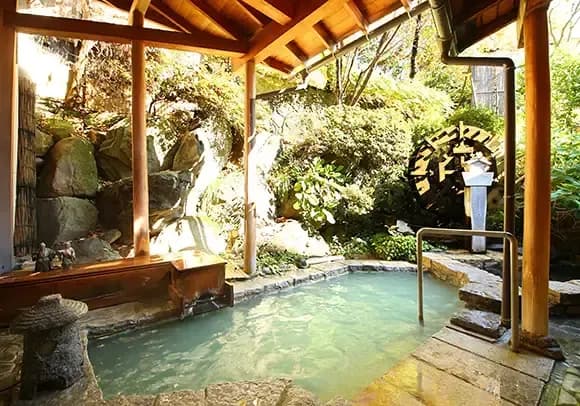
The spring, as recorded in its analysis, is a sodium chloride spring (hypotonic, weakly alkaline and high-temperature). Its pH is about 8.3, its source temperature roughly 49.8C, and it flows at an abundant 800 tons per day, remarkable for a small southern island. Drawn up from underground, the water is colorless and transparent, with a gentle saline taste and only the faintest hint of chlorine. Because it contains metaboric acid above the regulatory threshold, the water leaves the skin smooth and supple after bathing. The observation open-air bath uses a mix of flow-through and recirculation, while the garden open-air bath is filtered and recirculated, so the water management differs from bath to bath.
The complex has two distinct faces. One is the swimsuit-friendly jungle pool, dotted with a cave bath, a cascade bath and a lying-down bath, kept warm year-round so families and friends can soak together with ease. The other comprises the nude open-air baths and a sea-view observation bath. The open-air bath sits at a mild 41C or so, gently easing the parasympathetic nervous system, while the roughly 42C observation bath commands a sweeping view of Miyako's sea and sky. Women can also enjoy an amethyst sauna and a Mongolian rock-salt sauna, and there are a cafe, gym and massage services on site.
Access is easy: about 15 minutes by car from Miyako Airport, with a free resort shuttle bus also available. Because admission includes a bath towel and face towel, you can arrive empty-handed with only a swimsuit in hand. At dusk, after a day under the southern sun, surrendering to the water while the subtropical breeze drifts by is an experience that lingers long in the memory of any Miyako Island stay.
5. Ryukyu Onsen Ryujin no Yu (琉球温泉 龍神の湯) — Tomigusuku City, Senaga Island
Ryukyu Onsen Ryujin-no-Yu sits on Senaga Island, a small island linked to the mainland by a causeway just south of Naha Airport, and is famous for a rare setting where aircraft take off and land within arm's reach of the baths. The island features in Ryukyuan creation lore and, before the war, was a sacred place visited by those praying for children. The 'child-bearing rock' (Ishiirii), worship sites and sacred springs were scattered across it, drawing pilgrims from the wider region. After the Battle of Okinawa, however, the entire island was requisitioned by the U.S. military and its residents were forced to resettle on the opposite shore. The island's worship sites and sacred springs were consolidated and relocated to Akasachi Forest across the water, becoming today's Senaga distant-worship site (finalized in 1975). The hotel grounds where the resort now stands are therefore not themselves the sacred site. The island was returned in 1977 and, through that history, was reborn into its present form.
The spring rises from 1,000 meters underground at an abundant rate of about 500 liters per minute. It is a sodium-chloride strong salt spring with a high source temperature of roughly 50C. Because it holds a dense concentration of sea-derived salts, the water has a thick, clinging texture and keeps the body remarkably warm after bathing. As a strong salt spring, though, it is heated, recirculated through filtration and chlorinated for hygiene and temperature control, and so is not a free-flowing kakenagashi source. It is best enjoyed for what it is: a resort hot spring on the edge of the city.
The centerpiece is the open-air area overlooking Naha Airport's second runway and the East China Sea. From the standing bath, where you soak upright, a panorama of sea, runway and departing planes spreads out before you. Jar baths, rock baths and reclining baths add variety, while indoor baths, a loyly sauna, a mist sauna and a cold-water bath round out the offering. At dusk the sun sinking into the East China Sea tints the water, wrapping bathers in a sense of tropical-resort openness.
Day-trip bathing costs 2,000 yen for adults and 1,000 yen for children, and the baths are open from 6:00 in the morning until midnight (last entry 23:00), year-round. The early-morning and late-night hours make it easy to stop by at the start or end of a trip, and hotel guests may bathe free of charge throughout their stay. Just 15 minutes by car from Naha Airport, with a bus stop right at the door, it even lets you slip in a soak during a layover. The island's Senagajima Umikaji Terrace, lined with restaurants and shops, pairs well with the baths for an easy half-day out.
6. Terme VILLA Chura-yu (Terme VILLA ちゅらーゆ) — Chatan Town, Nakagami District
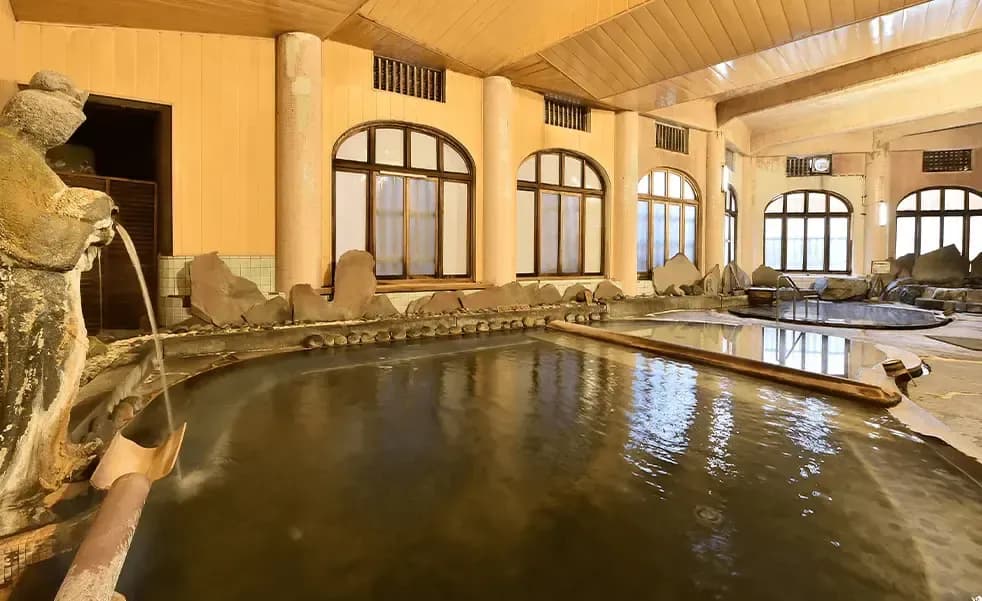
The land in Mihama, Chatan, where Terme VILLA Chura-yu stands was once Hanby Airfield, a U.S. military installation. The airfield was returned in 1981, and from 1988 the neighboring shoreline was reclaimed to create what is now one of Okinawa's leading tourist areas, the Mihama Town Resort American Village. On a corner of this district, which transformed from a base town into a resort where young people gather, this natural hot spring sits within the grounds of the resort hotel The Beach Tower Okinawa. Its view of the sea and a Ferris wheel rests atop the history postwar Okinawa has walked.
The water is a sodium bicarbonate spring drawn from a source named Chatan Megumi Onsen Mihama no Yu. Pumped from roughly 1,400 meters underground, it emerges at 42.1 degrees Celsius with a pH of 8.47, a weakly alkaline, hypotonic, high-temperature spring. Characteristic of bicarbonate springs, it gently removes excess dead skin and sebum, earning its reputation as a skin-beautifying bath that leaves the skin feeling light and smooth. The open-air bath is supplied with free-flowing source water without dilution, so bathers can enjoy a genuine natural hot spring even at a tropical resort.
The bathing area centers on an open-air bath open to blue skies and sea breezes, complemented by an indoor bath and a high-temperature sauna. A swimsuit zone adds Okinawa's first natural hot spring healing pool, surrounded by tropical plants, along with multipurpose pools, making it a place where families and couples can spend the whole day. Being able to drop in alongside a swim in the sea or shopping and dining at American Village is part of its distinctive appeal.
Standard admission (9:00-23:00) is 1,800 yen for adults, 800 yen for children and 1,300 yen for guests 65 and older. The morning bath option for those entering between 7:00 and 9:00 is a bargain at 1,000 yen for adults, handy for a soak on the first day of a trip or before heading home. The indoor baths open 7:00-23:00 (last entry 22:00) and the outdoor pools 10:00-21:00, open year-round. It is about 40 minutes by car from Naha Airport, with the Chatan Park municipal parking lot (about 430 spaces) available, and it can also be reached by route bus. Between sightseeing, it is the perfect place to relax in a natural hot spring welling up on returned land.
7. Naha Tennen Onsen Rikka Rikka Yu (那覇天然温泉 りっかりっか湯) — Naha City
Just a few minutes on foot from Kokusai-dori, the main street of Naha, the natural hot spring Rikka Rikka Yu sits right in the middle of Okinawa's busiest shopping and sightseeing district. Attached to the COMMUNITY&SPA Naha Central Hotel, this urban hot spring is about a 5-minute walk from Miebashi Station on the Yui Rail monorail and roughly 15 minutes by car from Naha Airport. On the main island of Okinawa, which is not known for its hot springs, it has become a rare and welcome place to soak between the legs of a trip, cherished by both locals and visitors. The name Rikka Rikka comes from the Okinawan dialect for let's go, a fittingly local nickname.
The source, named Naha Natural Hot Spring Bijin-no-yu, is a sodium chloride spring drawn from deep underground. Its source temperature of about 26.6 degrees Celsius barely clears the legal threshold for a hot spring (25 degrees or above), but it is close to a cold mineral spring and too cool for bathing as is. The facility therefore officially heats the water and, for hygiene, supplies it with recirculation filtering, chlorination, and dilution. In other words, this is not a free-flowing kakenagashi spring but a recirculated, urban super-sento-style operation. With that understood honestly, one can still enjoy the lingering warmth of a chloride spring, which is slow to let the body cool.
Inside are two large bathing zones with different characters, Shiun-sen and Tougen-sen, which alternate between men and women each day. The genuine hot spring water is used only in the semi-open-air spring tub, while the jet baths, rolling baths, and similar tubs use heated tap water. Add three saunas (dry, salt, and steam), a stone-bed bathing area, and the Yuntaku dining space, and the place feels less like a single bath than a full-day integrated spa where you can hop from tub to sauna in a relaxed, tropical atmosphere.
Open from 6:00 in the morning to 23:00 at night, year-round, it is easy for travelers to drop in early or late. Adult admission starts at a reasonable 1,250 yen on weekdays for a facility in the city center, and users get three hours of free partner parking. After sampling street food and hunting for souvenirs on Kokusai-dori, stopping in to soothe a tired body is exactly what this spring is for, making it a fitting final soak to round off a trip to Okinawa.
Summary: What to Know Before Exploring Okinawa's Hot Springs
Okinawa's hot springs fall into five areas: greater Naha, the south of the main island, the central coast, the north, and Miyako Island. Most sit where you would pass them during sightseeing or a resort stay, so it makes sense to build them into a broader itinerary.
Greater Naha. Three baths cluster here. Miegusuku Onsen Shimanchu no Yu is attached to a hotel on Naha Port, close to the city center. Ryukyu Onsen Ryujin no Yu sits on Senaga Island in Tomigusuku City, on a rise right beside Naha Airport with views over the runway and the East China Sea — easy to slot in on an arrival or departure day. Naha Tennen Onsen Rikka Rikka Yu is near Kokusai-dori in central Naha and within walking distance of a Yui Rail (monorail) station, one of the few facilities you can reach entirely by public transport.
Southern Main Island. Sashiki no Enjin no Yu, in Nanjo City, is the only bath on this list that claims 100% source-fed water. Its brown, strongly saline chloride water stands out in a prefecture where heated, recirculated baths are the norm. Reach it by car from Naha, and pair it with southern sights such as Sefa-utaki, a sacred Ryukyuan site, or the Nirai-kanai Bridge.
Central and Northern Main Island. Terme VILLA Chura-yu, near American Village in Chatan Town, runs part of its open-air bath as source-fed water and pairs well with the central beaches. Jurassic Onsen Chura-umi no Yu, in Motobu, sits on the route to the Okinawa Churaumi Aquarium; its name refers to the ancient strata the water comes from. Buses are infrequent in the north, so a rental car is the practical choice.
Miyako Island. Shigira Ougon Onsen is part of the Shigira Seven Miles Resort in Miyakojima City and is known as one of Japan's southernmost hot springs. Reaching Miyako means a flight from Naha or a major mainland airport, and getting around the island requires a car. It includes swimsuit zones, giving it a resort character quite different from the baths on the main island.
A few practical points apply across the list. Tattoos: attitudes at resort-style facilities in Okinawa tend to be more relaxed than at many mainland inns, but policies still vary, so contact the facility in advance rather than assume entry. Bathing is generally separated by gender and done without swimwear, except in mixed swimsuit zones such as those at Shigira Ougon Onsen, where swimwear is required — check each facility's rules. Reservations are not usually needed for day bathing, though hours can be limited or change. Cash remains the safer default at smaller facilities, even as card and IC payment spread at the larger resorts. Only central-Naha spots like Rikka Rikka Yu are realistically reachable without a car; for the south, the north, and Miyako Island, plan on a rental car.
The information in this article (admission fees, operating hours, water quality data, etc.) is based on research conducted at the time of writing. Details may have changed or contain errors. Please verify the latest information on each facility's official website or through the local tourism association.