7 Hidden Hot Springs in Aichi: From Ancient Horai Gorge to Ise Bay
Aichi Prefecture runs from the Chita Peninsula and Ise Bay in the south to the mountains of Oku-Mikawa in the north, a stretch of coastline and highland rarely associated with hot springs. Yet in the hills of eastern Aichi, Yuya Onsen has flowed for some 1,300 years. Legend holds that Rishu Sennin, the ascetic who founded nearby Horaiji Temple, discovered a sacred spring here; the adjacent Horaisan Toshogu Shrine, dedicated to Tokugawa Ieyasu, still stands close by. Further into the hills, Kitashitara District is home to Toei Town, where Hana Matsuri, a ritual dance handed down for more than 700 years since the Kamakura period, is performed each winter, and to Toyone Village, a mountain community on the shore of the Sakuma Dam reservoir where bathing, faith, and regional revival are closely intertwined.
Toward the plains, the town of Kanie in Ama District, just outside Nagoya, is home to Owari Onsen, whose source water is drawn from roughly 1,200 meters underground and served without dilution, heating, or recirculation — the only hot spring in Aichi selected for Japan's "100 Famous Hot Springs." Out on the Chita Peninsula, Handa City has a day-trip bath named for the folk tale Gon, the Little Fox, and in Minamichita Town, an inn overlooking Ise Bay keeps its bath running straight from the source.
Aichi is not a prefecture rich in hot spring resources. Below are 7 springs where a genuine flow-through source could be confirmed, chosen for quality over quantity.
1. Yuya Onsen Hazuki (湯谷温泉 はづ木) — Shinshiro City
Nestled in the scenic Horai Gorge in Shinshiro City, Aichi Prefecture, Yuya Onsen traces its origins back some 1,300 years. According to legend, Rishu Sennin — born in 570 CE and later ordained after studying Buddhism in Baekje — discovered a sacred spring here and used its restorative waters to sustain his ascetic practice, reportedly living to the age of 308 according to the local Nagashino village chronicles. That original source is still known today as Horekisen. Centuries later, the third Tokugawa shogun, Iemitsu, learned during a pilgrimage to Nikko Toshogu that Ieyasu's birth was said to have been granted through prayers at nearby Horaiji Temple, and ordered the construction of Horaisan Toshogu Shrine beside the temple. Ranked alongside Nikko and Kunozan as one of Japan's Three Great Toshogu Shrines, it still stands quietly near the onsen today. Hazuki, a five-room ryokan on the banks of the Ure River, sits within this storied hot spring town.
Hazuki draws its water from its own source, known as Yuya Onsen Well No. 7, classified as a sodium chloride spring (hypotonic, neutral, low-temperature spring). The source emerges at 35.9°C, colorless and odorless but rich in mineral salts, giving bathers a deep, lasting warmth. The bath water is supplied on a pure kake-nagashi basis — no added water, no heating circulation, no recycling — delivering the spring in its natural state straight into the tub, valued for easing neuralgia, muscle pain, and joint stiffness, and for leaving the skin notably smooth.
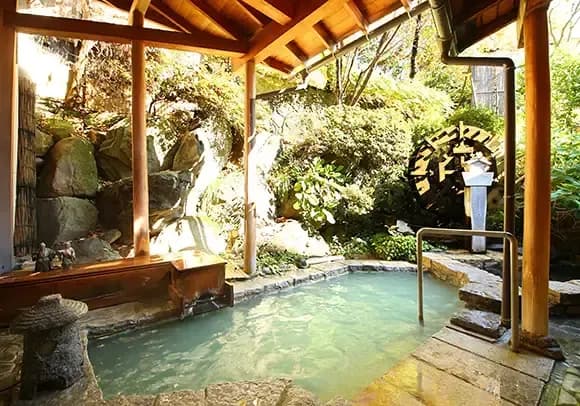
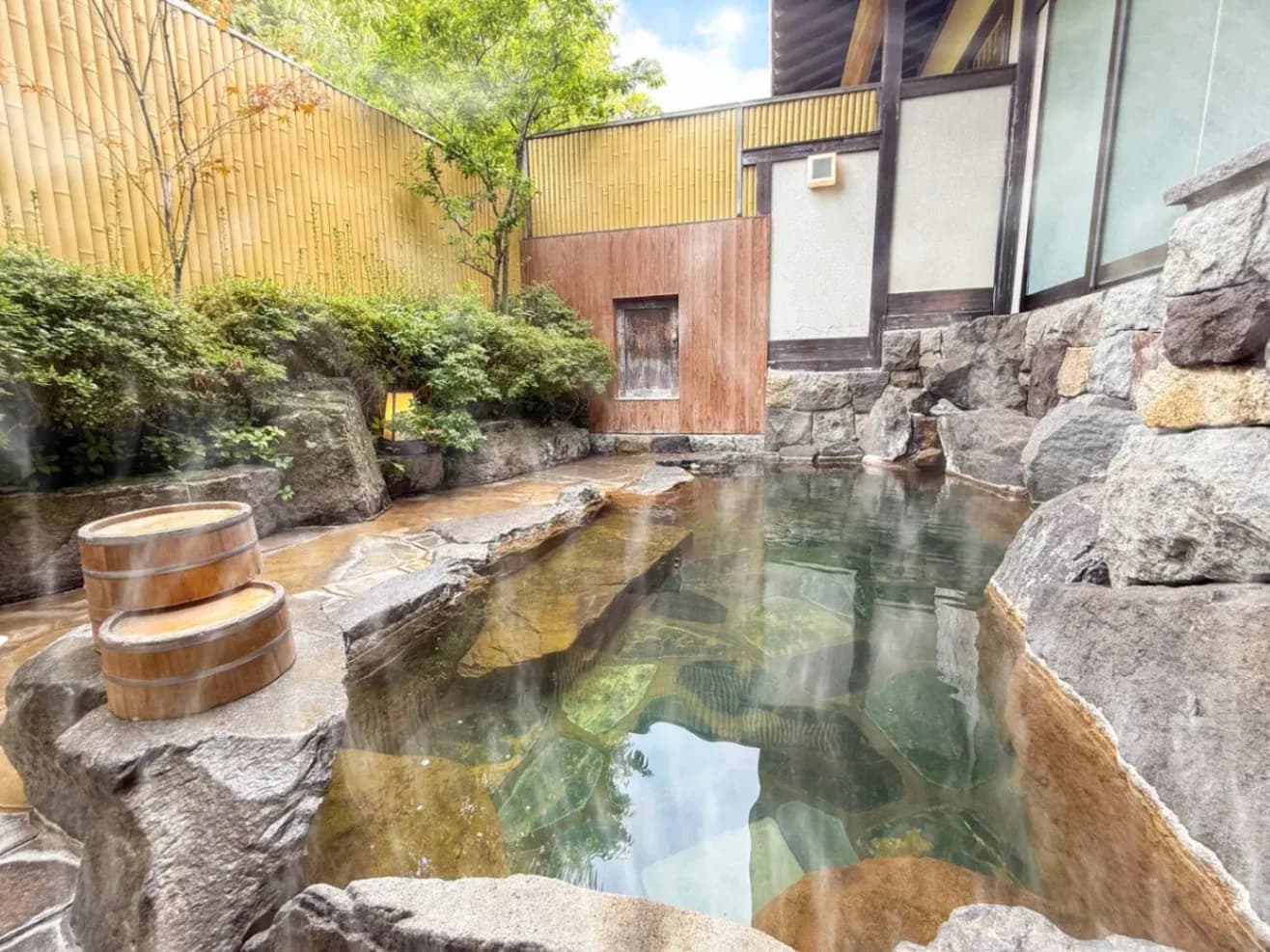
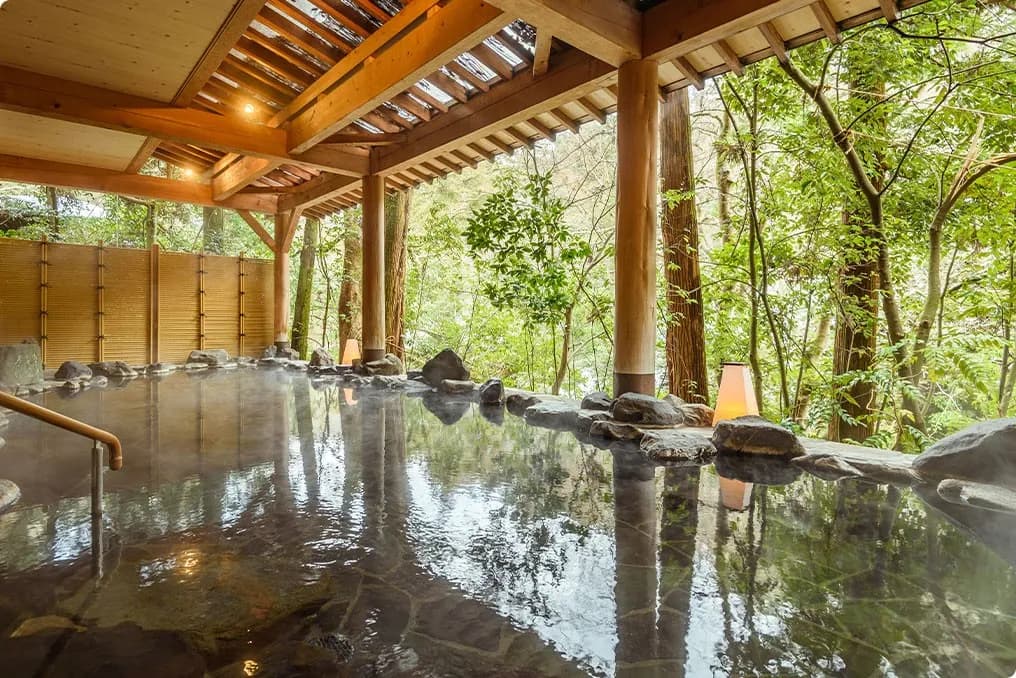
The all-wood sukiya-style building showcases traditional Japanese craftsmanship throughout. Its signature bath is a hinoki cypress open-air tub overlooking the Ure River valley, offering unobstructed views of the gorge's changing seasonal scenery. Both this outdoor bath and the indoor bath are reservable for private use by overnight guests, typically for 40-minute sessions. Dining centers on Chinese herbal kaiseki cuisine prepared by a chef trained in Shanghai, blending medicinal wisdom with refined kaiseki presentation — a hallmark of hospitality made possible by the inn's intimate five-room scale.
Overnight stays start from around 44,000 yen (tax included) for two guests sharing a room, with distinctive plans such as fasting retreats also available. Day-trip bathing is offered only through a reservation-required lunch plan, available from 11:00 to 14:30. The inn is roughly 15 minutes by car from Shinshiro IC via Route 151 toward Iida/Toei, or about 3 minutes on foot from JR Iida Line Yuya Onsen Station, making it accessible by both car and public transport. Visitors can easily combine their stay with a visit to the maple-famed Horai Gorge and the historic Horaisan Toshogu Shrine and Horaiji Temple nearby, rounding out a journey into a hot spring with 1,300 years of history.
2. Yuya Onsen Ryoso Mitsui (湯谷温泉 旅荘みつい) — Shinshiro City
Yuya Onsen is said to have been discovered some 1,300 years ago by Rishu, the ascetic monk who founded nearby Horaiji Temple, making it one of Aichi Prefecture's oldest hot spring sites. The hot spring town lines both banks of the Ure River, a tributary of the Toyo River, and once had about ten inns; today Ryoso Mitsui is the only one still open to day-trip bathers. Just a three-minute walk from Yuya Onsen Station on the JR Iida Line, the inn nonetheless retains a quiet, secluded atmosphere framed by the sound of the river and the surrounding greenery.
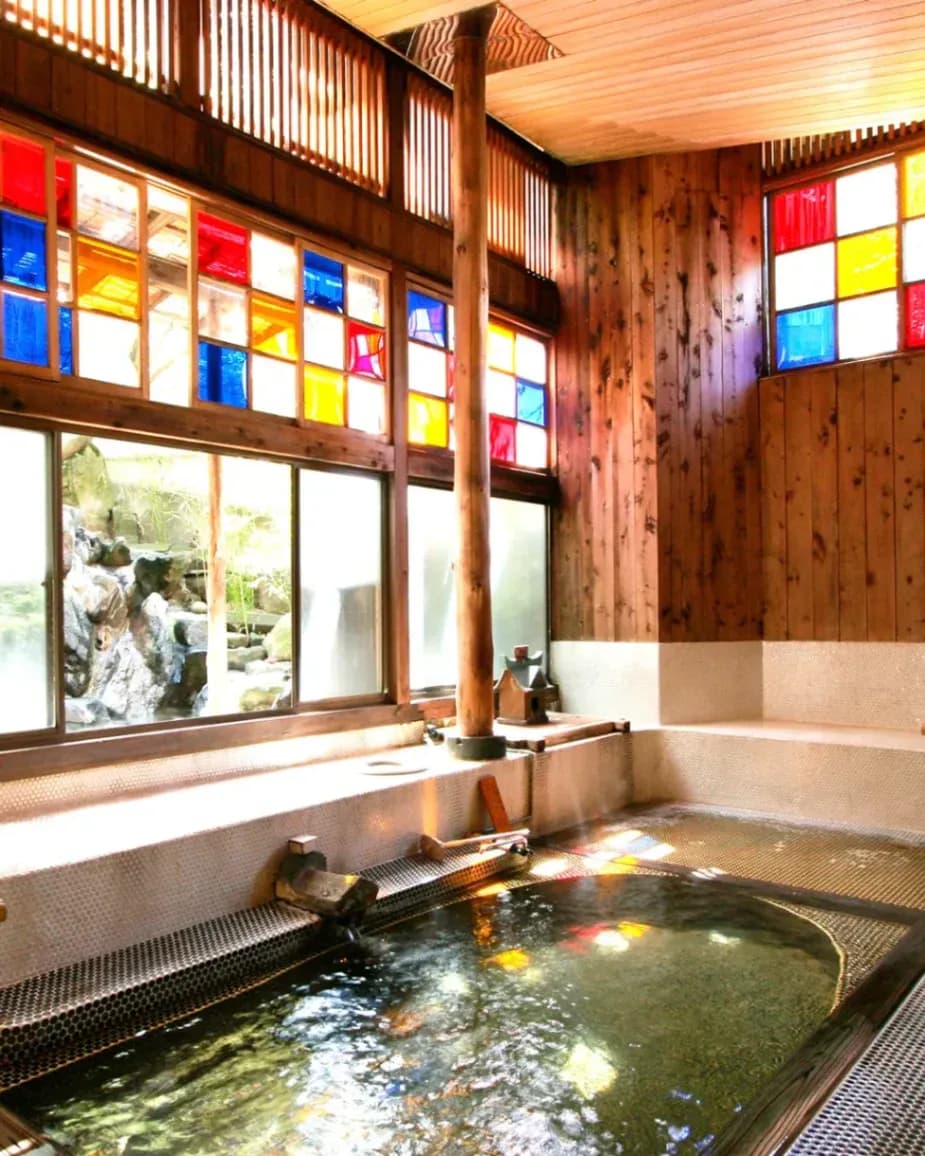
The water is officially classified as a sodium-calcium chloride spring. The source emerges at 35.6°C and is heated before being fed into the baths. True to its chloride-rich character, the water takes on a deep golden hue that bathers often describe as sparkling, with a faint metallic scent. It has a smooth, non-slippery feel on the skin, and its salt content is said to help the body retain heat, making it a traditional remedy for neuralgia, poor circulation, and muscle fatigue. According to the inn's official website, the indoor bath is heated but supplied 100 percent directly from the source with no recirculation. However, whether the open-air and private baths are diluted or filtered and recirculated is not officially disclosed, so no claim of pure source-fed bathing can be made for those baths.
Beyond the indoor bath, the inn offers an open-air bath overlooking the Ure River and its wooded banks, plus a private family bath that guests can reserve for their own use. Day-trip bathing is offered strictly by reservation, in one-hour private blocks, letting visitors soak at their own pace without sharing the bath with strangers. The changing rooms are kept spotless, and guests can choose from several types of shampoo among the well-stocked amenities. A major renovation in 2023 further improved the guest experience. Overnight guests can also enjoy home-style mountain cuisine paired with the valley's seasonal scenery.
Day-trip bathing costs 1,000 yen for adults and 500 yen for children under elementary-school age, with children three and under admitted free; it is available from 10:00 a.m. to 2:00 p.m. by advance reservation only. By car, it is about a 10-minute drive from the toll-free Horaikyo IC on the Sanen-Nanshin Expressway via Route 151, or about 15 minutes from the Shinshiro IC on the Shin-Tomei Expressway, and free parking for nine cars is available on site. Each season brings its own charm, from fresh greenery in spring to river play in summer, autumn foliage, and quiet soaking in winter, but because the baths are reservation-only, calling ahead is essential. The inn also makes a convenient stop when combined with sightseeing at nearby Mt. Horaiji or the Horaikyo gorge.
3. Toei Onsen Hanamatsuri no Yu (とうえい温泉 花まつりの湯) — Toei Town, Kitashitara District
Toei Town, deep in Aichi Prefecture's Oku-Mikawa region, is known as the home of Hana Matsuri, a sacred ritual dance handed down for more than 700 years since the Kamakura period. Performed through the night in villages across the town every year from November to January, the festival drives away evil spirits and prays for a bountiful harvest and freedom from illness, and was designated a National Important Intangible Folk Cultural Property in 1976. Toei Onsen Hanamatsuri no Yu, literally the bath of the flower festival, opened in 2002 in this very land steeped in Hana Matsuri tradition, offering a hot spring shaped by the intertwined mountain cultures of therapeutic bathing and ritual faith.
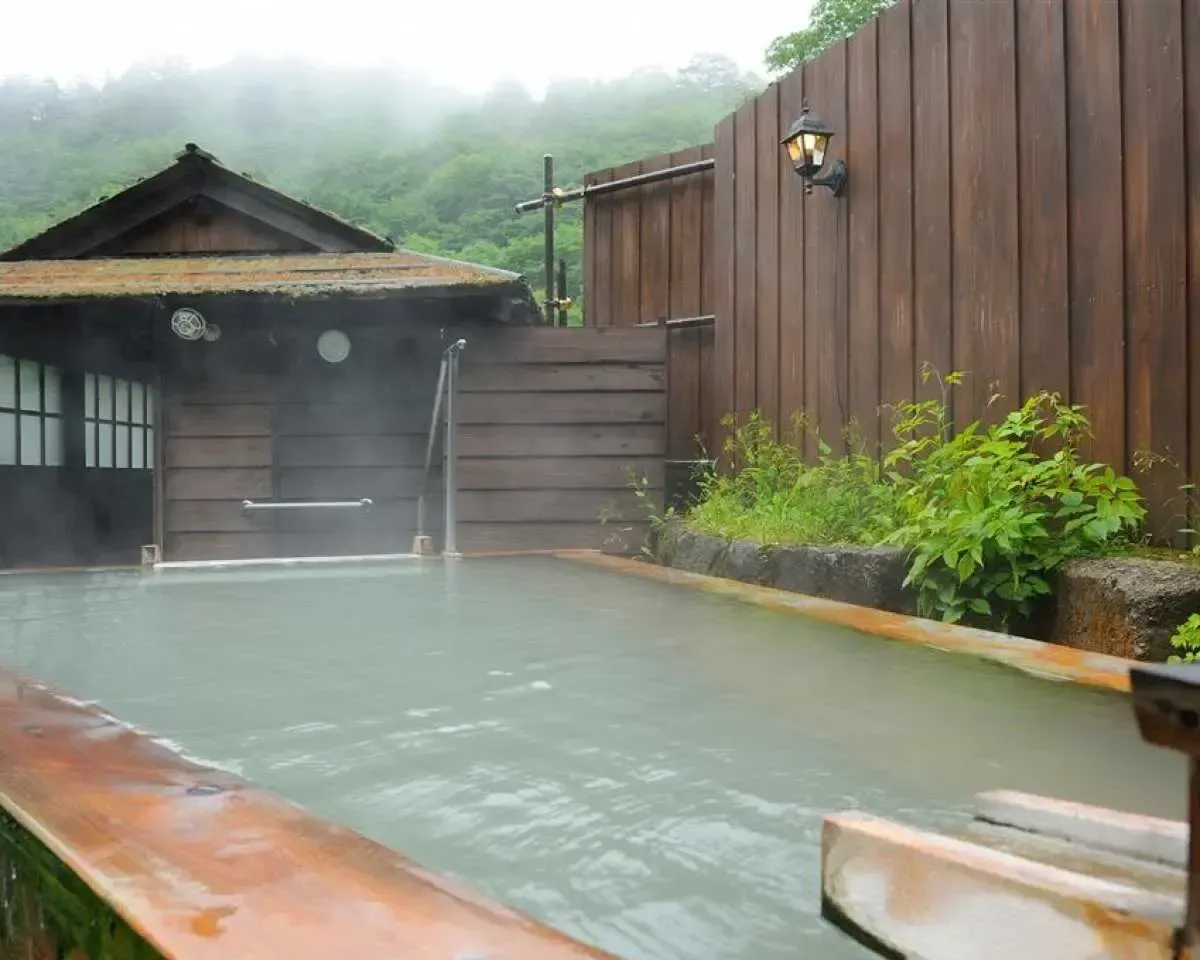
The water here is officially classified as a sodium-calcium chloride spring (hypotonic, neutral, low-temperature spring). According to the facility's spring analysis certificate, it has a pH of 7.4, a source temperature of 32.2°C, a discharge rate of 430 liters per minute, and total dissolved solids of 5.867 g/kg. Notably, only the Gensen-buro (source bath) uses the spring water directly, without dilution, heating, or circulation, delivering it on a genuine flow-through basis; its faintly yellowish, slightly cloudy water conveys the gentle, warming character typical of chloride springs. The other baths, however, are heated, circulated, and disinfected, so it is worth understanding precisely that flow-through bathing is available in only part of the facility, not throughout.
The bathing area combines a rustic, rock-lined open-air bath, a shallow reclining bath for stretching out, a seated soaking bath, and a sauna heated to roughly 80°C. A walking path leads from the open-air bath to a lookout over Tsuta-no-Fuchi, the roughly 70-meter-wide waterfall behind the facility nicknamed the Niagara of Oku-Mikawa, making a post-bath stroll part of the experience. The on-site restaurant Hana no Mai serves local specialties such as gohei-mochi rice cakes and Toei-grown chicken, complemented by a tatami-matted lounge, a souvenir shop, and coin-operated massage chairs, enough to fill a relaxed full day even as a day-trip visitor.
Admission costs 800 yen for adults and 350 yen for children (ages 3 through elementary school), with discount ticket books also available. The facility is open from 10:00 to 21:00 (last entry 20:00) and closed on Wednesdays, except when a Wednesday falls on a public holiday. It is roughly 10 minutes by car from Toei Interchange on the Sanen-Nanshin Expressway, or about 15 minutes by community bus from Toei Station on the JR Iida Line, making it relatively easy to reach within the Oku-Mikawa area. With free parking for 180 vehicles, it makes a fitting stop for a day-trip soak during the Hana Matsuri season from November to January or after enjoying the region's autumn foliage.
4. Yunoshima Onsen (湯の島温泉) — Toyone Village, Kitashitara District
On the shore of the reservoir held back by the Sakuma Dam, tucked deep in the mountains of Toyone Village in Aichi Prefecture, Yunoshima Onsen quietly sends up its waters. Through the changes brought by the dam's construction, the people of the Tomiyama district have carefully protected this spring and passed it down as a village-run communal bathhouse to this day. Surrounded by deep mountains and difficult to reach by either public transport or car, it is known among hot spring enthusiasts as a "hidden hot spring of Oku-Mikawa," a destination worth the deliberate detour.
The spring water is a sodium bicarbonate-chloride type: hypotonic, weakly alkaline, and known for a smooth, slightly silky feel on the skin. Because the source temperature is low, the water is heated before use. The indoor bath is heated, recirculated, and filtered, with disinfection applied as part of hygienic management, while the outdoor bath draws from both a raw source spout and a heated spout, balancing the rustic character of a mountain spring with responsible sanitation. The water is said to ease neuralgia, muscle pain, poor circulation, and fatigue, offering a quiet soak far from the crowds.
The bathing facilities consist of a rock-lined indoor bath and a small open-air bath enclosed by a bamboo fence, each barely large enough for a handful of bathers at once. This modest, unpolished character stands in sharp contrast to larger, more commercialized resorts. Beyond the bamboo fence and windows, the mountains cradling Lake Sakuma spread out in green summer foliage or autumn color, offering a luxurious moment of silence while soaking. There is no restaurant on-site, so visitors should bring their own food and drink.
The facility is open only on Saturdays, Sundays, and public holidays from 1:00 PM to 7:00 PM, and closed on weekdays. Admission is an affordable 440 yen for adults and 330 yen for elementary school children, with preschoolers admitted free. The outdoor bath is typically closed in winter (roughly mid-November through late April) to protect the facility, so visitors hoping to enjoy it should plan a weekend visit between spring and autumn. Combining a visit with a drive around Sakuma Dam and the surrounding Oku-Mikawa villages makes for a rewarding day trip.
5. Owari Onsen Tokai Center (尾張温泉 東海センター) — Kanie Town, Ama District
Just a few dozen minutes by car from central Nagoya, Owari Onsen Tokai Center sits in the town of Kanie in Aichi Prefecture's Ama District. The facility traces its roots back to 1963, when Tokai Radio opened it as "Kanie Onsen Tokai Health Center." Hot spring water was successfully tapped in 1966, and the sitting governor of Aichi, Mikine Kuwahara, gave it the name "Owari Onsen"; the following year it was renamed Owari Onsen Tokai Center, the name it carries today. While many hot springs near major cities rely on recirculated water, this facility has kept faith with its natural source ever since it opened.
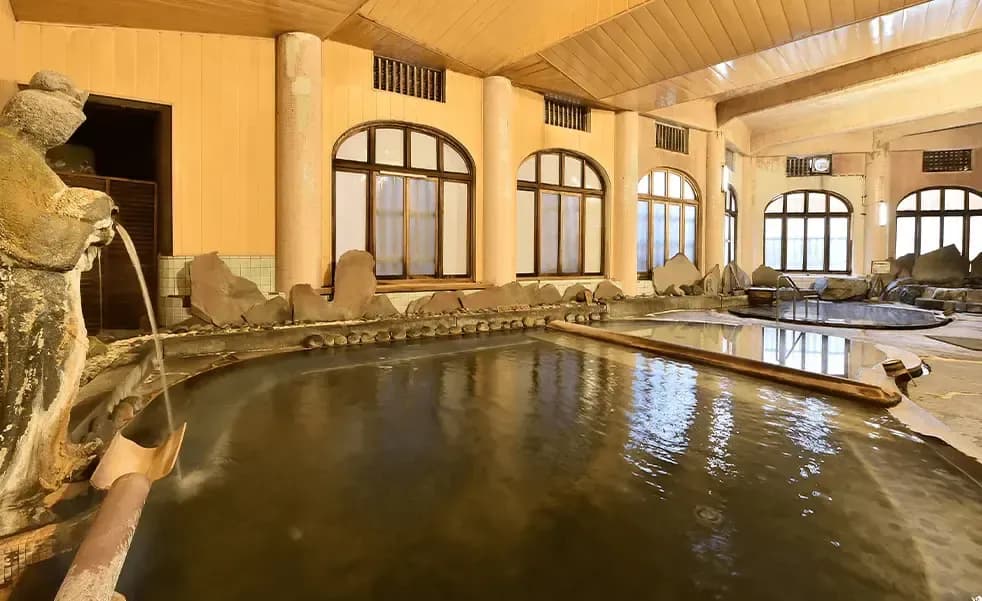
Its defining feature is a truly unadulterated flow-through bath: water drawn from roughly 1,200 meters underground is delivered straight to the tubs with no added heat, no diluting tap water, no circulation-filtration system, and no chlorine treatment. By skillfully blending four high-temperature wells (around 50°C) with two cooler wells (around 28°C) — six self-owned sources in total — the center achieves a comfortable soaking temperature through nature alone, without mechanical heating. The water is classified as a simple hot spring (partly alkaline simple hot spring), colorless and clear with a notably soft, gentle feel on the skin. This uncompromising commitment to flow-through bathing has earned Owari Onsen the distinction of being the only hot spring in Aichi Prefecture selected among Japan's "100 Famous Hot Springs."
The bathing hall itself impresses with indoor and open-air baths accented by large natural boulders, offering a sense of openness rarely found at an urban-adjacent day-trip bath. Inside, guests will find a lounge, a children's play area, a light-meal corner, and a gift shop, making it easy for families to spend a relaxed full day there. The grounds also include a free foot bath, "Kanie Ashiyu no Sato," fed by the same source water, letting visitors enjoy the spring's warmth even without a full soak.
The center is open year-round from 1:00 PM to 11:00 PM (last entry 10:30 PM). Admission for adults (junior high school age and up) is 700 yen on weekdays and 800 yen on weekends and holidays, while children (elementary school age) pay 300 yen; towel rental costs an additional 270 yen. With the Kanie interchange on the Higashi-Meihan Expressway just three minutes away by car, it is an easy stop after work or for a spontaneous weekend visit. For anyone near Nagoya in search of a genuine, fully source-fed hot spring, this is one of the first places worth visiting.
6. Handa Natural Onsen Maruha Gongitsune no Yu (半田天然温泉 まるはごんぎつねの湯) — Handa City
Handa City in Aichi Prefecture is the hometown of Nankichi Niimi, the celebrated children's author behind the folk tale 'Gon, the Little Fox' (Gongitsune). Handa Natural Onsen Maruha Gongitsune no Yu is a day-trip hot spring facility that takes its name from this beloved local story. It is operated by Maruha Shokudo, a restaurant famous locally for its jumbo fried shrimp, which runs a food-court-style dining area right next to the baths, letting visitors enjoy the signature dish after soaking. Just a one-minute drive from the Handa Chuo Interchange on the Chita Peninsula Toll Road, the facility's convenient location has made it a favorite for locals seeking a quick, everyday soak at a well-regarded local bathhouse.
The water is a sodium chloride strong salt spring (hypertonic, weakly alkaline, high-temperature spring) drawn from 1,500 meters underground, with a source temperature of 59.2°C and a pH of roughly 7.5. Rich in sodium and chloride ions, its total mineral concentration exceeds 26 grams per kilogram, among the highest in the Tokai region. Not every bath here runs pure source water, however: only the open-air 'Takitsubo-yu' waterfall pool is fed undiluted straight from the source at 44-45°C, while the remaining indoor and outdoor baths are heated, filtered through a circulation system, and chlorine-treated. Visitors hoping for a genuine source-fed soak should head straight for the Takitsubo-yu.
The highlight of the bathing area is the varied lineup of pools set within a garden-view open-air bath. There is a cave bath tucked into a rock grotto, a reclining bath, a seated bath, and a walking bath for circulation, alongside the Takitsubo-yu, where hot spring water tumbles down from a 3.5-meter waterfall, combining the invigorating force of a shower bath with the character of source-fed water. A pure Japanese-style indoor bath scented with wood, along with a sauna and cold plunge pool, rounds out the facility, catering to those who want a long, slow soak as well as those chasing a sweat.
The facility is open from 10:00 to 22:00 (last entry 21:00) and closed on Mondays, though it stays open on public holidays (shifting the closure to the following Tuesday) and remains open every Monday from the 26th through the end of each month. Admission is 900 yen for adults and 400 yen for children on weekdays, rising to 950 yen and 450 yen on weekends and holidays, with discounted pricing on the 26th of each month ('bath day'). Free parking for 60 vehicles makes driving convenient, and the facility is also about 10 minutes by taxi from Chita-Handa or Sumiyoshicho stations on the Meitetsu Kowa Line. Consider pairing a visit with nearby attractions such as the Handa Canal or the Nankichi Niimi Memorial Museum, and be sure to try Maruha Shokudo's famous jumbo fried shrimp after your bath.
7. THE BEACH KUROTAKE — Minamichita Town, Chita District
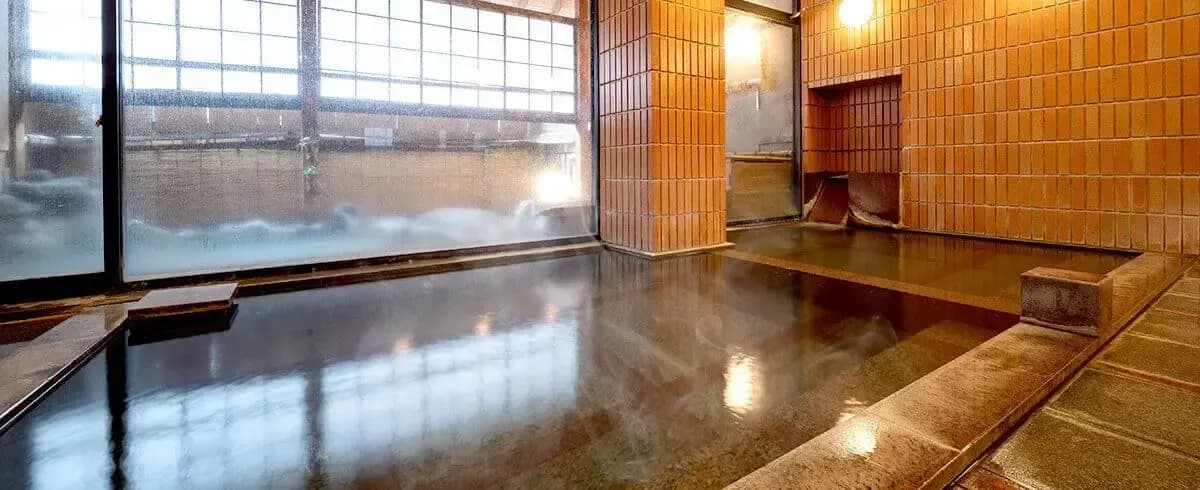
THE BEACH KUROTAKE is a hot spring inn standing along the Utsumi coastline in Minamichita, Chita District, Aichi Prefecture. Once known locally as Kanko Hotel Uotomo, the inn underwent a complete renovation before reopening under its present name. Its guiding claim is that it is the only hot spring inn on the Chita Peninsula with a genuine source-fed, non-circulating bath, and that commitment to kake-nagashi bathing has become the core of the renewed property. Steam rising from its own on-site source, KUROTAKE no Yu, can be seen up close within the grounds, a sight unique to this inn.
The spring water is a sodium chloride spring with a source temperature of 50.2 degrees Celsius. Rather than diluting or heating the water, the inn adjusts the bath temperature by controlling the volume of source water it lets flow, and it does not run the water through circulation filtration. A minimal amount of chlorine is used for hygiene purposes, but otherwise the water reaches the tub much as it emerges from the ground. The bath has a clear, faintly yellowish tint and a subtle briny scent, and is said to help with neuralgia, muscle and joint pain, poor circulation, and general fatigue recovery.
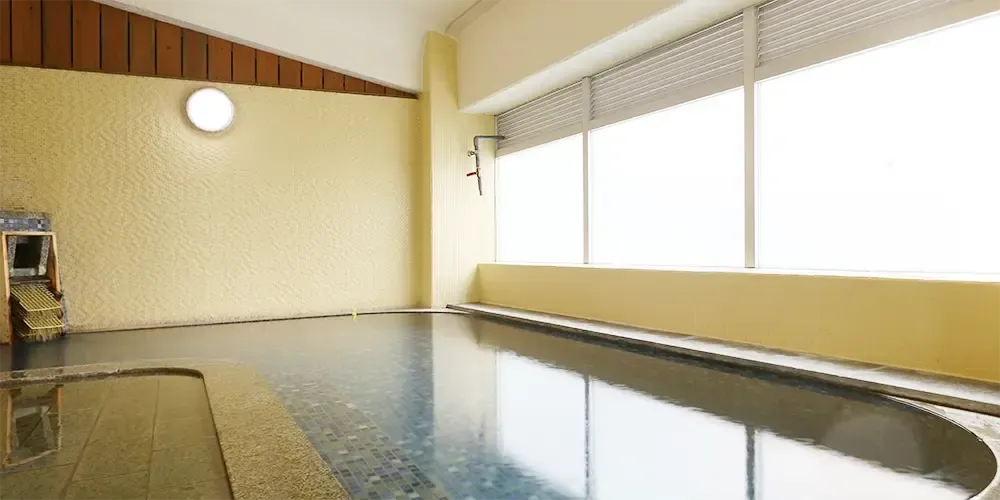
The bathing facilities center on an approximately 60-square-meter indoor bath and an open-air bath, both separated by gender, offering an unobstructed view of the Ise Bay horizon from the tub. Rooms on the upper floors and the 4th floor come with their own private open-air hot spring baths, the Open-Air Bath Japanese-Western Rooms A and B, and the View Bath Japanese-Western Room, letting guests enjoy the source water without sharing it with anyone else. All 24 rooms face the ocean, and dining on Ise Bay seafood in the private dining rooms is one of the inn's other pleasures.
By car, it's about 15 minutes from Minamichita IC on the Minamichita Road via Prefectural Route 52 and National Route 247, with free parking for 30 cars (no reservation needed). Travelers arriving by train can use the inn's shuttle from Utsumi Station on the Meitetsu Chita Shinsen Line (reservation required, running 15:00-17:00 and 9:00-11:00 the next morning). Stays start from 28,400 yen for two people with two meals included (tax included). Day-trip bathing is not offered, making the hot spring an exclusive luxury reserved for overnight guests. With every room facing the ocean, the inn shines not only during the summer swimming season but also on winter mornings, when the first sunrise of the year rises over Ise Bay.
Summary: What to Know Before Visiting Aichi's Hot Springs
Aichi's hot springs fall into three areas: the mountains of eastern Mikawa, the Owari plain, and the Chita Peninsula.
Eastern Mikawa Mountains. Two inns at Yuya Onsen in Shinshiro City still accept day-trip bathers. Hazuki draws on Yuya Onsen's Well No. 7, a sodium chloride spring at 35.9°C served free-flowing with no dilution or recirculation. Day bathing, however, is offered only through a reservation-required lunch plan from 11:00 a.m. to 2:30 p.m. Ryoso Mitsui's water is officially classified as a sodium-calcium chloride spring at 35.6°C; its indoor bath is heated but supplied 100 percent directly from the source, according to the inn, while the open-air and private baths have no published information on dilution or recirculation. Of the roughly ten inns Yuya Onsen once had, Ryoso Mitsui is now the only one open to day-trip bathers, in one-hour reserved blocks from 10:00 a.m. to 2:00 p.m. for 1,000 yen. Both inns are about a 3-minute walk from Yuya Onsen Station on the JR Iida Line.
In Toei Town, Hanamatsuri no Yu supplies pure flow-through water only through its outdoor Gensen-buro (source bath); the other tubs are heated, recirculated, and disinfected. It is open from 10:00 a.m. to 9:00 p.m. for 800 yen, closed Wednesdays. In Toyone Village, the village-run Yunoshima Onsen sits on the shore of the Sakuma Dam reservoir and opens only on Saturdays, Sundays, and public holidays, from 1:00 to 7:00 p.m. Its indoor bath is heated, recirculated, and disinfected, while the outdoor bath blends a raw source spout with a heated one. Both facilities lie 20 to 30 minutes by car from the nearest expressway interchange, deep in the mountains where public transport is sparse — a car is the practical way to reach them.
Owari Plain. Owari Onsen Tokai Center in Kanie, Ama District, draws on six of its own wells — four hot sources near 50°C and two cooler ones near 28°C — all pulled from roughly 1,200 meters underground. Blended together with no added heat, no dilution, no filtration-recirculation, and no chlorine, the water reaches the tub as a genuine flow-through bath, the only hot spring in Aichi Prefecture selected for Japan's "100 Famous Hot Springs." It's about 3 minutes by car from Kanie IC on the Higashi-Meihan Expressway, making it an easy stop from the Nagoya area. Open year-round from 1:00 to 11:00 p.m., admission is 700 yen on weekdays and 800 yen on weekends and holidays. It is a day-trip-only facility with no lodging on site.
Chita Peninsula. In Handa City, Maruha Gongitsune no Yu draws a concentrated salt spring at 59.2°C with total mineral content above 26 grams per kilogram, but only its outdoor "Takitsubo-yu" waterfall pool runs undiluted straight from the source — the other baths are heated, recirculated, and chlorine-treated. It sits about a minute by car from Handa Chuo IC, open 10:00 a.m. to 10:00 p.m., with weekday admission of 900 yen; note that guests with tattoos are not admitted. In Minamichita Town, THE BEACH KUROTAKE is an overnight-only inn on a bluff above Ise Bay, marketed as the only hot spring inn on the Chita Peninsula with a genuine source-fed bath. It neither dilutes nor heats the water, adjusting temperature instead by controlling the flow rate, and does not recirculate it, though a small amount of chlorine is used for hygiene. Day-trip bathing is not available; a stay starts from 28,400 yen for two guests with two meals. It's about 15 minutes by car from Minamichita IC, or reachable by train to Utsumi Station followed by the inn's reservation-only shuttle.
A few points apply across the list. Tattoo policy varies: Handa's Maruha Gongitsune no Yu explicitly turns away visibly tattooed guests, so anyone with tattoos should confirm policy directly with the other facilities before visiting. All seven baths are separated by gender rather than mixed, and swimwear is not the norm in the standard tubs — Yuya Onsen Ryoso Mitsui's private family bath is the one option here for those who would rather not bathe with strangers. Reservations matter more than at a typical city sento: Hazuki accepts day bathers only through its lunch plan, Ryoso Mitsui books hourly private slots, and Yunoshima Onsen opens on weekends and holidays alone. Payment methods vary by facility — Handa's bathhouse and THE BEACH KUROTAKE accept credit cards, but the smaller inns and the village-run Yunoshima Onsen are cash-only, so carrying cash is the safer default. None of the seven is a quick walk from a train station outside the two Yuya Onsen inns: reaching Owari Onsen means a taxi or bus from Kintetsu Kanie Station, Handa's bathhouse a taxi from Chita-Handa or Sumiyoshicho Station, Toei Onsen a community bus from Toei Station, Yunoshima Onsen a 30-minute walk or rental bicycle from Oozora Station, and THE BEACH KUROTAKE a reserved shuttle from Utsumi Station — budget extra time if traveling by public transport.
The information in this article (admission fees, operating hours, water quality data, etc.) is based on research conducted at the time of writing. Details may have changed or contain errors. Please verify the latest information on each facility's official website or through the local tourism association.