10 Hidden Hot Springs in Shizuoka: From the Izu Peninsula to the Southern Alps
Shizuoka's Izu Peninsula is one of the most densely packed hot-spring regions in Japan. The peninsula itself is a geological oddity: a volcanic island that once floated in the seas to the south, carried north on the Philippine Sea Plate until it collided with Honshu. Volcanic heat and a web of active faults together feed a remarkable range of springs across a small area of land. From central Izu around Shuzenji and Yugashima, down through southern Izu toward Shimoda, and out to the cliffs of western Izu where the land drops into Suruga Bay, no two baths share the same water or the same view.
Izu is also a landscape of literature. The novelist Yasunari Kawabata stayed for long stretches at Yumotokan in Yugashima Onsen, and the memories he gathered here became The Izu Dancer. Fukudaya at Yugano Onsen, where the traveling dancers of that novel bathe, is named in its pages too. Both inns belong to the Japan Association of Secluded Hot Spring Inns (Nihon Hitou wo Mamoru Kai).
Beyond the peninsula, springs rise deep in the mountains of central Shizuoka. Umegashima Onsen sits near the headwaters of the Abe River, while Sumatakyo Onsen and Minami Alps Akaishi Onsen lie along the upper Oi River, all cradled in the folds of the Southern Alps where peaks rise above 3,000 meters. These are mountain-gorge springs, a world apart from the coastal baths of Izu.
Shizuoka's hot springs span two very different stages: the Izu Peninsula and the foothills of the Southern Alps. Below are 10 of the most distinctive, arranged as a route that runs south through central Izu, along the western coast, and then upstream toward the sources of the Abe and Oi rivers.
1. Shuzenji Onsen Arai Ryokan (修善寺温泉 新井旅館) — Izu City

Arai Ryokan is a distinguished inn representing the Izu hot spring town of Shuzenji, founded in 1872 (Meiji 5). It sits in the heart of the hot spring quarter near Shuzenji Temple, associated with the monk Kobo Daishi, and the riverside Tokko-no-Yu spring, and has marked more than 150 years alongside the murmur of the Shuzenji River. Fifteen of the wooden buildings scattered across its grounds were designated National Registered Tangible Cultural Properties in 1998, and the entire inn is preserved as a whole. From the Taisho into the Showa era the novelist Ryunosuke Akutagawa stayed here, and the playwright Kido Okamoto completed his masterpiece Shuzenji Monogatari within these rooms. With painters such as the master Yasuda Yukihiko among its guests, the inn carries a rich history as a gathering place for writers and artists.
The water is an alkaline simple spring, common in Izu, with a pH of 8.5. It is colorless, clear, and gentle on the skin, mild and easy to enjoy. The bathing setup, however, deserves an accurate understanding: the official bath guide clearly states that every bath uses a circulation-and-filtration system. Free-flowing source water can be enjoyed only in certain tubs, and because the source is very hot, the water is diluted in some seasons to keep it at a comfortable temperature. This is not an inn that advertises 100 percent free-flowing source water; it is better appreciated as a place to quietly savor cultural-property architecture and hot spring heritage.
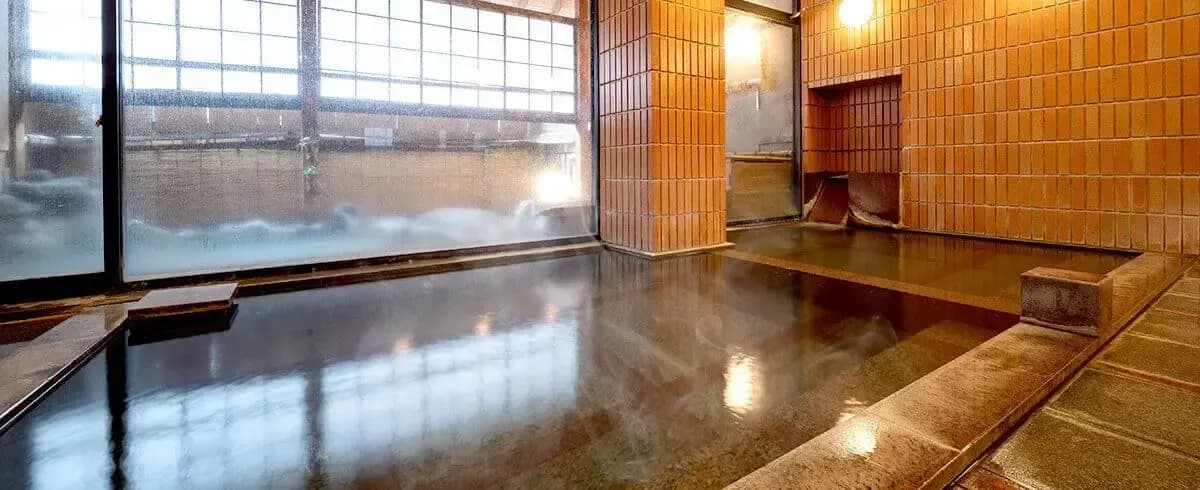
The symbol of Arai Ryokan is the all-cypress grand bath, the Tenpyo Daiyokudo. Designed by the painter Yasuda Yukihiko and completed in 1934 (Showa 9), it is a striking space wrapped in the scent of cypress beneath a coffered ceiling evoking the Nara Tenpyo period. The touch of soaking while watching carp swim in the pond outside the window conveys the inn's distinctive aesthetic. There are also an open-air bath dappled with sunlight and private baths for quiet relaxation. Overnight guests can join a guided tour of the cultural-property buildings (500 yen), enjoying the architecture and art during their stay.
Day-trip bathing is roughly 2,500 yen (plus tax) for adults from 11:30 to 14:00, though it may not be offered in every season, so checking in advance is advisable. Overnight stays with two meals begin at around 35,000 yen per person, featuring seasonal kaiseki cuisine. Access is about 10 minutes by bus or 7 minutes by taxi from Shuzenji Station on the Izuhakone Railway; because local rules prohibit inn pickup, guests use the route bus or a taxi. The fresh green and autumn foliage seasons are especially beautiful, and a visit pairs well with a stroll through the Bamboo Path and Shuzenji Temple in this atmospheric hot spring town.
2. Yugashima Onsen Yumotokan (湯ヶ島温泉 湯本館) — Izu City
Yugashima Onsen lies at the heart of the Izu Peninsula, on the banks of the Kano River at the northern foot of the Amagi mountains. Along that mountain stream stands Yumotokan, an inn so quiet it seems to have stopped in time, known as the Kawabata Inn. Its name was made immortal by a young Yasunari Kawabata. In 1922, in his early twenties, Kawabata shut himself away in a small four-and-a-half-mat room here and, drawing on his student travels through Izu, completed his celebrated novella The Izu Dancer. The room where he stayed is preserved to this day as the Kawabata Room, drawing literary pilgrims from across Japan.
The waters of Yumotokan are a calcium-sodium sulfate spring. The source emerges at about 45 degrees Celsius, a temperature well suited to bathing, and the water is colorless, transparent, and gentle to the touch. Served as pure free-flowing spring with no added water and no reheating, it carries the calm, mild character typical of sulfate springs, warming the body from its core. There is nothing flashy about it; rather, it holds the quiet richness of a true mountain hot spring.
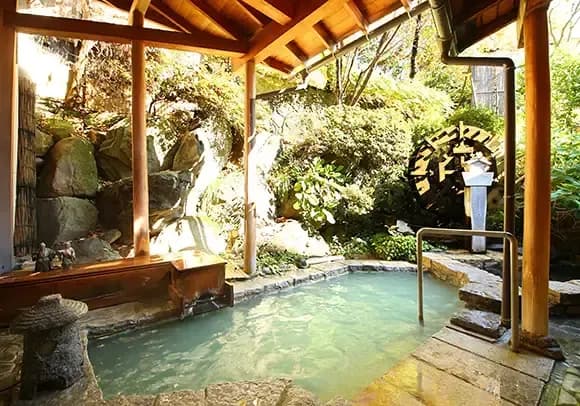
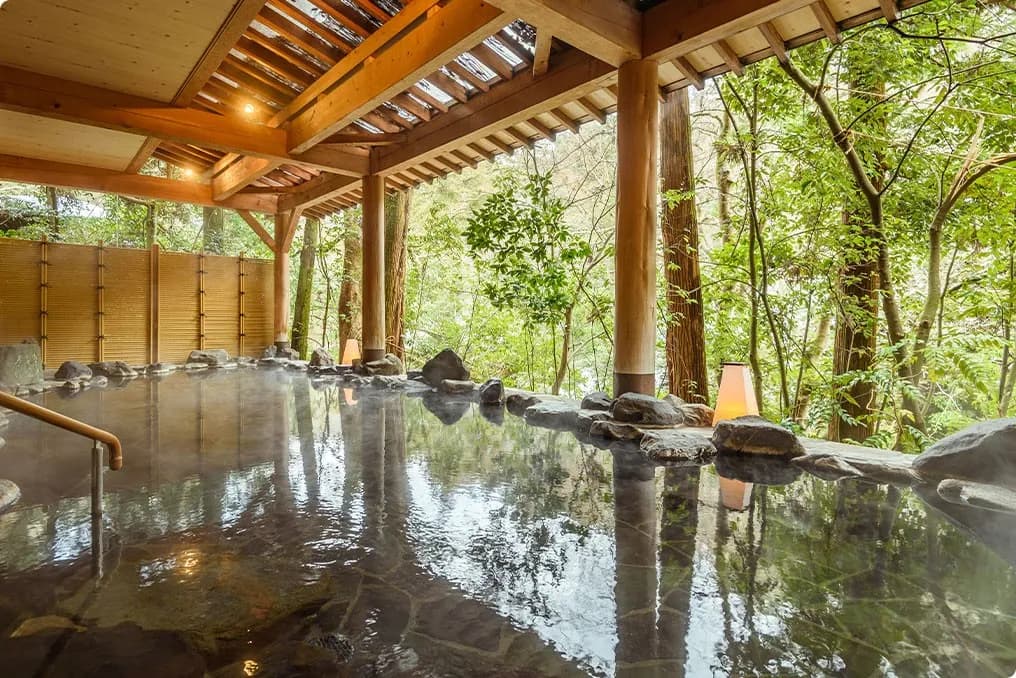
The baths include a large hall that alternates between men and women, an open-air bath on a rotating basis, and a private open-air bath. The open-air bath in particular is built almost level with the surface of the Kano River, and to sink into the water amid the murmur of the stream and the green of the surrounding trees is a rare pleasure. The wooden interior retains a strong Showa-era atmosphere, and simply walking its corridors evokes the presence of the writers of old. Dinner features dishes made from the mountain and river bounty of Amagi, gracing a quiet evening.
Day-trip bathing is available from 12:00 to 14:30 for 1,000 yen for adults and 500 yen for children, and a private bath may be used for 1,000 yen per 30 minutes. Overnight stays with two meals start from around 18,850 yen. Access is easy for a secluded inn: about 50 minutes by car from the Numazu IC, or about 35 minutes by bus from Shuzenji Station on the Izuhakone Railway. In the fresh green of early summer and again in the fiery foliage of autumn, this is an inn where one can savor a literary hot spring alongside the four seasons of the Kano River.
At the southern foot of Mount Amagi in Izu, along the murmuring Kawazu River, lies the quiet hot spring hamlet of Yugano. At its heart stands Fukudaya, which has welcomed travelers since 1879 (Meiji 12). What made this inn's name immortal was a single young writer. As a high school student in the early Taisho era, Kawabata Yasunari crossed the Amagi Pass, encountered a troupe of traveling performers, and lodged here at Fukudaya. The beat of the dancer's drum drifting up from beside the bridge, and her innocent figure glimpsed through the rising steam, would later crystallize into his beloved masterpiece The Izu Dancer. The second-floor room overlooking the Kawazu River where Kawabata stayed is still lovingly preserved as the Odoriko no Ma, and the inn continues to draw readers from across Japan as a place of literary pilgrimage.
The waters of Fukudaya form a calcium sodium sulfate spring. The source emerges hot, at about 59 degrees Celsius, and is weakly alkaline with a pH of around 8. Served as pure free-flowing spring water with no added water, no heating, no circulation, and no chlorination, the colorless, transparent, and gentle bath carries a faint hot spring fragrance. As is typical of sulfate springs, it is said to ease neuralgia and muscle pain and to aid recovery from fatigue, and its silky, enveloping feel speaks of the inn's long history as a healing retreat. Unshowy but genuine, it is the real hot spring water that a solitary mountain inn has faithfully preserved.
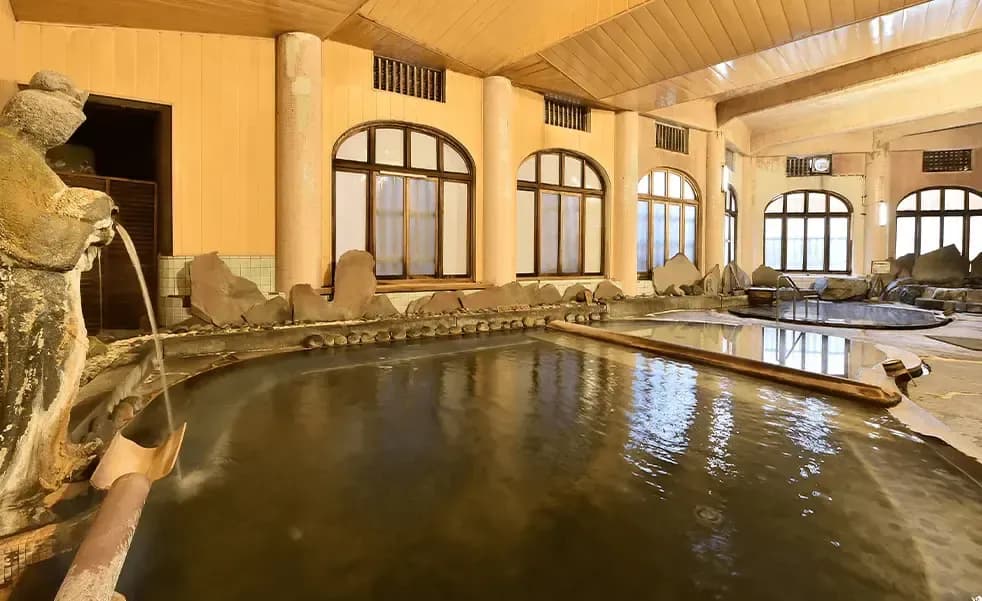
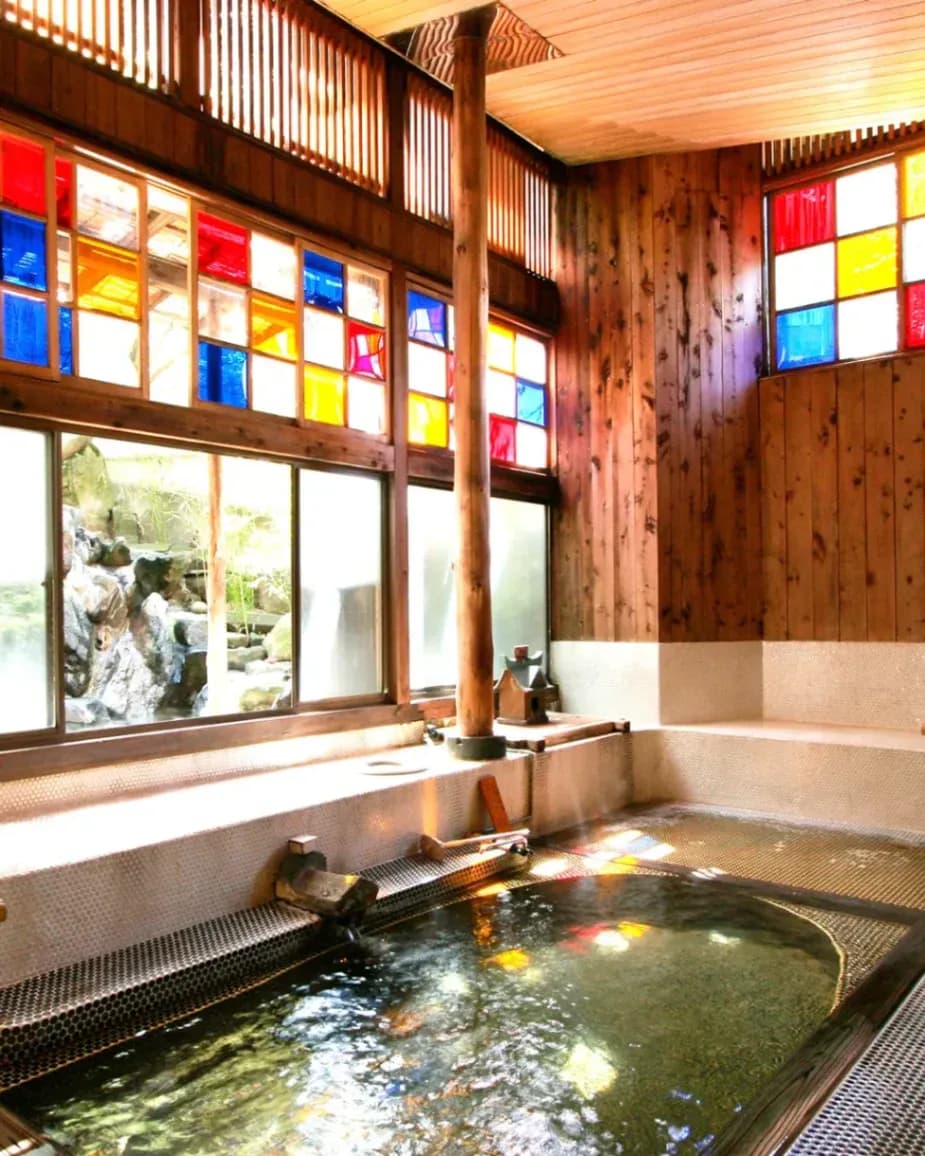
Fukudaya's greatest treasure is the Kaya-buro, an indoor bath built of kaya (Japanese nutmeg) wood that has scarcely changed since the inn's founding. In this small, wood-warmed bathing room, fresh spring water flows without pause, letting visitors soak in the very waters Kawabata once knew. There are also an open-air bath and a rock bath where one can bathe to the sound of the Kawazu River, and after 7 p.m. guests may reserve the baths for private use free of charge. Dinner brings the bounty of Izu's sea and mountains, and a night wrapped in the warmth of this wooden inn feels like slipping into the world of the story itself.
Day-trip bathing is available for 990 yen for adults and 550 yen for children, from 10:30 to 15:00 (advance inquiry is advisable). Overnight stays with two meals start from roughly 12,750 yen, remarkably approachable for such a storied literary inn. Access is about 14 minutes by Tokai Bus from Kawazu Station on the Izukyu Line, then a three-minute walk from the Yugano bus stop; by car it is about 90 minutes from the Numazu IC on the Tomei Expressway via the Amagi Pass, with the inn's parking and a free municipal lot available. Visit the Kawazu countryside, also renowned for its early-blooming cherry blossoms, and with a passage from The Izu Dancer in mind, spend an unhurried hour at an inn where time seems to stand still.
Kannon Onsen wells up in a quiet valley in Yokokawa, in the hills of Shimoda near the southern tip of the Izu Peninsula. Its name traces back to the excavation work that founded it. During drilling, a small Kannon statue about fifteen centimeters tall emerged from the earth; it was consecrated at Sensoji Temple in Asakusa and enshrined at the entrance to the facility. The spring was named Kannon Onsen in the spirit of offering its abundant waters to people with a heart of mercy and charity. Far from the bustle of the city, it has long drawn a quiet following as a hidden retreat deep in Shimoda.
The great appeal of Kannon Onsen lies in the quality of its source. It is classified as an alkaline simple spring, drawn up from roughly 600 meters underground. Strongly alkaline at around pH 9.5, the water is exceptionally soft, worthy of being called a fine natural water. The source emerges at 42.6 degrees Celsius with an abundant flow of about 250 liters per minute, and the inn holds to a private-source free-flow with neither heating nor dilution. Clear and silky to the touch, it is praised as a beautifying bath, and as one of the few springs permitted for drinking, guests may sip the source water directly. Its quality is so highly regarded that it is bottled and sold as drinking water across Japan.
The lodging is divided among several buildings, including the main hall, the Shoun-kan, the detached Ubusuna-tei, and Pygmalion, each with its own character. In the guests-only bathing area Kannon-no-yu Galatea, visitors can tour eleven baths, indoor and open-air, from 16:00 until 8:30 the next morning. Sinking slowly into the strongly alkaline water, one feels the skin wrapped in a smooth, gentle softness. Dinner features dishes made with local ingredients, rounding out a stay steeped in mountain quiet.
For a day visit, the on-site Kannon Principle facility is convenient. It offers indoor baths (hot and cool), an open-air bath, a bubble bath, a sauna, and a footbath, with admission of 1,300 yen for adults and 700 yen for children on weekdays, and 1,500 and 800 yen on weekends and holidays. It is open 11:00-16:00 on weekdays and 11:00-17:00 on weekends and holidays. Access is about 25 minutes by taxi from Izukyu-Shimoda Station, with a shuttle bus also available by advance reservation. It is a place to savor a celebrated strongly alkaline spring at leisure, a bathing experience unique to the depths of Oku-Shimoda.
In the hamlet of Sakurada, a short way inland from the center of Matsuzaki on the Nishi-Izu coast, the solitary inn Sanpoen sits cradled by rice paddies and low hills. Though the town of Matsuzaki is famous for its namako-kabe plaster walls and lies only about five minutes by car from the sea, here the air carries the quiet of a mountain village rather than the salt of the coast. The inn's story began in 1980, when a family growing mikan oranges on this land struck a hot spring source with their own hands. In time the farmhouse became a ryokan, and though rebuilt into its present ten rooms in 1995, it still keeps the warmth of a humble family trade as a member of the Japan Association of Secluded Hot Spring Inns.
The waters of Sanpoen are a calcium-sodium sulfate spring. The source wells up hot at around 73 degrees Celsius, alkaline at a pH of roughly 8.4. Backed by an abundant flow of more than 600 liters per minute, the inn achieves a pure free-flowing bath with no added water, no heating, no recirculation, and no chlorination whatsoever. The water is nearly colorless and clear, and lean in close and you will catch a faint breath of sulfur. Said to ease cuts, burns, and chronic skin conditions, it has been passed down among bathers as a healing and beautifying water, and a drinking-spring station approved by the health authorities beside the entrance lets guests taste its mineral richness for themselves.
The centerpiece of the baths is a large reservable open-air bath, some ten meters deep and spanning twenty tatami mats in area. Overnight guests may have it entirely to themselves whenever it is free, and sinking shoulder-deep into water a full meter deep, one sees the mountain sky and the season's greenery mirrored on its surface. There are also gender-separated cypress indoor baths and a private family bath, while three guest rooms come with their own open-air baths. Dinner brings the bounty of nearby sea and mountains, and the attentive hospitality possible only at an inn of just ten rooms lets the clamor of the city fall away.
Sanpoen offers no day-trip bathing; this exquisite free-flowing water is a luxury reserved for overnight guests alone. Stays including two meals start from roughly 18,700 yen, check-in is from 3 p.m., and the inn is generally closed on Tuesdays and Wednesdays. Access takes about 90 minutes by car from the Numazu area via the Izu Jukan Expressway and National Route 136 toward Matsuzaki, or by public transport, a Tokai bus from Izukyu-Shimoda Station to the Sakurada stop, then a three-minute walk. Time a visit to the flower-filled paddies of Matsuzaki in spring or the beautiful sunsets of nearby Dogashima, and set out for a soak at this quiet inn in the hills.
6. Osawa Onsen Noten-buro Yama no Ie (大澤温泉 野天風呂 山の家) — Matsuzaki Town, Kamo District
On the banks of the Ikashiro River, deep in the mountains of Matsuzaki Town in western Izu, Osawa Onsen Notenburo Yamanoie stands quietly apart from the world. The history of its source reaches back some 250 years to the mid-Edo period, when steam rising along the river is said to have led to its discovery. Known from the start as the beautifying bath, it has long been cherished by those seeking a therapeutic soak. The facility adjoins a self-catering lodge, Osawaso Yamanoie, and to this day welcomes visitors amid a rustic mountain-village scene where wild sweetfish swim in the clear stream and fireflies and river frogs thrive.
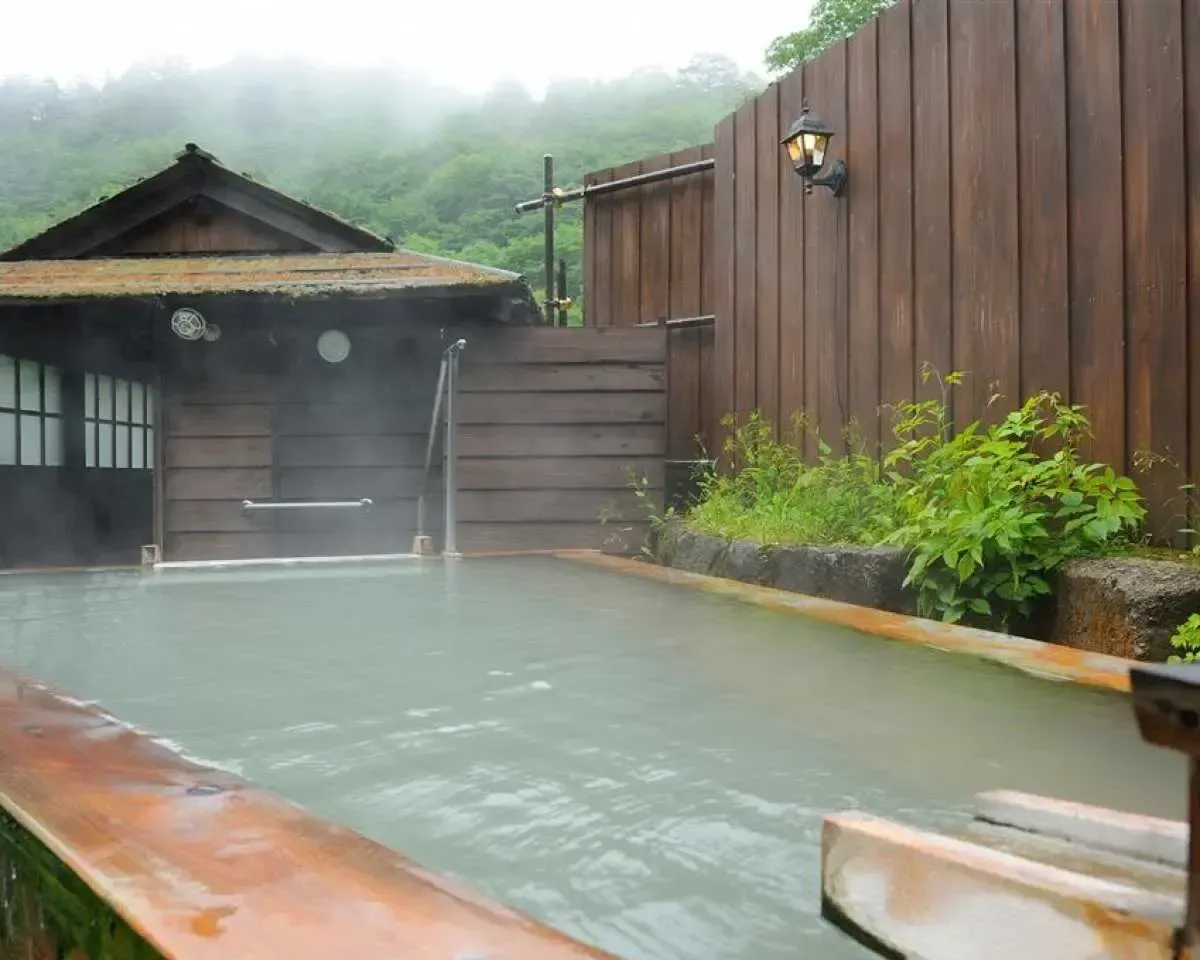
The waters of Yamanoie are a calcium-sodium sulfate spring. Weakly alkaline at around pH 8.4 and hot at roughly 46.7 degrees Celsius, the water is colorless and clear yet gentle against the skin. Its defining feature is that the spring wells up directly from the floor of the rock-hewn bath itself, gushing at about 230 liters per minute in a true foot-of-the-bath emergence. Never touching the air and served with no dilution or heating whatsoever, this pristine, fresh-from-the-source water is what captivates hot spring enthusiasts from across the country.
The bathing area centers on gender-separated open-air baths, with a private bath offered in 50-minute slots. The plain wooden bathhouse, more than 80 years old, together with a rest room overlooking the ravine, preserves the vanishing atmosphere of an old therapeutic bathing ground. So abundant is the flow that even the taps at the washing stations run with hot spring water, and this lavishness is the true hallmark of the place. The water runs hot, leaving the skin smooth and supple after a soak.
Day-trip bathing costs a modest 600 yen for adults and 300 yen for children, or just 900 yen to enjoy both the open-air and private baths, and is available from 9:00 to 21:00. The only closure is the second Wednesday of each month. Cherry blossoms in spring, fireflies and sweetfish in early summer, and forest bathing in the warmer months lend seasonal color to each visit. Paired with Matsuzaki's namako-wall streetscape, Dogashima, and the western Izu coastline, it offers a full taste of a simple, deeply satisfying secluded hot spring of Izu.
7. Sawada Koen Rotenburo (沢田公園露天風呂) — Nishiizu Town, Kamo District
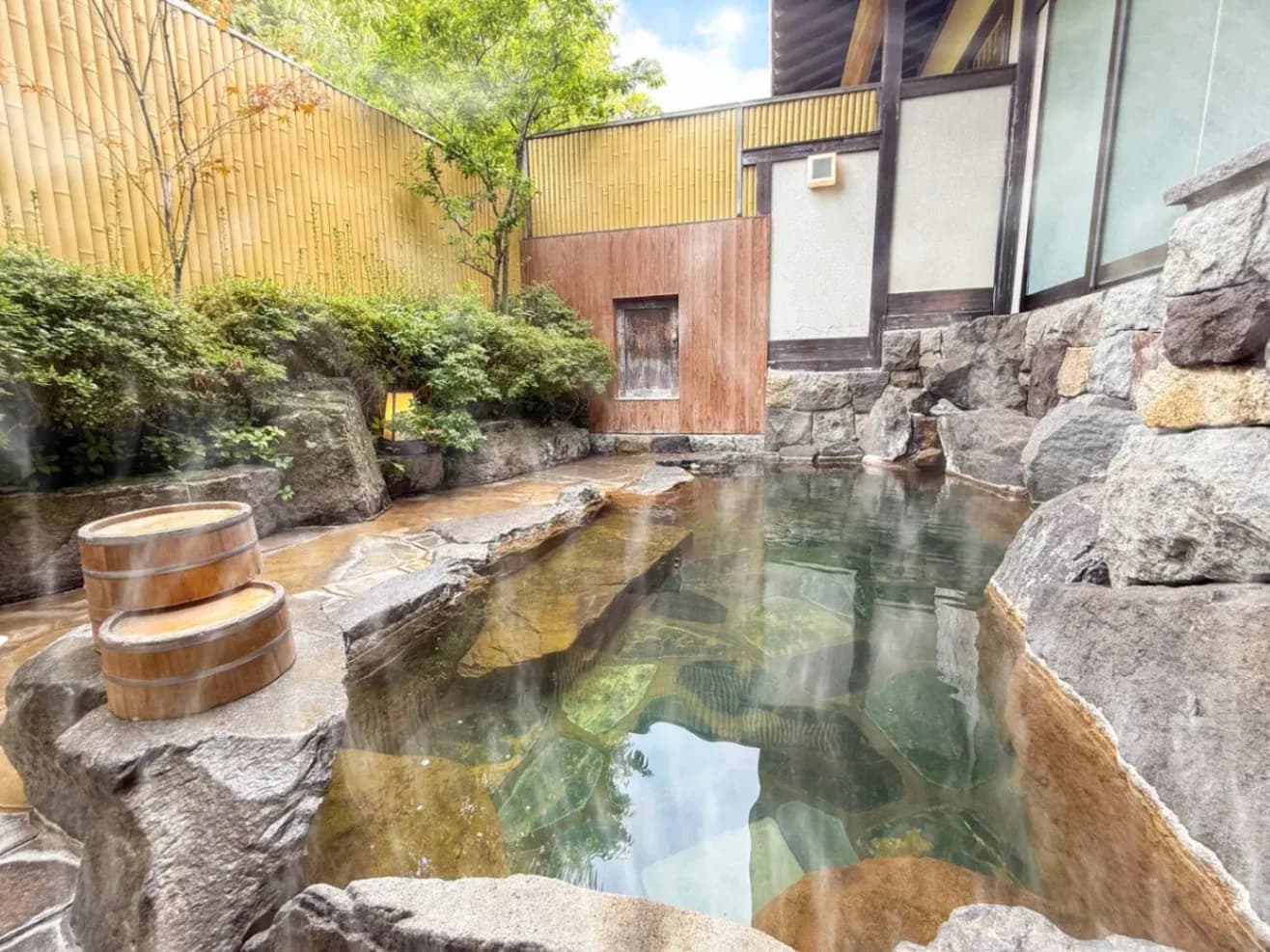
Sawada Koen Rotenburo is a municipally run public open-air bath set atop a cliff that juts into Suruga Bay, within Sawada Park in the Nishina district of Nishiizu Town, Shizuoka. Carved into the rocky shoreline overlooking the Sanshiro Islands, its two small rock baths, one each for men and women holding four or five people, open directly toward the sea from the very edge of the cliff. Though it is a communal day-use bath with no lodging attached, its remarkable outlook has made it one of Izu's most celebrated scenic open-air baths, drawing bathers from well beyond the town.
The water is a sodium-calcium sulfate spring, confirmed by primary sources from the Nishiizu town office and tourist association, and is described as beneficial for joint pain and chronic digestive ailments. Whether the bath is fed by free-flowing source water or recirculated, however, is not stated in any official primary source, so this account makes no claim either way. Several references give the pH as 8.8, but no official source temperature has been published; visitors may wish to check the spout and the facility's notices on site.
The true draw of this bath is the sweeping sense of openness over Suruga Bay. Sightseeing boats and fishing vessels pass below while the horizon stretches wide ahead. At dusk in particular, the sight of the sun descending into the seam of a crimson sky and sea is breathtaking, and many visitors time their arrival for this hour. With no washing area and no indoor bath, the appeal is a plain and honest soak in a clifftop rock pool, given over entirely to the view.
Admission is modest and by cooperative fee: 600 yen for adults (400 yen for town residents) and 200 yen for children. Hours shift with the seasons, staying open until 20:00 during the long days of June through August, 19:00 in March-May and September, and 18:00 from October to February, with last entry 30 minutes before closing. The bath is closed on Wednesdays and, given its exposed clifftop position, shuts during stormy weather and cleaning. Soap and shampoo may not be used, so save any washing for your inn or home, and aim to climb the stairs from the free parking lot to reach this clifftop view in time for the evening light.
8. Umegashima Onsen Yu no Yado Ichikawa (梅ヶ島温泉 湯の宿いちかわ) — Aoi Ward, Shizuoka City
Umegashima Onsen, which rises among the headwaters of the Abe River at the far northern edge of Aoi Ward in Shizuoka City, is an ancient spring said to have been opened some 1,700 years ago in the era of Emperor Ojin. It flourished alongside the region's gold mining and has been handed down in legend as a hidden bath of the warlord Takeda Shingen and a secret retreat of Tokugawa Ieyasu. During the Edo period it gained fame as a therapeutic bathing ground, and a tale survives that it cured the illness of Prince Yoshizumi. Within this hot spring hamlet, Yunoyado Ichikawa has kept watch over the quiet mountain waters as a family-run inn since its founding in 1967.
The inn's prized water is an alkaline simple sulfur spring with a strikingly high pH of about 9.4. Because the source temperature is a relatively cool 40 degrees Celsius, the water is carefully piped from a spring about two kilometers upstream and brought to bathing temperature by warming alone, with no added water, then supplied as free-flowing spring water. Its gentle scent of sulfur and its smooth, lotion-like texture that clings to the skin have long earned it the name of a beauty-enhancing bath. It is said to ease bruises, sprains, fatigue, rheumatism and women's ailments, and the silky feel of the skin after bathing captivates many visitors.
The bathhouse consists of separate indoor baths for men and women along with an open-air bath. The open-air bath is a rare feature that only a handful of Umegashima's inns possess, letting bathers take in the green of the mountains and the murmur of the stream from beneath the eaves. The tubs are modest in size, but that only adds to the calm and unhurried nature of the soak. At mealtimes the proprietresses serve an original kaiseki course built around mountain vegetables and produce gathered locally, a reputation that helped the inn win a 2024 Jalan Award for a memorable stay.
Day-trip bathing is available for 600 yen per hour, though it can be unavailable during group reservations, so a phone call ahead brings peace of mind. Overnight stays begin at a reasonable 11,500 yen with two meals, in keeping with the character of a mountain inn. The inn is about 50 minutes by car from the Shin-Shizuoka IC on the Shin-Tomei Expressway, or reachable by Shizutetsu Just Line bus bound for Umegashima Onsen from JR Shizuoka Station. Beyond the fresh green of spring and the autumn foliage, nearby attractions such as the Abe Great Falls and the Sandan Falls, one of Japan's hundred finest waterfalls, make this an ideal base for combining a secluded hot spring with nature walks.
Minami-Alps Akaishi Onsen Shirakabaso is a municipally operated hot spring lodge tucked deep in the mountainous Ikawa district of Shizuoka City, just short of the Hatanagi Daiichi Dam. Its predecessor was built in 1957 as a lodging camp for the dam's construction workers and reborn in 1966 as a hot spring mountain lodge. Long loved as a resting place for climbers of the Southern Japanese Alps, the aging building was rebuilt and reopened at its present location in July 2009. Named after Mount Akaishi, the lodge still serves as a base camp for mountaineers.
The water is a simple sulfur spring. With an alkaline pH of 9.3, it feels silky against the skin, in the manner of Japan's celebrated "beauty" waters. The source emerges at a relatively cool 38.2 degrees Celsius, hypotonic and faintly turbid, carrying a soft scent of hydrogen sulfide. To make up for the low source temperature, the water has been heated since fiscal 2011 with a wood-biomass boiler fueled by locally thinned timber, an approach that turns the surrounding forest into a sustainable energy source. The spring is said to ease nerve and joint pain and skin conditions.
The greatest draw is the open-air bath framed by mountains. Sinking into the water, bathers look out on Mount Chausu and Mount Kamikochi and the ridgelines of the southern Southern Alps, which change with every season. A large indoor bath and a multipurpose bath round out the offering, letting hikers unwind tired bodies. Meals are served on site, and day-use bathing is refreshingly affordable at 600 yen for junior-high age and above and 200 yen for elementary schoolchildren, true to its municipal character.
Early summer, when the peaks gleam, and autumn, when the leaves turn, are the finest times to visit. For climbers heading toward the Hatanagi trailheads, the lodge is an invaluable place to bathe and rest before and after the mountains. Overnight stays offer twin and quad rooms by reservation. Hours run 10:00-18:00 from April to November and 10:00-17:00 from December to March, with Tuesday closures. Note that the roads beyond Ikawa are narrow and winding, so allow ample time when driving, and bus services on the public-transport route are infrequent.
Sumatakyo Onsen rises deep in the folds of the Southern Alps, in a gorge carved by the Sumata River, a tributary of the Oi River, at about 550 m above sea level. Its history is relatively recent: the source was struck in 1957 by a local resident, Koichi Mochizuki, and certified as a hot spring the following year. Suikoen has operated here since the spring first opened, making it the oldest hot spring inn in the area. Its interior preserves the mood of the Taisho romance era, with artworks and antiques collected by the owner displayed throughout, wrapping every guest in a nostalgic and restful atmosphere.
Sumatakyo Onsen has long been called a beautifying bath, prized for its distinctively silky feel on the skin. The water is a simple sulfur spring with a source temperature of about 43 degrees Celsius and an alkaline pH of 9.18, carrying a faint scent of sulfur. Piped from a source roughly 4 km upstream, the large communal baths are heated, circulated with filtration, and chlorinated to protect the resource and maintain hygiene, while the special rooms feature private free-flowing family baths where guests can enjoy fresh water all to themselves. The soft, skin-smoothing water is said to ease neuralgia, muscle pain, sensitivity to cold, chronic skin conditions, and fatigue.
Beyond indoor and open-air baths, the inn offers private family baths, including a barrier-free option. Dinner brings kaiseki cuisine generously using the mountain and river bounty of Oku-Oi, served alongside the local wild-boar hot pot and Shizuoka sake. Just outside, the Sumatakyo Promenade trail leads to the celebrated Yume-no-Tsuribashi, a suspension bridge strung over emerald-green water that draws travelers from across the country.
Sumatakyo is especially beautiful in autumn, when the gorge turns to brocade from mid to late November. Day-trip bathing is available to adults for 600 yen from 11:30 to 20:00, but it can be turned away during busy periods, so pairing it with an overnight stay is recommended. Access is about 40 minutes by bus from Senzu Station on the Oigawa Railway. Because of the remote mountain setting, bus service is limited, so check timetables before setting out.
Summary: What to Know Before Visiting Shizuoka's Hot Springs
Shizuoka's hidden springs fall into four areas that are easiest to plan separately: central Izu, southern Izu, western Izu, and the headwaters of the Abe and Oi rivers. Parts of the Izu Peninsula can be reached by train and bus, but the mountain-gorge springs at the river sources really require a rental car. It helps to fix the travel style for each leg before you go.
Central Izu. Arai Ryokan at Shuzenji Onsen was founded in 1872 (Meiji 5), and fifteen of its wooden buildings, raised through the Taisho and early Showa eras, are registered as Tangible Cultural Properties of Japan. Its baths combine source water with a recirculating system, so it is not a fully "flow-through" (kakenagashi) inn — worth keeping in mind if that distinction matters to you. It is usually reached by bus from Shuzenji Station on the Izuhakone Railway Sunzu Line. Also in central Izu, Yumotokan at Yugashima Onsen preserves the room where Kawabata stayed and, as a member of the Association of Secluded Hot Spring Inns, keeps an old therapeutic-bathing atmosphere. It is primarily an overnight inn, so confirm in advance whether day bathing is available.
Southern Izu. Fukudaya at Yugano Onsen in Kawazu Town stands along the Kawazu River, the setting of The Izu Dancer; the surrounding area is famous for its early Kawazu cherry blossoms, and the inn is another member of the secluded-inn association. Kannon Onsen in Shimoda City draws a highly alkaline spring from its own source, well known as a "beauty bath" — the high-pH water feels smooth on the skin, and the spring is also sold as bottled drinking water. It is a stay-and-soak destination, with lodging spread across a wooded valley.
Western Izu. Matsuzaki Town has two source-fed hidden springs: Sanpoen at Sakurada Onsen, and Osawa Onsen Yama no Ie, an open-air bath along the Naka River. Both sit well away from the tourist crowds and draw visitors for the water itself. Nearby, the character changes at Sawada Koen Rotenburo in Nishiizu Town — a town-run public open-air bath perched on a cliff above Suruga Bay. There is no lodging; it accepts day visitors only, in gender-separated tubs with a wide sea view, and is known as a spot to watch the sunset. Its water-management details are not published, so we avoid claiming it is a flow-through spring.
Headwaters of the Abe and Oi Rivers, and the Southern Alps. Yu no Yado Ichikawa at Umegashima Onsen sits high on the upper Abe River, in a valley about an hour's drive north of central Shizuoka, with soft alkaline water. In the Oi River watershed, deep in Aoi Ward near the Hatanagi Dam, Minami Alps Akaishi Onsen Shirakabaso serves as a base for climbers heading to Chausudake and Akaishidake; it is remote, with limited public transport, so a car is the practical choice. Suikoen at Sumatakyo Onsen stands at the gateway to Sumata Gorge, home of the famous "Dream Suspension Bridge," and is reachable by bus from Senzu Station on the Oigawa Railway. Its main bath uses recirculation with chlorine treatment, so it is best enjoyed together with the gorge scenery and walking trails rather than for the water alone.
A few practical points apply across the list. Baths here are separated by gender rather than mixed, and ordinary tubs are entered without swimwear; the private and family baths at the ryokan are the option if you would rather not share the water. Reservations matter more than at a city bathhouse: the inns are geared to overnight guests, and day-trip bathing may be limited or unavailable, so confirm ahead. Tattoo policies vary by facility and are often stricter at ryokan than at public baths, so travelers with tattoos should check directly before visiting. Payment can be cash-only at smaller mountain inns and at the town-run Sawada bath, so carry cash even where cards are usually accepted. Finally, the Izu Peninsula and the Southern Alps foothills are the same prefecture but several hours apart by road — plan on at least two or three days and focus on one or two areas rather than trying to cover everything. Road conditions in the mountains can change in winter; check each facility's official website or the local tourism association for the latest details before you go.
The information in this article (admission fees, operating hours, water quality data, etc.) is based on research conducted at the time of writing. Details may have changed or contain errors. Please verify the latest information on each facility's official website or through the local tourism association.