8 Hidden Hot Springs in Shiga: From a Sengoku Battlefield Spring to Koka Ninja Country
Shiga Prefecture wraps entirely around Lake Biwa, Japan's largest lake, and sits landlocked with no coastline of its own — a geography that rarely brings hot springs to mind. Yet the hills ringing the lake hold a genuine cluster of single-inn hot springs, with water ranging from iron-rich mineral springs to a rare radium bath. In Nagahama, the spring at Sugatani Onsen is said to have treated the wounds of Azai Nagamasa, lord of nearby Odani Castle, and his wife Oichi during the Sengoku wars; drawn from the ground clear, the water turns a deep rust red as its iron oxidizes in the air.
Konan, in Koka City, is the historical home of the Koka school of ninja, and two of its valleys hold springs of their own: Shiono Onsen, documented in the Edo-period gazetteer Omi Yochi Shiryaku, and Miyano Onsen, which still draws on its own private source. Makino, in Takashima City, is home to one of the few radon-bearing radioactive springs in the Kansai region. Otsu City alone contributes two very different baths — one at the foot of the Hira Mountains, the other at the gate of Ishiyamadera, the temple where Murasaki Shikibu is said to have begun writing The Tale of Genji — and the northern shore of Lake Biwa adds a ryokan facing the sacred island of Chikubushima.
Genuine single-inn, source-fed hot springs are not abundant in Shiga. Below are 8 of the prefecture's most distinctive.
1. Sugatani Onsen (須賀谷温泉) — Nagahama City
Tucked into the foot of Mount Odani in Nagahama, Shiga Prefecture, Sugatani Onsen is a single-inn hot spring known as a hidden spring of the Sengoku era. Azai Nagamasa, lord of nearby Odani Castle, and his wife Oichi, sister of Oda Nobunaga, are said to have travelled here to heal battle wounds and illness. The ruins of Odani Castle and the Anegawa battlefield lie close by, so a soak here comes with a direct line to the region's warring-states past.
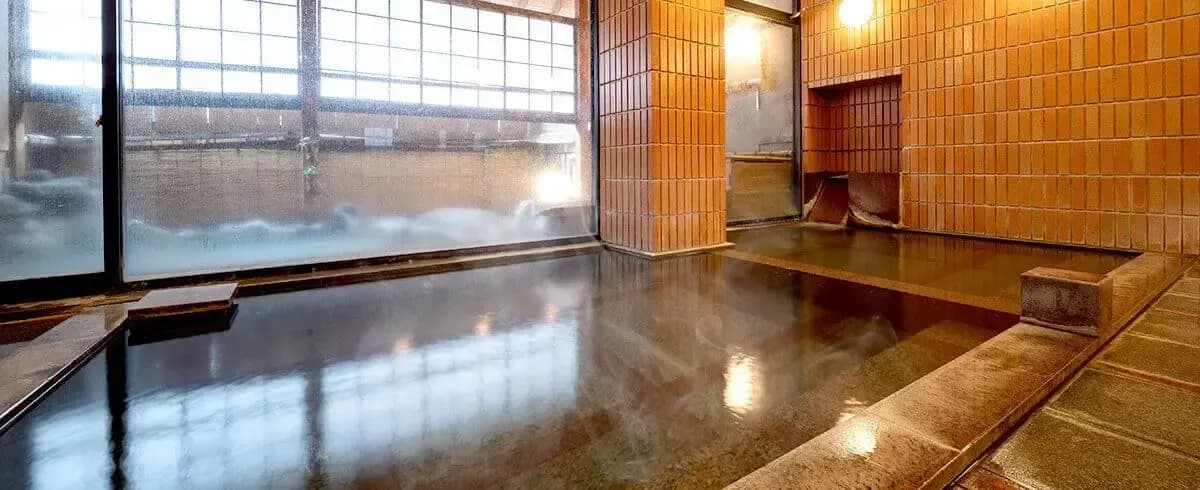
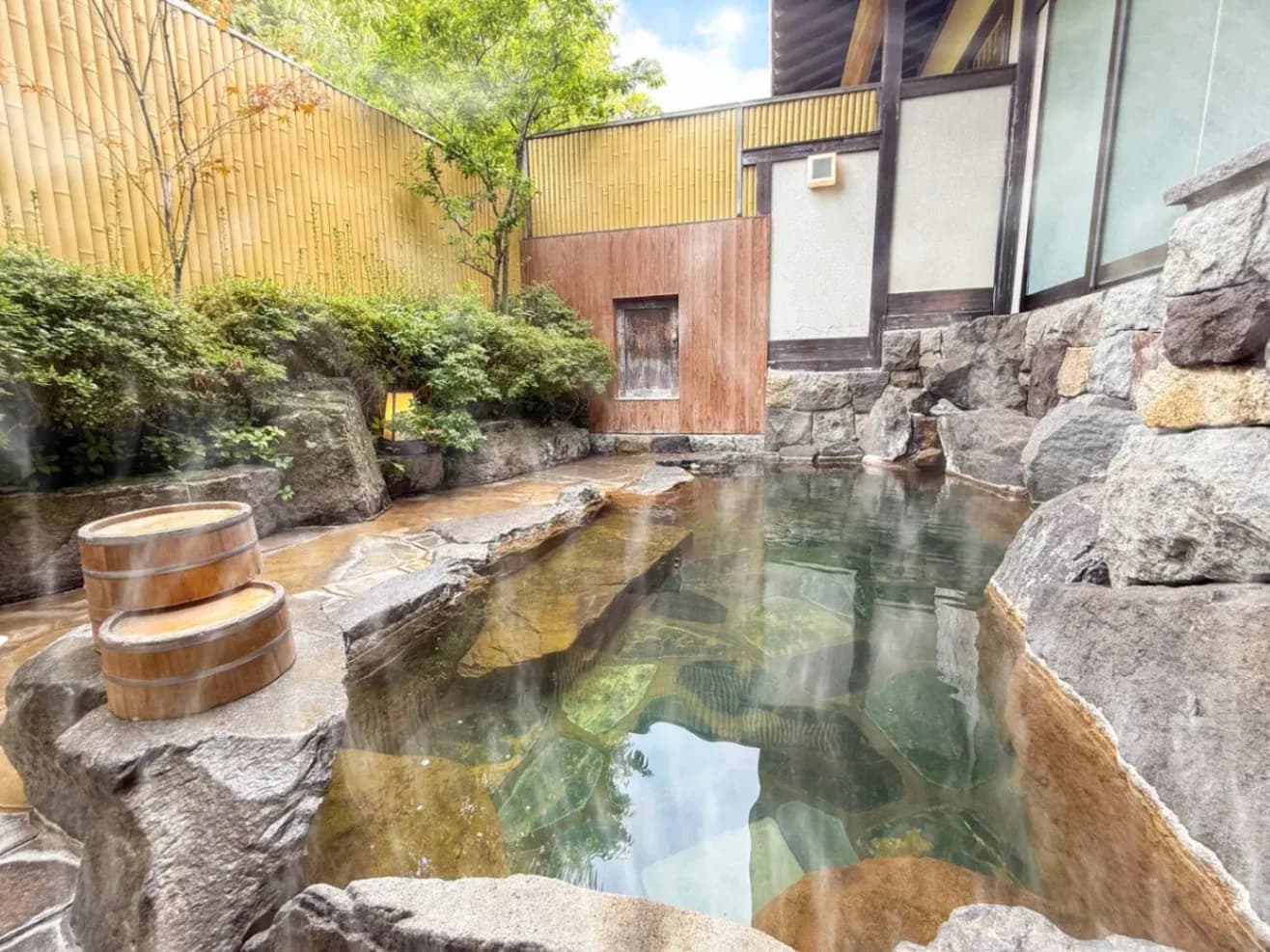
The spring is an iron-bearing calcium-magnesium bicarbonate water, posted at the inn under its older name, hydro-carbonate iron spring. Because the source emerges at only about 15 degrees Celsius, the water must be heated, yet Sugatani is recognised as the first inn in Shiga to serve its baths free-flowing rather than recirculated. Drawn from underground it is perfectly clear, but the moment it meets the air the iron begins to oxidise, and by the time it reaches the tub it has turned a deep rust red. That colour shift is itself the proof of how much iron the water carries.
The mens and womens bathhouses each contain two indoor tubs held at different temperatures, one hot and one lukewarm. Warming through in the hot tub and then settling into the cooler one for a long soak suits an iron-rich water well. An open-air bath filled with the same reddish-brown water looks out over the wooded hills of the Kohoku countryside. Inside, guests find a dining room, rest areas, massage and esthetic treatments, a shop, and barrier-free facilities throughout.
Day-trip bathing runs from 11:00 to 15:00 at 1,000 yen for adults and 500 yen for children, plus a 150 yen bathing tax. The inn has 20 rooms, with overnight rates from 19,800 yen including two meals built around Omi beef and seasonal Kohoku produce. Access is easy: roughly five minutes from Odanijo Smart IC on the Hokuriku Expressway, with free parking for about 40 cars, and a free shuttle from JR Kawake Station if reserved a day ahead. Fresh green in late spring and autumn foliage are the scenic highlights, but the warmth of this iron-rich water is most welcome in the cold of winter. Day-trip bathing can be suspended when the inn is busy, so it is worth calling ahead.
Quality
Iron(II)-containing - Calcium ( - Magnesium ) - Bicarbonate Spring
2. Ryori Ryokan Shiono Onsen (料理旅館 塩野温泉) — Konan, Koka City
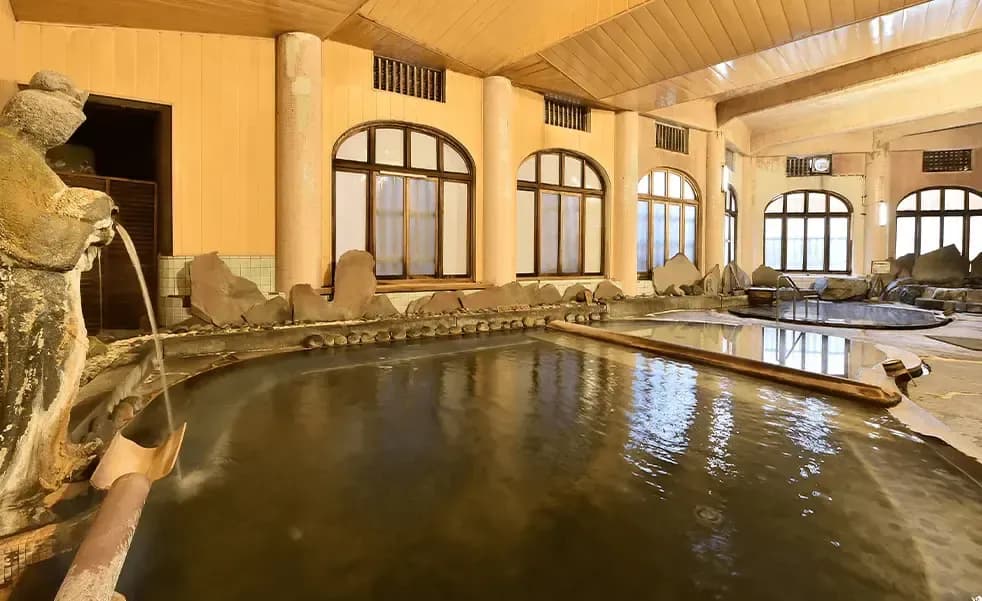
Shiono Onsen sits quietly in the hills of Konan-cho, Koka City, in southern Shiga Prefecture, a district long famous as the homeland of the Koka school of ninja. Legend credits the discovery of the spring to Kobo Daishi, the monk Kukai, some thousand years ago. Its documented history begins in the Edo period: the Omi Yochi Shiryaku, a regional gazetteer compiled by Sangawa Tatsukiyo, a retainer of the Zeze domain, describes a small pool in Shiono village known as Shio-no-ike, roughly six feet square, whose waters rose and fell as though with the tide, and which villagers drew upon for bathing to cure a range of ailments. That a tidal rhythm should appear in an inland valley is the clearest possible sign of a saline mineral spring welling up beneath. The inn opened its doors in 1898, and for more than 120 years it has served both as a place where local farmers come to rest their bones and as a ryori ryokan serving Kyoto-style kaiseki.
The water here is a natural cold mineral spring. It emerges below 25 degrees Celsius and must be heated before it reaches the tubs, yet its mineral load more than compensates. Containing sodium, potassium, calcium and magnesium, it is classified as a sodium chloride spring, and chloride waters have long been called the heat springs of Japan for good reason. The dissolved salt forms a film on the skin that traps warmth, so bathers continue to perspire well after leaving the water and rarely feel the chill even in midwinter. Reputed to be among the oldest spring sources in Shiga, it has traditionally been sought out for gynecological complaints, digestive disorders, neuralgia and rheumatism. There is nothing flashy about this water; it is the sort that rewards repeat visits.
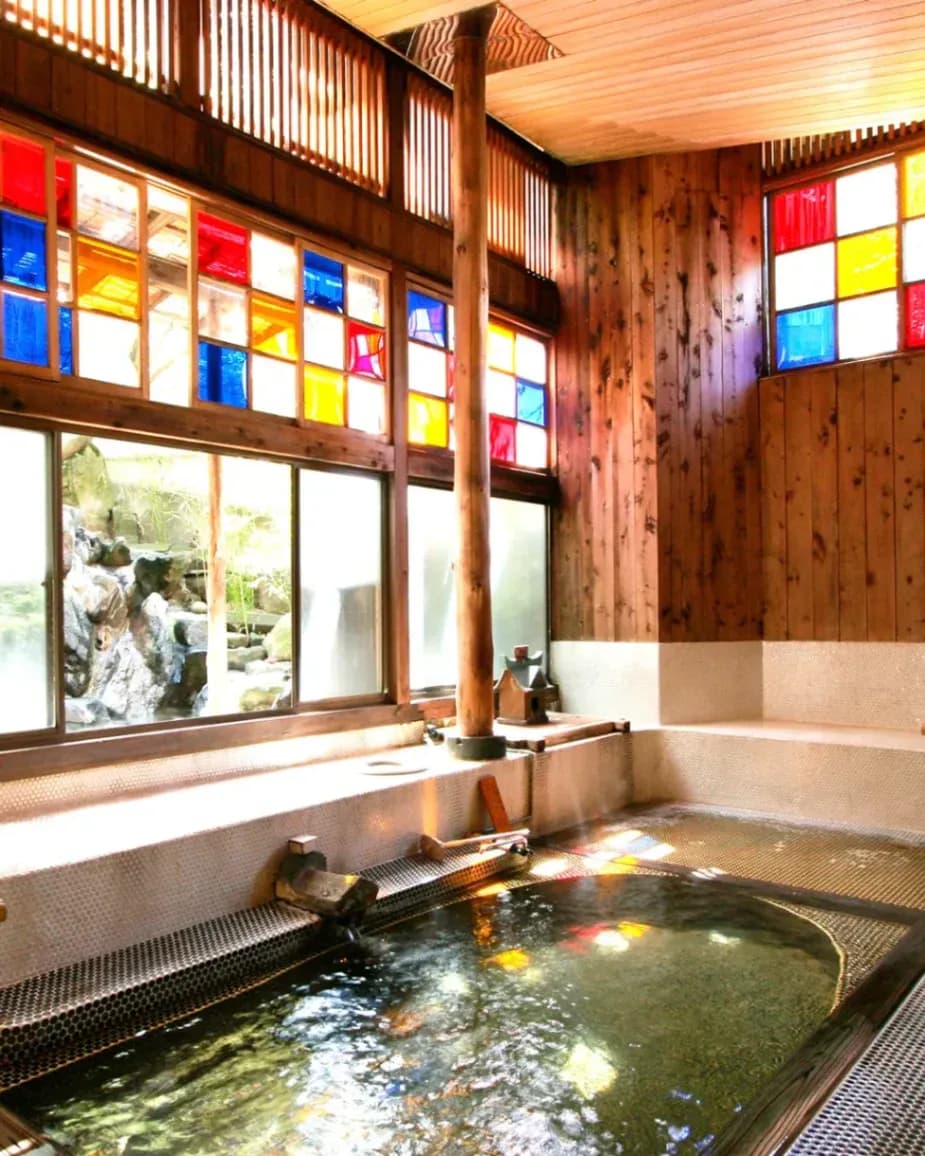
There are two bathing spaces. The indoor bath is built of granite, its restrained stonework setting off the softness of the water. Outdoors stands a goemon-buro, a cauldron bath in which the bather lowers themselves into an iron pot set over a fire, a form of bathing that has all but vanished from modern Japanese spa facilities. A private family bath is also available for those who prefer solitude. Notably, the entire property is barrier-free, equipped throughout with handrails and shower chairs, which makes it a rare find among historic single-inn hot springs and a genuinely practical choice for travelers with elderly family members. Meals follow the Kyoto kaiseki tradition, with rice grown on the inn's own fields.
One practical point deserves emphasis before planning a visit: bathing alone is not permitted. To use the spring you must either stay the night or reserve a meal. Seen another way, this is a bath designed to be enjoyed alongside the food. Hours run from 11:00 to 21:30, with the family bath closing at 21:00, and holidays are irregular, so a phone call ahead is strongly advised. Getting there is easy: about five minutes by car from Konan IC on the Shin-Meishin Expressway, or five minutes by car from Konan Station on the JR Kusatsu Line, with a free shuttle available if arranged in advance. Parking is free for fifteen to twenty vehicles. Though it lies within a comfortable day trip of Kyoto and Osaka, the place has escaped the usual tourist development entirely. Paired with the ninja houses of Koka or the pottery kilns of Shigaraki, it makes for a day that reveals a quieter, deeper side of Shiga.
North-west of Lake Biwa lies the Makino highlands, best known for its long avenue of metasequoia trees. About a kilometre north of the ski slopes there, up a narrow valley road, stands Makino Shiratani Onsen Hachiojiso in near-complete solitude. No record survives of when the Shiratani spring was first opened, but the inn that now serves as its custodian was founded in 2006. There are almost no other buildings nearby, and the only sounds are the stream and the birds.
The spring is a simple weak radioactive cold mineral spring: hypotonic, weakly alkaline, emerging at 21.4 degrees Celsius with a pH of 8.3. What sets it apart is its radon content. As a natural radium spring it has long been recommended for rheumatism, arteriosclerosis and high blood pressure, and it counts among the leading therapeutic waters of the Kansai region. Radioactive springs are uncommon across Japan, and the options for experiencing one in western Japan are few. No water is added to the source, though because the water emerges cold it is heated and passed through filtration with chlorine disinfection. The water runs clear and colourless, with a soft, almost silky touch and a warmth that lingers well after the bath.
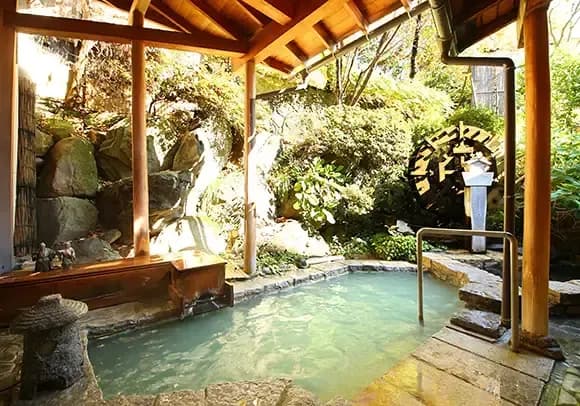
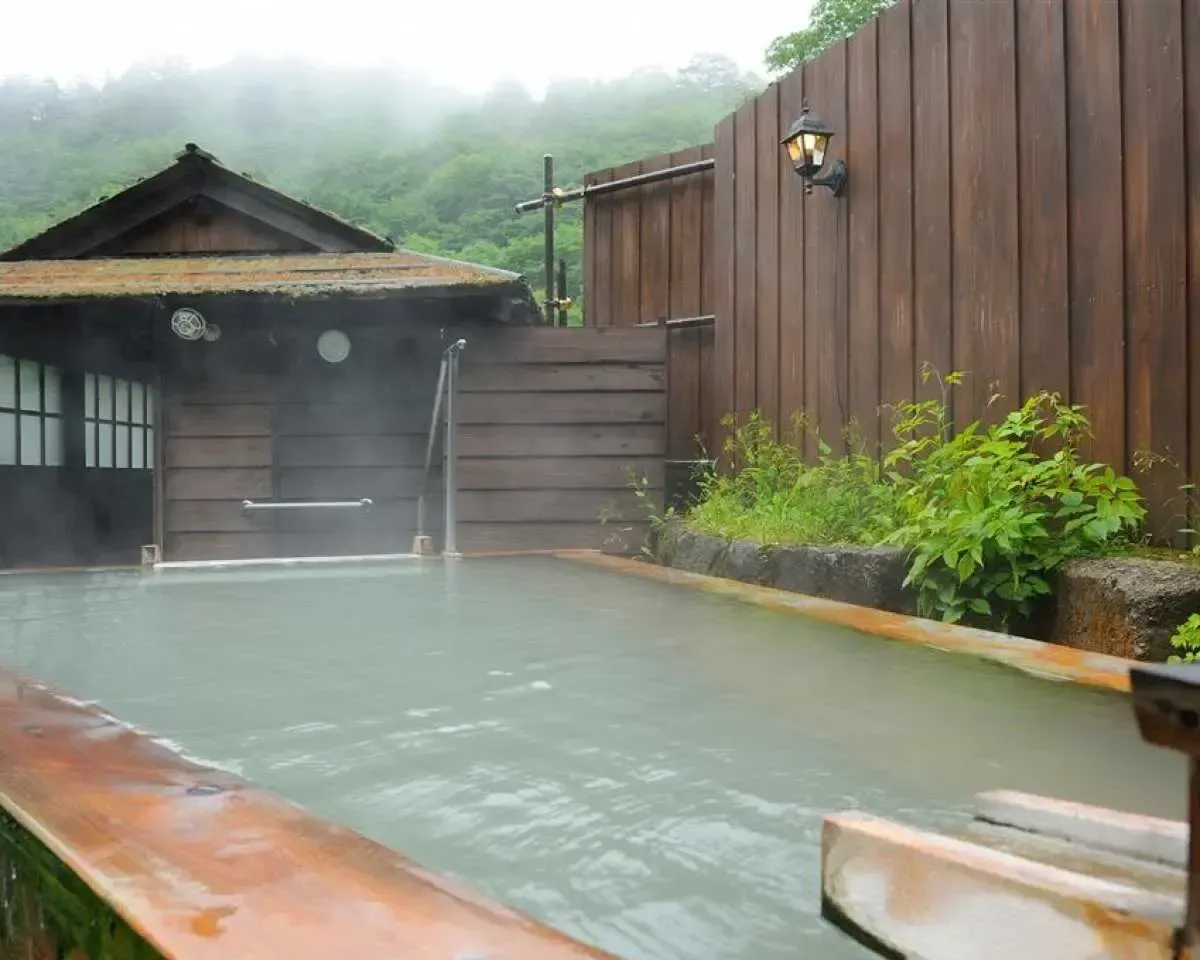
Bathers can choose between two indoor baths, Buna-no-yu and Sakura-no-yu, and an open-air bath facing the valley. From the outdoor tub the seasons pass in full view: pale new growth in spring, deep shade in summer, turning broadleaf foliage in autumn, and quiet snowfall in winter. Families and those seeking privacy can reserve the private bath Tsubaki-no-yu for 1,000 yen an hour. Overnight stays are limited to four Japanese-style rooms and fourteen guests, with kaiseki dinners built around seasonal produce from the Takashima area. Wi-Fi and a dedicated workation space make an extended working stay entirely practical.
Day bathing costs 700 yen for adults and 380 yen for children, available from 10:00 to 20:30 with last entry at 20:00, closed on Thursdays. By car it is roughly 90 minutes from Kyoto-Higashi IC via Route 161, or a much shorter 40 minutes from Kinomoto IC on the Hokuriku Expressway. By public transport, take the Takashima City community bus from JR Makino Station to the Shiratani stop and walk five minutes, but check the timetable first as services are sparse. May, with its fresh greenery, and early November, for the autumn colours, are the finest times to visit; combine the trip with a walk along the metasequoia avenue for a full day in the landscapes of northern Lake Biwa.
4. Koka Shinobi no Yado Miyano Onsen (甲賀流 忍びの宿 宮乃温泉) — Konan, Koka City
Miyano Onsen stands alone in a quiet wooded valley in Sugatani, Konan-cho, Koka City, Shiga Prefecture, in the countryside that produced the Koka school of ninja. The inn has kept its place here for more than a century, and the water that rises beneath it has long been called a sacred spring. The Koka Ninja House and Aburahi Shrine lie close by, and the air of the old shinobi villages still lingers over the fields and hills. Nothing about the building is showy, which is precisely what makes the phrase hidden inn fit so well.
The water is a cold mineral spring of the alkaline-earth chloride and sodium chloride type. It emerges at just 14 degrees Celsius with a near-neutral pH of 7.7, so it is warmed before filling the tubs. Clear and colourless, it leaves an unusually soft, clinging sensation on the skin. It has long been used as a cure spring and is credited with easing rheumatism, neuralgia, chronic skin conditions and general fatigue. That a single small inn still draws on and maintains its own source adds considerably to the appeal.
The bathing area comprises separate indoor baths for men and women plus an open-air bath. The indoor bath includes a warm-stone foot bath where guests can take their time reheating after a soak. The best-loved feature, though, is Kakuremino, a private open-air bath fitted with a tub of local Shigaraki ware. It is booked by the hour at 4,500 yen for a pair or 5,000 yen for a family, and soaking against the rough warmth of the pottery with the green hillsides or the night sky entirely to yourself is an experience particular to this inn. Meals lean on regional cooking, served as kaiseki courses or hot pot.
Day-trip bathing runs from 11:00 to 20:00 and costs 1,000 yen for adults, 800 yen for elementary school children and 500 yen for younger children, with towels available for 100 yen and bath towels for 200 yen. Overnight rates begin at 9,900 yen without meals and 22,000 yen with two meals. Closing days are irregular, so it is worth calling ahead. Access is straightforward: about 5 minutes from Konan IC on the Shin-Meishin Expressway, just under an hour from Kyoto and around 80 minutes from Osaka. From JR Konan Station, the reservation-based Komitaku shared taxi or the inn's own pick-up service will bring you the rest of the way. Late spring and the autumn colours show the valley at its best, and the trip pairs naturally with a visit to the ninja houses nearby.
Quality
Sodium - Magnesium ( - Calcium ) - Chloride Spring
On the western shore of Lake Biwa, a short distance inland from the Omi-Shirahama beach, a single inn stands at the end of a wooded lane. This is Takarabune Onsen Yumoto Kotobuki, which opened in 1967. Despite being less than an hour by car from central Kyoto, the setting is thoroughly rural: mixed woodland on all sides, birdsong, and little else. The inn has only four guest rooms, and as the name Yumoto suggests, it manages its own spring source rather than drawing from a shared supply.
The water is a simple ferrous spring of the bicarbonate type. It emerges at just 16.1 degrees Celsius, cold enough to be classed as a cold mineral spring under Japanese law, with a near-neutral pH of 6.8 and a total mineral content of 0.19 g/kg. The numbers sound modest, but the composition tells the real story: 9.6 mg/kg of ferrous iron, 74.1 mg/kg of bicarbonate and 57.6 mg/kg of metasilicic acid. The water is colourless as it leaves the spout, then turns reddish brown within moments as the iron oxidises in the air. Sink into the tub and fine brown mineral flakes swirl up around you; taste it and the metallic character is unmistakable. The high metasilicic acid content has given the spring a local reputation for leaving skin soft.
Bathing is divided between indoor baths for men and women and a private open-air bath housed in a separate building. The indoor tub holds about two people and includes a jet, using filtration and recirculation. The open-air bath, set among the trees, is heated and free-flowing, reserved in 50-minute slots so that guests have the woodland entirely to themselves. A barrel sauna and cold plunge have been added in recent years. Meals are a genuine draw here, built around Omi beef cooked on a hot plate, sashimi of Lake Biwa trout, and house-smoked dishes, and day visitors can book a private room for lunch.
Day-trip bathing costs 700 yen for adults, 350 yen for children and 200 yen for infants, available from 9:00 to 20:00 with last entry at 19:30. The private open-air bath runs from 10:00 to 20:00, last reservation 19:00, from 3,000 yen for 50 minutes. The inn closes on Mondays, or the following Tuesday when Monday is a public holiday. It is a five to eight minute taxi ride from Omi-Takashima Station on the JR Kosei Line, or about 50 minutes by car from Kyoto-Higashi IC via Route 161. Parking is free but limited to roughly five spaces, so arriving early pays off on weekends and during the autumn foliage season. Summer brings lake swimming at Omi-Shirahama, autumn the colours of the western shore, and winter the deep warmth of the heated iron-rich water.
Hira Shofuku Onsen sits in Kitahira, Otsu City, where the Hira Mountains press close to the western shore of Lake Biwa. It is a young spring, opened in 2007, with no lineage of old healing baths behind it. The owner of a handmade pension beside the Omi-Maiko Minamihama beach drilled the well himself, and the name Shofuku, meaning to invite good fortune, came from his wish that the spring would bring happiness to everyone connected with it. The name suits a place that faces both the trailheads of the Hira range and the swimming beaches of the lake.
The water is a sodium bicarbonate spring, neutral and hypotonic, with a pH of 7.25 and a source temperature of 38 degrees Celsius, close to skin temperature. Its most distinctive trait is colour. Freshly drawn it is a clear lemon yellow, but as it oxidizes in contact with air it shifts through olive green and olive yellow into a clouded brownish tone. The same tub can look quite different depending on the hour and the weather, so no two visits look alike. The spring is rich in metasilicic acid, a moisturizing component that has earned it a reputation as a beauty bath. It is heated, but never diluted, recirculated or chlorinated, and is served entirely from the source.
There is only one bath here: a cypress-lined private family bath, with no open-air pool and no communal hall. It comfortably holds two to five people and is booked in 55-minute slots for a single group at a time. Shampoo, conditioner, body soap and a hair dryer are provided. The lodging side is equally small, just four rooms split between loft-style mountain-lodge interiors and detached cottages. A stone sauna, a cafe baking its own croissants, a barbecue area and a dog run share the grounds, giving the place the feel of a lakeside hideaway rather than a conventional hot spring inn.
Day visitors are welcome from 10:00 to 17:00, closed Mondays and the following weekday when Monday falls on a holiday. The charge is 3,300 yen per group including tax, plus a 50 yen bathing tax for anyone aged 12 or over, and overnight guests use the private bath free of charge. The site is four to five minutes from the Hira ramp on the Kosai Road, with free parking for about 20 cars, and staff will collect guests from Omi-Maiko Station on the JR Kosei Line if contacted in advance. Summer brings lake swimming, autumn the colours of the Hira range, and winter a line of snow-covered peaks. Because everything runs by reservation, calling ahead is essential.
Ishiyamadera, perched above the Seta River at the southern tip of Lake Biwa, is the thirteenth temple of the Saigoku pilgrimage and the place where Murasaki Shikibu is said to have conceived The Tale of Genji. The Ishiyama hot spring rises at its gate, and Bodaiju, opened in 1950, is one of the very few inns that still draws on it. Its sukiya-style wooden architecture preserves the atmosphere of the temple town that once thrived here, and it counts among the oldest ryokan quarters in Otsu.
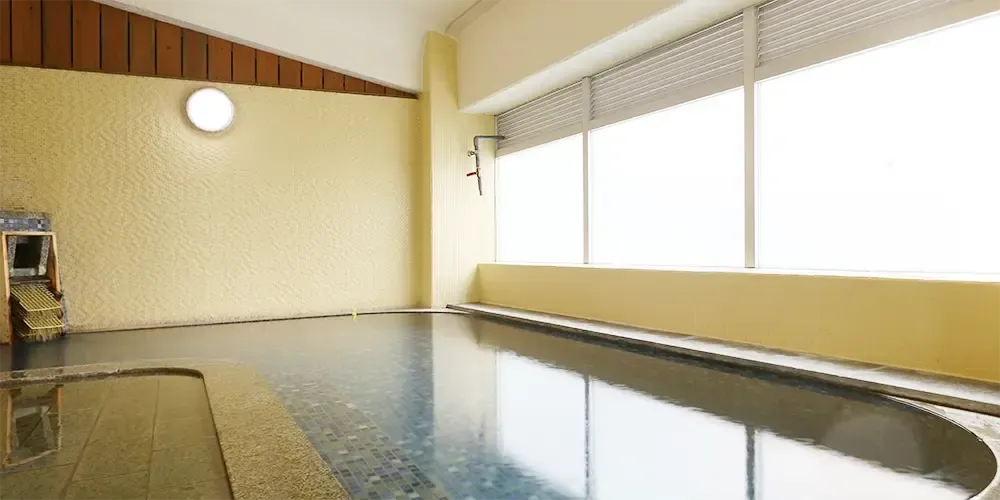
The spring is a simple radioactive water, a radium spring in common parlance. It is clear, odourless and tasteless, leaving a light, dry feel on the skin rather than the slipperiness of an alkaline bath, and it is gentle enough for those with sensitive skin. At 14 degrees Celsius the source is legally a cold mineral spring, so the water is heated before it reaches the tubs, yet nothing is added to dilute it. Output is 131 litres per minute from a single source, and since no day-use bathhouse exists in the area, an overnight stay is effectively the only way to experience it.
Bathing here means a choice of indoor bath, open-air bath and a private bath that can be reserved. With the Seta River flowing just beyond, the quiet is remarkable for somewhere only minutes from central Otsu. The inn keeps roughly twelve rooms, small enough that tour groups never fill it. Dinner is a kaiseki course drawn from Lake Biwa itself, including funazushi, carp simmered in miso and clear clam broth. Rates begin around 11,000 yen per person with two meals, modest for a hot spring inn this close to Kyoto.
Early April, when the cherry trees of Ishiyamadera bloom, and late November, when autumn colour lines the Seta River, are the best times to visit. The temple is a five-minute walk away and Kyoto Station about thirty minutes, making the inn a practical base for temple hopping. One caveat: day-trip bathing plans are currently suspended, so booking a room is the only route to the baths. From JR Ishiyama Station take the Keihan line three minutes to Ishiyamadera Station, then walk five minutes; by car it is about fifteen minutes from Seta-nishi IC, with free parking for ten vehicles.
Ryokan Beniayu stands alone on the northern shore of Lake Biwa, in the Onoe district of Kohoku-cho in Nagahama City. The story of Onoe Onsen begins in 1958, when workers drilling a well at the local shrine unexpectedly struck hot water, bringing a hot spring to what had been a quiet lakeside fishing village. The inn takes its name from the ayu, the sweetfish that has long been the lake's signature catch. Directly offshore floats Chikubushima, a small sacred island enshrining Benzaiten that has drawn pilgrims for centuries.
The spring is a sodium bicarbonate water yielding roughly 300 liters per minute, a generous flow for a single lakeside inn. Its source temperature, however, is only 21.3 degrees Celsius, too cool to fill a bath directly, so the water is heated before use and is posted in-house as a simple thermal spring. Slightly alkaline, it has the silky quality characteristic of bicarbonate waters, which soften the skin, and locals have long called it a beauty spring. The inn describes it as a golden, gentle water, and it is recommended for neuralgia, rheumatism, women's ailments and poor circulation.
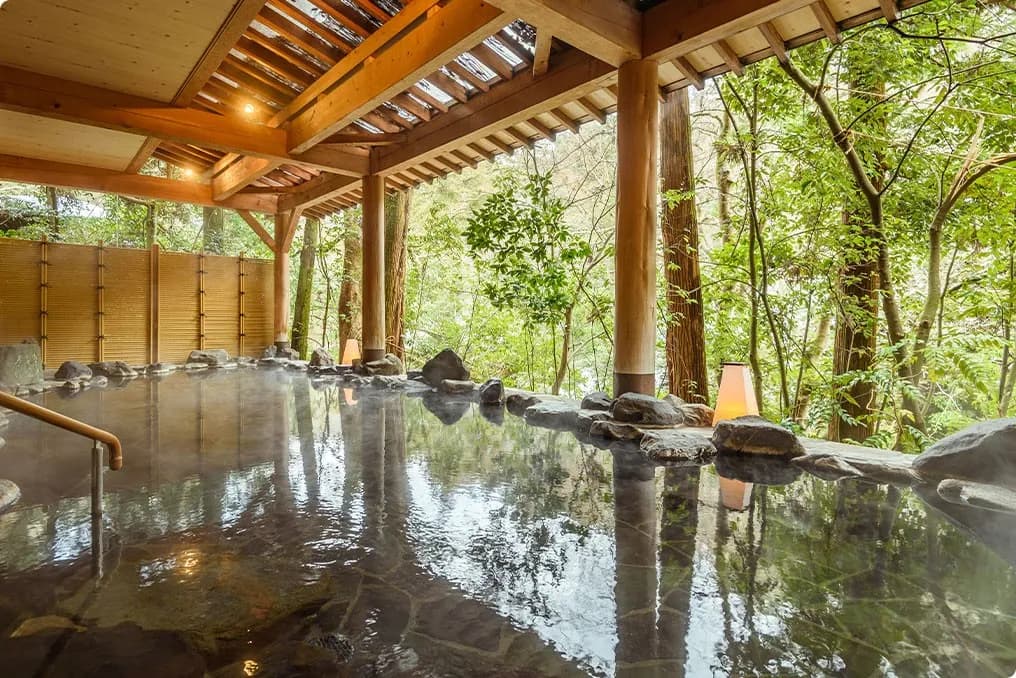
The men's and women's bathhouses each pair a marble-lined indoor bath with a granite open-air bath, and both face the water squarely, so bathers look straight out at Chikubushima and the mountains on the far shore. A sauna adjoins the main bath, while elsewhere in the building guests find a stone-bed bathing room built with locally quarried Chomei stone and a footbath beside the terrace. Beyond that, every one of the 15 guest rooms has its own semi-open-air hot spring tub, available in cypress, Shigaraki ware or granite. Being able to soak at any hour with the lake spread out below is the inn's greatest luxury.
The sunset seen from the inn is listed among Japan's 100 Best Sunset Views, and the hour when the lake turns copper is the one worth planning around. Dinner is a kaiseki course built on Omi beef and fish from Lake Biwa, with the lead ingredient rotating through the year: moroko in winter and spring, ayu, eel and duck from early summer into autumn. Rates begin at around 24,000 yen per person with two meals. Note that day use is open only to visitors who book a meal plan; bathing-only visits are not accepted. The inn is about 25 minutes from Nagahama IC on the Hokuriku Expressway, and a free shuttle runs from JR Takatsuki Station with advance reservation. Paired with a cruise to Chikubushima, a walk up Shizugatake or a stop at Nagahama's Kurokabe Square, it makes an easy overnight base for exploring the northern lake.
Summary: What to Know Before Visiting Shiga's Hot Springs
Shiga's hot springs group into four areas: Kohoku on the northern lake, Koka, Takashima on the western shore, and Otsu.
Kohoku Area. Sugatani Onsen and Onoe Onsen Ryokan Beniayu are both in Nagahama City, though set in contrasting landscapes — Sugatani inland at the foot of Mount Odani, Beniayu directly on the lakeshore. Sugatani Onsen is about 5 minutes by car from Odanijo Smart IC on the Hokuriku Expressway, and a free shuttle runs from JR Kawake Station if booked the day before. Its source emerges at a cold 15 degrees Celsius and is heated, but the inn serves the water free-flowing with no dilution or recirculation. Beniayu heats its 21.3-degree source rather than serving it free-flowing, so it is not marketed as a kake-nagashi bath. Every room has its own semi-open-air tub facing the lake, but day use is limited to guests who book a meal — bathing-only visits are not accepted.
Koka Area. Shiono Onsen and Miyano Onsen both sit in Konan, Koka City, a district long associated with the Koka school of ninja. Shiono Onsen serves its water free-flowing with no dilution, but bathing alone is not offered; a stay or a meal reservation is required to use the baths. Miyano Onsen heats its own private cold-water source, but the inn does not publish whether the baths are free-flowing or recirculated, so this guide makes no claim either way. Both inns are about 5 minutes from Konan IC on the Shin-Meishin Expressway, making them easy to pair on a single day trip.
Takashima Area (Western Shore). Makino Shiratani Onsen Hachiojiso and Takarabune Onsen Yumoto Kotobuki both lie in the hills of Takashima City. Hachiojiso's water is a rare radon-bearing radioactive spring used at full strength with no dilution, but because the source is cold it is heated and run through filtration with chlorine disinfection — it is not a free-flowing bath. Takarabune Onsen Yumoto Kotobuki is only partly free-flowing: the indoor bath is heated and recirculated, while a separate private open-air bath in its own outbuilding runs heated and genuinely free-flowing. Public transport to both is limited, so a car is the practical choice.
Otsu Area. Hira Shofuku Onsen Holiday Afternoon and Ishiyama Onsen Bodaiju sit on opposite sides of Otsu City, one by the lake, one at a temple gate. Holiday Afternoon's water is served at full source strength with no dilution or recirculation, but the only bath is a single cypress-lined private family tub, booked in 55-minute slots for one group at a time — there is no open-air bath or communal hall. Ishiyama Onsen Bodaiju, at the gate of Ishiyamadera, also serves its 14-degree source undiluted and free-flowing, but as of July 2026 its day-trip bathing plan is suspended, so an overnight stay is currently the only way to use the baths.
A few points apply across the list. Tattoo policies vary by inn, and none of these are large public bathhouses, so contacting the facility in advance is the safer approach for visibly tattooed travelers. Baths are separated by gender rather than mixed, and swimwear is not the norm in the standard tubs, though the private and family baths at several inns — Miyano Onsen's Kakuremino, Takarabune's open-air bath, and Hira Shofuku's family bath — can be booked as a group, which suits travelers who prefer not to bathe nude among strangers. Reservations matter more here than at large day spas: Shiono Onsen and Onoe Onsen Beniayu require a meal booking simply to bathe, Hira Shofuku Onsen operates by reservation only, and Ishiyama Onsen Bodaiju currently accepts overnight guests exclusively. Cash remains the safer default at these small mountain and lakeside inns, even where card payment is available at some. None of the eight are reachable by rail alone — all require a taxi, a shuttle arranged in advance, or a drive from the nearest station, and community bus services in the Koka and Takashima hills run infrequently, so build in extra time rather than planning a tight connection.
The information in this article (admission fees, operating hours, water quality data, etc.) is based on research conducted at the time of writing. Details may have changed or contain errors. Please verify the latest information on each facility's official website or through the local tourism association.